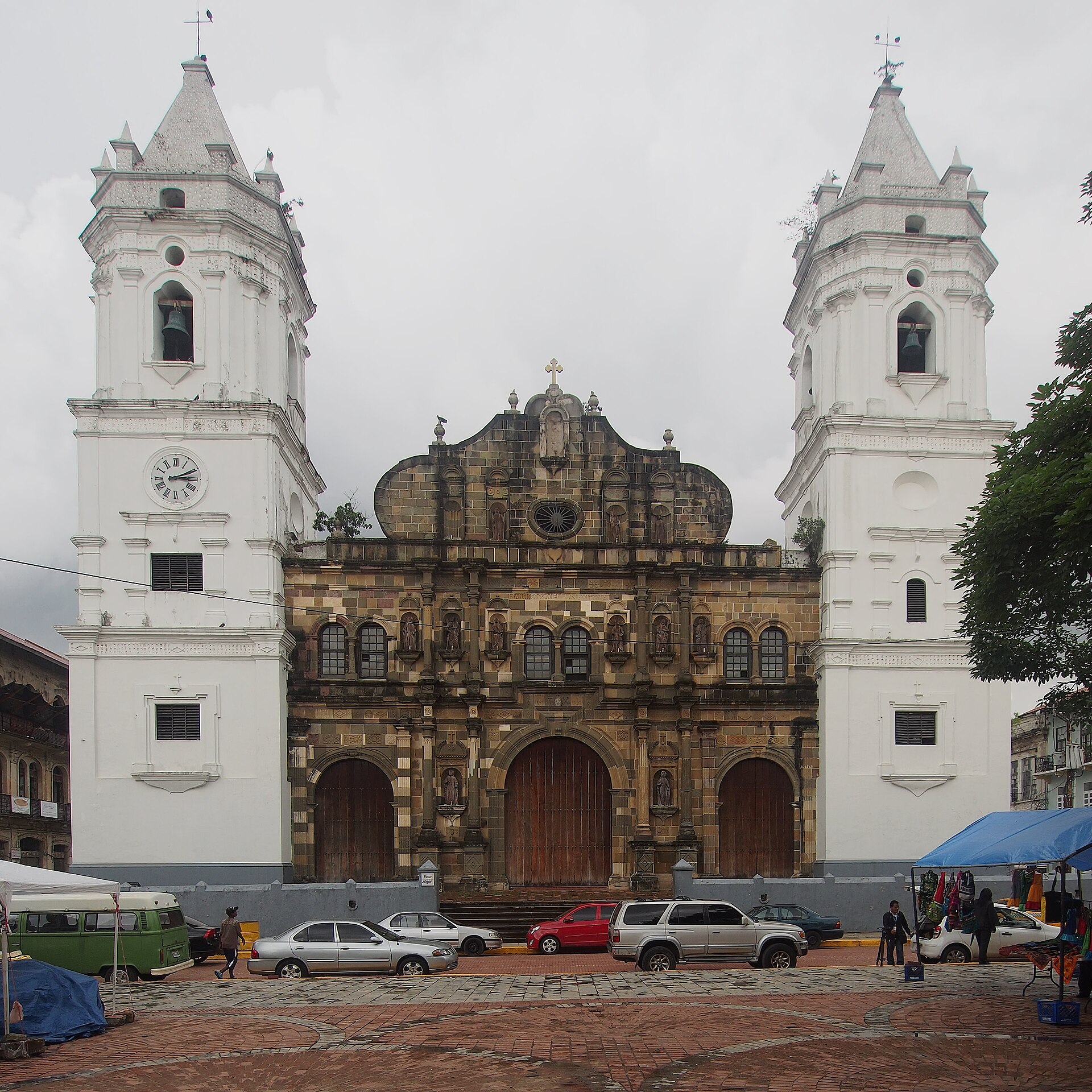
Panama City’s Cathedral Basilica of Santa María la Antigua
The Cathedral Basilica of Santa María la Antigua is one of Panama’s most enduring colonial landmarks. It sits in the old quarter, where Spanish settlers traded, plotted, and prayed. This was where the pulse of a fledgling empire beat strongest—a narrow land bridge where Inca gold passed on its way to Europe and where the city’s fortunes rose and fell with conquest and piracy.
Construction started in the mid-1600s, but the cathedral we see today took nearly a century to complete. Fires, earthquakes, and raids repeatedly halted progress. The final design reflects this history: colonial solidity meets Baroque ornamentation. The façade is imposing, its twin bell towers rising symmetrically above the plaza. These towers once called the faithful to prayer and served as lookouts—necessary in an age when danger arrived by sea as often as salvation.
The interior feels grand yet intimate.
Thick stone columns support high vaulted ceilings. The floor is paved with European tiles, their patterns still sharp. The main altar, simpler than those in Mexico or Peru, carries quiet dignity. Gold leaf and dark wood frame the saints, their expressions serene under stained glass. The most revered piece is the statue of the Virgin of La Antigua, Panama’s patroness, drawing pilgrims for generations. Faded frescoes on the walls depict biblical scenes, their stories refusing to fade entirely.
The cathedral’s history is Panama’s history. Here, the first bishops of the isthmus were consecrated. When fire destroyed the city in 1737, the cathedral survived, witnessing its rebirth. Even after independence from Spain and later Colombia, it remained a symbol of continuity. When the capital moved in the early 20th century, the cathedral didn’t fade. It became the spiritual anchor of the old city, where the past isn’t just remembered—it’s still felt.
The cathedral is a working church and an open-air museum. Visitors come to step into a world suspended in time. The surrounding streets, lined with colonial mansions and crumbling monasteries, echo with the footsteps of merchants and sailors. The plaza outside is quieter now, but in the late afternoon, the sun casts long shadows, and the cathedral’s walls glow golden. The bells still ring, their sound carrying over the rooftops.
What makes the cathedral remarkable? Its resilience. It has stood through conquest, neglect, and the rise and fall of empires. There’s no grandiosity here—no overwhelming gold or marble. Instead, it offers permanence. It doesn’t demand attention; it earns it, quietly asserting its place in a city that has moved on while carrying its past.
For visitors, the experience is about connection. The cool stone underfoot, the light through stained glass, the faint scent of incense—all pull you into a rhythm older than the city itself. Even without faith, history feels tangible here. The cathedral isn’t a relic. It’s a living part of Panama’s story, unfolding with every person who steps through its doors.