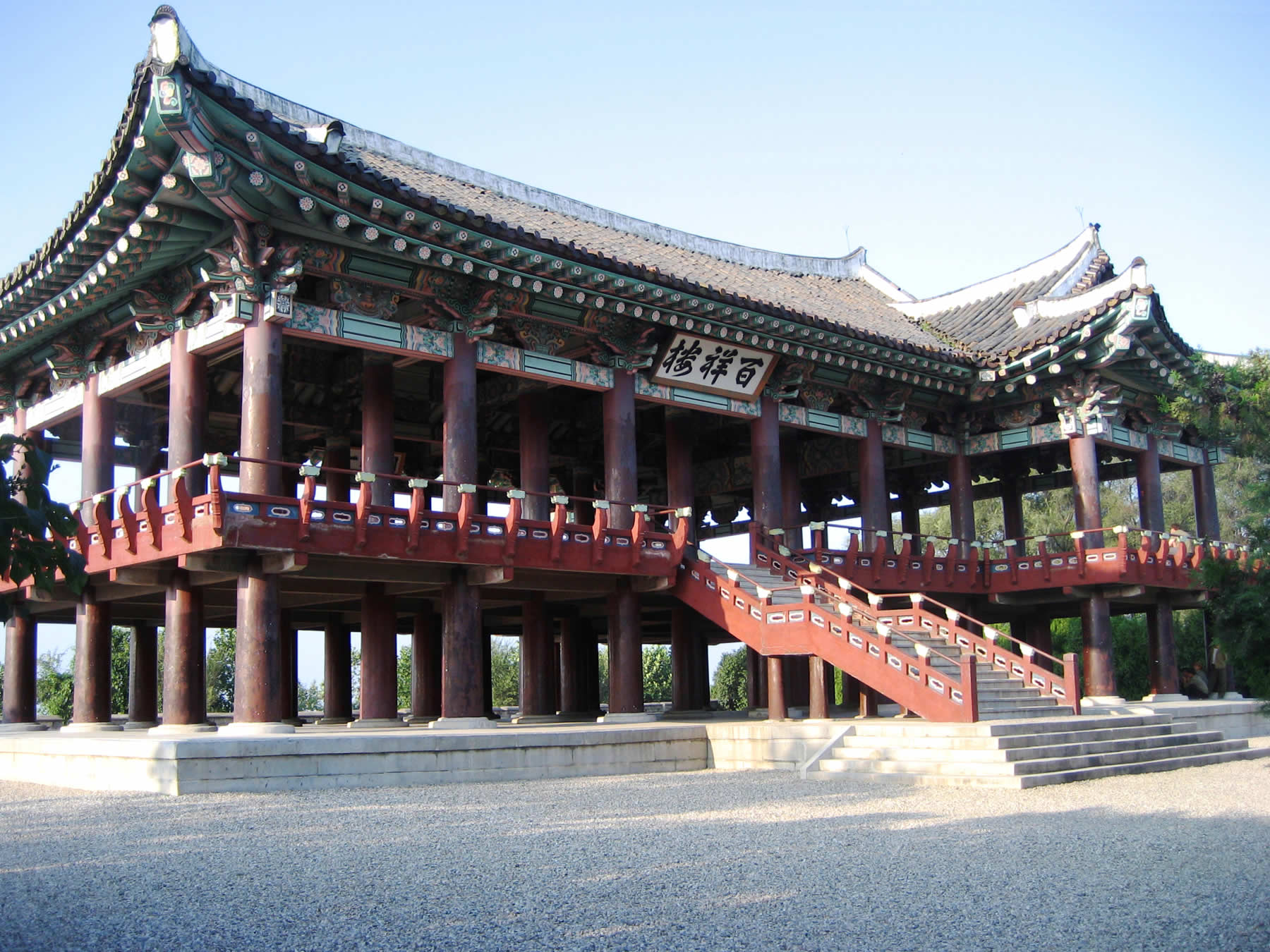
Paeksang Pavilion stands quietly on the banks of the Chongchon River in Anju, a city better known today for its industry than its history. Yet this small wooden structure carries the weight of centuries, a remnant of the Joseon Dynasty when architecture was as much about power as it was about beauty. Built as both a lookout and a retreat for the nobility, it once offered commanding views of the river and the rolling hills beyond. Such pavilions were more than decorative—they marked control over land and waterways, serving as both practical outposts and symbols of authority in a landscape where every hill and bend in the river held strategic value.
The design is unmistakably Korean: a raised wooden frame resting on stone foundations, its curved tiled roof sweeping downward like the wings of a bird. The columns supporting it are simple but elegant, their proportions calculated to create a sense of balance rather than grandeur. Inside, the space is open and uncluttered, with low ceilings that force visitors to slow down, to sit rather than stand. There are no elaborate carvings or gilded details—just the natural grain of the wood and the play of light through the lattice windows. Over time, the elements have left their mark: the paint on the beams has faded, the stone steps are worn smooth, and the scent of damp earth lingers in the air. It feels less like a preserved relic than a place that has simply endured, absorbing the quiet rhythms of the river and the changing seasons.
Anju is not a city that draws crowds. It exists in the shadow of more famous destinations, its streets lined with factories and apartment blocks rather than temples or palaces. Paeksang Pavilion, too, is easy to overlook—it doesn’t appear in glossy travel brochures or feature on lists of must-see sights. But that’s precisely what makes it worth finding. The Chongchon River here is narrow, its waters dark and slow-moving, especially in the early morning when mist clings to the surface. The hills on either side are low and wooded, their slopes dotted with the occasional farmhouse or stand of pine trees. In the distance, the silhouettes of smokestacks and cranes rise against the sky, a reminder that this is still a working city. The contrast is striking: the ancient pavilion, its lines softened by time, and the industrial sprawl beyond, a collision of past and present that somehow feels natural.
Little is known for certain about how the pavilion was used over the centuries. It was likely part of a larger complex—perhaps a fortress or administrative compound—that has long since disappeared. During the Joseon era, such structures often hosted official gatherings: local governors meeting with envoys from the capital, or celebrations marking military victories. The river would have been a vital artery, carrying goods and travelers between the interior and the coast. It’s easy to imagine officials pausing here on their journeys, stepping onto the wooden veranda to stretch their legs and take in the view. Today, the pavilion stands alone, its original purpose faded into speculation, but the setting remains much the same. The same river flows past, the same hills rise in the distance, and the same wind rustles through the trees.
There are no guided tours here, no gift shops or interpretive signs. Visitors are rare, and that’s part of the appeal. You can sit on the steps leading down to the river and watch the water slip by, or lean against one of the columns and listen to the call of birds in the trees. The only sounds are natural ones—the rush of the current, the creak of the wooden beams, the occasional rumble of a train in the distance. Locals might pass by on their way to work or stop for a moment to rest, but they don’t linger. For them, the pavilion is just another part of the landscape, something that has always been there, as unremarkable as the river itself.
In recent years, North Korea has made efforts to restore some of its historical sites, and Paeksang Pavilion may have benefited from such work. Yet it hasn’t been scrubbed clean or turned into a sanitized version of itself. The wood is still weathered, the stone still bears the grooves of countless footsteps, and the air inside smells faintly of damp and old timber. This isn’t a place that has been frozen in time; it’s a place that has simply aged, its imperfections adding to its character. There’s a good chance it will be restored again in the future, its beams reinforced and its roof resealed, but for now, it retains the quiet dignity of something that has survived by being useful, not by being perfect.
For anyone who finds their way to Anju, the pavilion offers a chance to step away from the noise of modern travel. There are no crowds, no selfie sticks, no vendors hawking trinkets. Just the river, the trees, and the silence. You could bring a book and spend an hour on the steps, or simply stand on the veranda and watch the light change over the water. It’s the kind of place where time feels different—slower, deeper, as if the centuries that have passed since the pavilion was built have settled into the very air. There’s no grand revelation here, no dramatic story waiting to be uncovered. Just the quiet satisfaction of being in a place that has seen generations come and go, and yet remains.
Anju will never be a tourist hotspot, and Paeksang Pavilion will never be a must-see attraction. But that’s exactly why it matters. It doesn’t exist to impress or entertain; it simply is. For those who seek out history not as a spectacle but as something lived and breathed, this small pavilion on the banks of the Chongchon River offers a rare kind of connection. It asks nothing of its visitors except that they slow down, look closely, and listen. In a world where so much is curated and staged, that’s a gift in itself. The pavilion doesn’t need to be grand. It only needs to be real.