Anju People’s Park is one of those quiet, unassuming places that doesn’t announce itself to the world. Tucked away in Anju, a working city in North Korea’s industrial heartland, it offers a rare glimpse of everyday life far from the polished facades of Pyongyang. There are no crowds here, no tour groups following guides with flags, just locals going about their routines—children chasing each other across the grass, families spreading out picnic blankets, elderly men hunched over chessboards by the pond. The park doesn’t try to impress; it simply exists, a small patch of green where the city exhales.
The space is modest, but thoughtfully arranged. Open lawns stretch across the center, inviting visitors to sit, play, or simply lie back and watch the clouds. Towering pines and broadleaf trees line the edges, softening the hum of the city beyond. In summer, the pond is a murky green, its surface dotted with duckweed; in winter, it freezes over, and children test the ice with careful steps. Ducks are a rare sight, but that doesn’t stop people from tossing them scraps of bread. Benches along the shore are occupied at all hours—sometimes by old men lost in conversation, sometimes by teenagers stealing a quiet moment, sometimes by anyone who just needs a break from the noise.
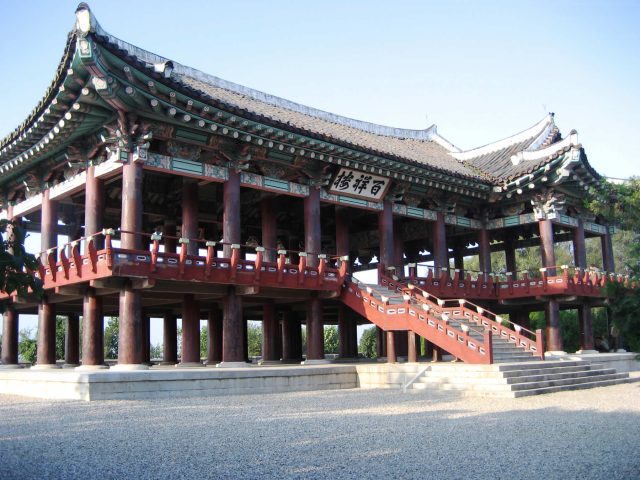
The park’s design is unpretentious. The main path is paved with simple tiles, flanked by lampposts shaped like traditional Korean lanterns. Their light is gentle, just enough to guide the way after dark. A few pavilions with sloping roofs offer shelter from rain or sun, though most people prefer the open air. Tucked away in one corner stands a small structure with a plaque detailing Anju’s history, but unless you read Korean, the words remain a mystery. It’s not the kind of place where you come for grand architecture or sweeping vistas. Instead, it feels like a pause button, a place where time moves a little slower.
Anju isn’t a city that draws tourists, and the park wasn’t built with them in mind. Like many green spaces across North Korea, it was created in the mid-20th century as part of a broader effort to provide workers and their families with places to unwind. These parks were a symbol of the state’s care for its people, a way to show that even in industrial towns, nature had a place. Over the decades, they became woven into the fabric of daily life. The People’s Park in Anju may not be historic or grand, but it carries the quiet legacy of an era when even small cities were given their own pockets of green.
The rhythm here is unhurried. Mornings belong to those practicing tai chi in slow, deliberate motions, their shadows stretching across the grass. By afternoon, mothers push strollers along the paths, and in the evenings, teenagers gather on benches, laughing or scrolling through phones. Weekends bring a livelier energy—music drifts from impromptu performances by local groups, and the scent of roasted corn and sweet snacks lingers near the entrance. Winter transforms the park into a hushed, snow-dusted space, where the few visitors tread carefully over frozen puddles and the trees stand bare against the gray sky.
For outsiders, this isn’t the kind of place that makes it into guidebooks. There are no towering statues, no grand monuments, no carefully curated displays of national pride. What you find instead is something far more revealing: the unscripted moments of ordinary life. People here go about their routines without fanfare—arguing over chess moves, sharing snacks, or simply sitting in silence. Foreigners are still a novelty, and you’ll draw curious glances, but the atmosphere is more welcoming than wary. No one is performing for an audience; they’re just living.
The park doesn’t cater to tourists. There are no English signs, no souvenir stalls, no attempts to package the experience for outsiders. The benches are worn, the trash cans rusted, the paths slightly uneven—all signs of a place that has been used, not preserved. And that’s what makes it special. It doesn’t pretend to be anything other than what it is: a small, unremarkable green space where people come to breathe, to rest, to forget the rush of the outside world for a little while.
Places like Anju People’s Park rarely get mentioned in travel stories, but they often leave the deepest impressions. There’s nothing extraordinary about it—no breathtaking views, no famous landmarks, no stories of ancient kings or legendary battles. What it offers instead is something harder to define: a sense of authenticity, a quiet corner where you can see a country as it truly is, not as it’s meant to be seen. If you ever find yourself in Anju, it’s worth stopping by, even just for half an hour. Sit on a bench, listen to the rustle of leaves, watch the light change over the pond. In a country where so much is carefully controlled, this is one of the few places where life feels unscripted.