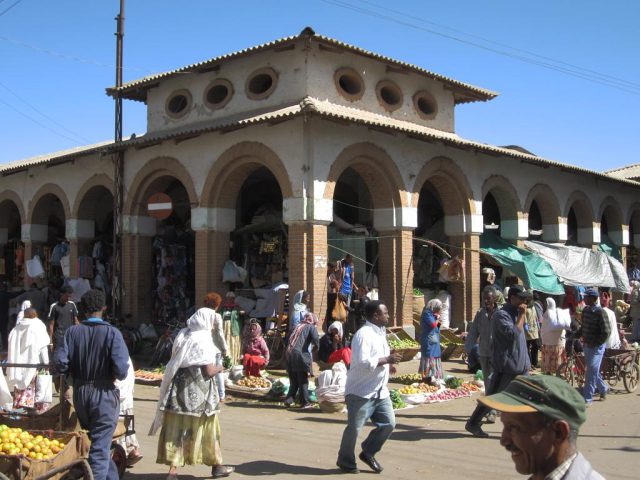
Asmara’s Opera House is one of the city’s most striking landmarks. Built in the early 20th century during Italian colonial rule, the building shows the ambitions of a time when Asmara was planned as a modern African outpost of European culture. The architecture mixes neoclassical elements with Art Nouveau details popular in Italy then. Tall arched windows, stonework, and a grand entrance mark its design, though today it bears the wear of decades.
The opera house was a symbol for Italian administrators and settlers. It represented an attempt to bring European high culture to the Horn of Africa. Operas, ballets, and orchestral concerts were staged here, drawing audiences from the Italian community and some local elite. The acoustics carried voices and instruments clearly—a detail that still stands out to visitors. Over time, it became a social hub where colonial society gathered for entertainment and to affirm their identity.
After Eritrea’s independence in 1991, the opera house’s role changed. The new government focused on rebuilding after conflict, leaving colonial-era institutions to decay. The building’s interiors faded under dust and neglect, yet it remained a point of interest. Some Eritreans saw it as a reminder of foreign rule; others valued it as part of the city’s architectural heritage.
In recent years, perceptions of Asmara’s colonial buildings have shifted. The city’s historic center, with its Italian-style cafés and cinemas, became a UNESCO World Heritage site in 2017. This brought attention to structures like the opera house, now seen as part of a unique urban landscape. The facade has been cleaned, and occasional efforts stabilize its structure, though full restoration is unlikely soon. For now, it stands as a silent witness to the past.
The streets around it are quieter today. The opera house retains a dignity, its presence showing how places outlast their original purposes. Visitors pause to notice details—the light on the stonework in the afternoon, the contrast between its symmetry and the city’s organic shapes.
The opera house’s future is uncertain. Eritrea’s isolation makes large preservation projects difficult, and cultural priorities lie elsewhere. Still, the building endures, linking to a time when Asmara was a city of contradictions—European dreams imposed on African soil, grand ambitions meeting colonial realities.
No performances happen here now. The seats are empty, the stage bare. Yet the emptiness invites reflection. It asks what it means for a place to survive beyond its purpose, to become a monument, a curiosity, a piece of history. In a city where the past lingers, the opera house remains one of Asmara’s most evocative spaces, where echoes of the past can still be heard if you listen.