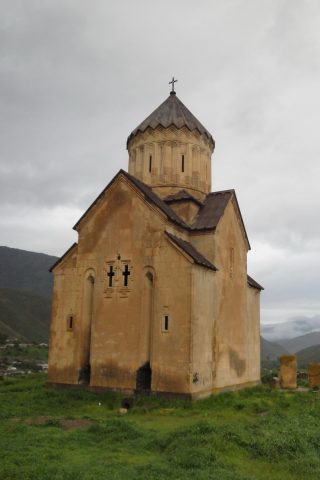
Nestled in the rugged beauty of Armenia’s Vayots Dzor region, Noravank Monastery emerges from the red cliffs of the Arpa River gorge like a natural extension of the landscape itself. The approach to the site winds through the village of Areni, where sunbaked hills roll into vineyards that have thrived here for centuries. As you draw closer, the monastery reveals itself in stages—a cluster of stone buildings perched on a narrow ledge, framed by sheer rock walls that glow amber in the late afternoon light. The setting is dramatic, almost theatrical, as if the cliffs and the structures were carved from the same ancient material. There’s a quiet grandeur to the place, a sense of timelessness that lingers long after you’ve left.
The history of Noravank is as layered as the sedimentary rock that surrounds it. While the earliest records date back to the ninth century, it’s likely that some form of religious site existed here even earlier. The monastery flourished between the thirteenth and fourteenth centuries, when it became the seat of the bishops of Syunik and a hub of cultural and spiritual life. This was the era when its most iconic structures took shape, including the two-story Church of Surb Karapet, a masterpiece of medieval Armenian architecture. The builders of Noravank had an intuitive understanding of the land, designing structures that feel organic rather than imposed. The monastery doesn’t just occupy the landscape—it belongs to it.
The Church of Surb Karapet, built between 1216 and 1221, is the heart of Noravank. Small but exquisitely proportioned, it rises from the rocky terrace with a grace that belies its age. The exterior is adorned with intricate stone carvings, a hallmark of Armenian ecclesiastical architecture, while the interior holds faded frescoes depicting saints and biblical scenes. What makes the church truly unusual is its two-level design: the lower floor serves as a mausoleum, while the upper level is a chapel, accessible via a narrow staircase hewn into the cliffside. The effect is intimate, almost secretive, as if the church were meant to be discovered rather than simply entered.
Nearby stands the Church of Surb Astvatsatsin, or Holy Mother of God, completed in 1339. It’s best known for its ornate portal, a deep arch flanked by columns and crowned with a carved cross. The craftsmanship is astonishing—every inch of the stone seems alive with detail, from the delicate floral motifs to the solemn figures of saints. Inside, the light filters through slender windows, casting shifting patterns on the walls. The frescoes here are less well-preserved than those in Surb Karapet, but the space retains a hushed, contemplative atmosphere. It’s easy to imagine the monks who once gathered here, their voices echoing softly under the vaulted ceiling.
Noravank’s history is one of resilience. Over the centuries, it endured raids, earthquakes, and neglect, particularly during the Mongol invasions and the turbulent years of Persian rule. By the seventeenth century, the monastery had been partially restored, though it never regained its former prominence. For generations, it stood abandoned, its stones weathered by wind and time. It wasn’t until the twentieth century that conservation efforts began in earnest, carefully stabilizing the structures while preserving their patina of age. Today, the monastery feels both ancient and alive, its walls bearing the marks of centuries—some smoothed by time, others still raw from restoration.
Visiting Noravank is as much about the journey as the destination. The road from Areni winds through a landscape of contrasts: lush vineyards give way to arid hills, where wild herbs scent the air and the only sounds are the rustle of dry grass and the occasional cry of a hawk. The village itself is worth a stop, especially for those curious about Armenia’s winemaking traditions. Areni is home to some of the country’s oldest vineyards, where grapes are still cultivated using methods passed down through generations. After exploring the monastery, a visit to a local winery offers a chance to taste the region’s signature wines—robust reds and amber-hued whites—or sample aged brandy, another specialty of the area.
What makes Noravank special is the way it harmonizes with its surroundings. The monastery isn’t grand in scale, but its presence is commanding. It was here that medieval architects and artists left their mark, where manuscripts were copied and preserved, and where pilgrims once traveled from across Armenia to pay their respects. Today, it draws a different kind of visitor—those seeking not just history, but a sense of place. The monastery may no longer be an active religious site, but it hasn’t been reduced to a mere tourist attraction either. It endures as a quiet witness to the past, a place where the boundaries between nature and human craftsmanship blur.
The best time to visit is in the late afternoon, when the sun dips behind the cliffs and the stones take on a warm, golden hue. The shadows stretch long across the gorge, and the air grows cooler, carrying the faint scent of wild thyme. There’s no rush here, no crowds to navigate. Just the wind, the rocks, and the silent stories embedded in the walls. Noravank doesn’t demand attention—it earns it, slowly, the way a landscape reveals itself to those who take the time to look.