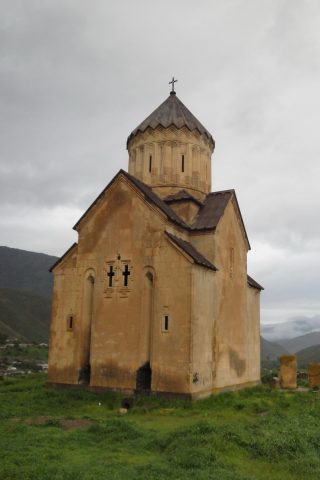
The Areni Bridge feels like a place where time has paused, suspended between the past and the present. Stretching across the Arpa River, it rests between rocky banks where the water twists and turns before continuing its quiet journey. This isn’t a grand monument, nor does it demand attention with towering arches or intricate carvings. Instead, it stands with quiet confidence, its medieval stonework worn smooth by centuries of use. The river has shaped it over time—sometimes eroding its base, sometimes retreating to leave behind nothing but the soft murmur of current. Yet the bridge remains, unshaken, as if it has always known its purpose would outlast the generations who built it.
Built in the Middle Ages, the bridge follows the traditional Armenian design of its era. Local stone, darkened by age but still solid, forms its single, gently sloping arch. The structure isn’t wide—just enough for foot traffic and pack animals, not carts or modern vehicles. Even today, walking across its uneven surface feels like stepping into history. The stones beneath your feet are polished by countless footsteps, their edges softened by time. There’s no engineering marvel here, no complex calculations, just the practical skill of people who understood how to build something that would last.
The bridge’s history is woven into the fabric of the region. The Arpa River has always been a vital waterway, and crossings like this one were strategic points for trade and travel. Areni, nestled in its valley, has long been a center of winemaking and commerce. For centuries, caravans passed over this bridge, carrying wine, wool, grain, and other goods to neighboring lands. In the Middle Ages, it was part of a route connecting Armenia to Persia and Byzantium, bearing witness to countless exchanges—some peaceful, some not. Merchants, pilgrims, and even soldiers would have paused here, and the bridge itself was often a point of contention among local rulers. It wasn’t just a path; it was a silent observer of the region’s shifting fortunes.
Today, Areni is a quiet village best known for its vineyards and wine. The bridge no longer holds the same importance it once did, but it hasn’t been forgotten. Locals still cross it on their way to fields or neighboring villages, and occasionally, visitors stop here on their way to taste Armenia’s famous wines or explore the countryside. The Arpa’s water runs clear, with a faint greenish tint, and on hot days, the shade near the bridge offers a welcome respite. The sound of the river rushing over stones is the only soundtrack here, a steady rhythm that has played for centuries.
What’s remarkable about the Areni Bridge is how unremarkable it seems. There’s no grand statement, no attempt to impress. It’s simply a bridge—one that has endured earthquakes, floods, and the rise and fall of empires without fanfare. Modern structures often crumble or become obsolete within decades, but this one, built with basic tools and local materials, still serves its purpose. The stone hasn’t weakened, the arch hasn’t sagged. It’s a quiet testament to the skill of its builders, who understood that the best structures don’t just stand—they last.
The landscape around the bridge is just as compelling. The Arpa Valley is framed by low mountains, their slopes dotted with sparse vegetation. Summers here are dry and hot, but in spring and autumn, the hills come alive with green, and the air fills with the scent of wild herbs and flowers. Vineyards stretch along the riverbanks, where grapes are grown for Armenia’s renowned wines. Many local winemakers still use traditional methods, and the wine produced here isn’t so different from what was made centuries ago. A visit to Areni offers a chance to taste history, not just see it.
There’s something deeply tactile about this place. Running your fingers along the bridge’s stones, you can feel the rough texture, the grooves worn by time and touch. There are no plaques, no crowds jostling for photos, no guided tours. Just the bridge, the river, and the quiet. The wind rustles through the valley, the water laps against the rocks, and for a moment, it’s easy to forget the outside world. That’s the bridge’s real value—it doesn’t try to be anything more than what it is. It simply exists, as it always has, a thread connecting the past to the present.
If you find yourself in Areni, it’s worth taking the time to cross the bridge, not just for the sake of seeing it, but for the chance to step into a slower rhythm. There’s no rush here, no agenda. The village moves at its own pace, the river flows as it always has, and the bridge stands as a reminder that some things don’t need to change to remain meaningful. It’s a place where history isn’t just remembered—it’s felt.