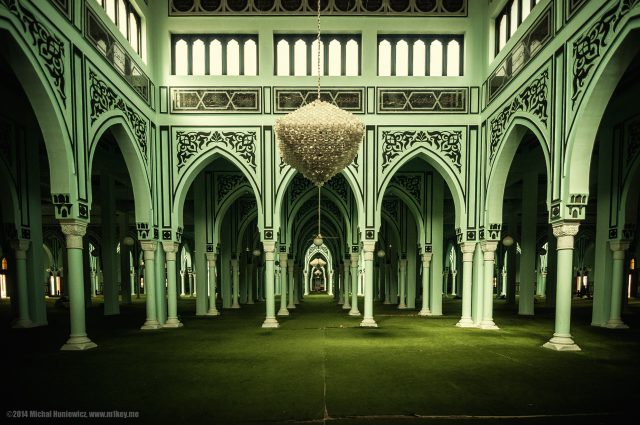
The National Museum of Mauritania sits quietly in the heart of Nouakchott, a place where the country’s past isn’t announced with fanfare but revealed through the quiet weight of objects that have endured. The building itself, constructed in the mid-20th century, carries the modest ambition of a young nation—Mauritania had only just gained independence in 1960 when the museum opened its doors. Its architecture is unassuming: low arches, wide windows, and pale walls that seem designed to slow visitors down, encouraging them to linger rather than rush. There’s no grandiosity here, just a sense that history deserves attention, not spectacle.
Inside, the museum unfolds across several rooms, each dedicated to a different chapter of Mauritania’s story. The archaeological section draws the most interest, filled with artifacts unearthed across the country. Stone tools, fragments of pottery, jewelry, and weapons trace human presence from the Neolithic era through the Middle Ages. But the most compelling pieces are those tied to the trans-Saharan trade, the ancient network that once linked North Africa to the sub-Saharan regions. Coins, textiles, and everyday objects evoke the caravans that crossed the desert carrying gold, salt, and enslaved people—trade routes that shaped economies and cultures for centuries.
A separate hall explores Islam’s profound influence on Mauritania. Here, visitors find delicate Quranic manuscripts, intricately carved wooden panels from old mosques, and ceramics inscribed with Arabic calligraphy. Some of the most striking exhibits come from the ruins of once-great cities like Ouadane and Chinguetti, which flourished as centers of learning and commerce. These artifacts aren’t just relics of craftsmanship; they’re evidence of how Islam wove itself into the fabric of society, shaping language, law, and daily life. The displays feel intimate, as if the past is still alive in the careful strokes of a scribe’s pen or the geometry of a mosque’s design.
The ethnographic section offers a glimpse into the lives of Mauritania’s diverse communities. Traditional clothing, musical instruments, and household items reveal the contrasts between nomadic and settled ways of life. One of the most engaging displays is a reconstruction of different dwellings—a Bedouin tent, a clay house from an oasis—showing how people adapted to the harsh desert environment. The exhibits don’t romanticize survival; they simply present it. Recordings of folk songs play softly in the background, while photographs on the walls capture moments of everyday life, from market scenes to family gatherings. It’s a reminder that culture isn’t just about grand monuments but about the small, persistent ways people make a home in the world.
For all its modesty, the museum plays a crucial role in preserving Mauritania’s heritage. Many of the artifacts were collected during colonial-era expeditions, later supplemented by local researchers. Beyond physical objects, the museum holds documents, photographs, and maps that piece together the country’s history from ancient times to the present. It’s a place where scholars and curious visitors alike can trace the threads of Mauritania’s identity, though the exhibits sometimes feel incomplete—descriptions are sparse, and some items show signs of wear. Yet this imperfection lends the museum an authenticity. It doesn’t pretend to have all the answers; it simply offers what it can, inviting visitors to fill in the gaps with their own curiosity.
The atmosphere inside is hushed, almost reverent. Visitors are few, which allows for a slow, unhurried exploration. The light filtering through the high windows casts a gentle glow over the displays, creating a sense of timelessness. There’s no rush here, no crowds jostling for a better view. Instead, there’s space to reflect on what these objects represent—not just for Mauritania, but for the broader story of human resilience and adaptation. The museum doesn’t demand attention; it earns it through the quiet power of its collections.
For those interested in African history, the National Museum of Mauritania is a revelation. It lacks the scale and fame of institutions in Cairo or Dakar, but that’s part of its charm. There are no tourist traps, no aggressive guides, just a chance to engage with the country’s past on its own terms. The museum doesn’t try to impress with grandeur; it succeeds by being honest. It reminds visitors that Mauritania is more than just desert and dunes—it’s a place with a layered history, where ancient trade routes, Islamic scholarship, and nomadic traditions have left their mark.
Of course, the museum has its limitations. Some exhibits are in need of restoration, and the information provided is often minimal. But these flaws don’t detract from the experience; if anything, they make it feel more real. There’s no polish here, no attempt to sanitize the past for easy consumption. Instead, the museum feels like a work in progress, much like the country itself. It doesn’t claim to tell the whole story, but it offers enough to spark the imagination.
A visit to the National Museum of Mauritania is less about ticking off a checklist of exhibits and more about connecting with the living history of a nation. It’s a place to spend an hour or two pondering the people who shaped Mauritania—the traders, scholars, nomads, and farmers whose lives were defined by the desert’s challenges and opportunities. The museum may not be world-famous, but it serves a vital purpose: preserving the past so that future generations can understand where they come from. In a country often overlooked, that’s no small achievement.