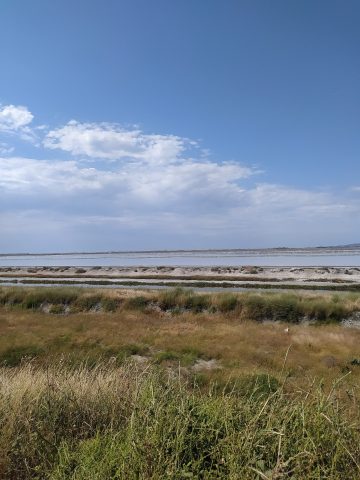
The museum sits in a quiet corner of southwestern Albania, where salt defined the town of Selenicë for centuries. The Adriatic coastline here was once lined with salt pans, and the industry shaped the local economy, daily rhythms, and traditions. The museum doesn’t just show how salt was harvested—it reveals the people who depended on it and how it became part of the region’s identity.
The building itself was once the heart of the town’s saltworks. Low stone walls, weathered wooden beams, and sunbaked courtyards tell their own story. Inside, the exhibits are simple: tools worn smooth by generations of use, barrels for transporting salt, and implements that show how labor-intensive the process was. There’s no unnecessary decoration, just objects that carry their own history.
Salt production in Selenicë goes back to antiquity. Ancient Greek and Roman records mention these salt pans as a valuable resource, supplying markets across the Mediterranean. The industry continued through the Middle Ages, and by the Ottoman era, salt had become a cornerstone of the regional economy. In the 19th century, Selenicë was one of the Balkans’ most important salt-producing centers, drawing workers from nearby villages and beyond. The salt was shipped to Italy, Greece, and farther, fueling the town’s growth.
The museum’s strength lies in how it connects salt production to the lives of the people who worked here. Old photographs show families in front of their homes, children playing in the salt pans, and workers with their tools. The exhibits explain the process: seawater channeled into shallow basins, left to evaporate under the summer sun, then collected by hand. The work was grueling, but the climate—hot, dry summers and steady sea breezes—made it possible.
Today, the large-scale saltworks are gone, but the museum preserves their legacy. It shows how salt fed families, built houses, and shaped local customs. Alongside tools and documents, you’ll find everyday items—clothing, household goods, toys—that bring the past to life. There’s no glossing over the hardships; the museum presents the realities of a life built on backbreaking labor.
The surrounding area still has salt marshes and lagoons where crystals form in shallow pools. A small section of the museum explains this unique ecosystem, home to rare birds and salt-tolerant plants. Salt isn’t just an industrial product here—it’s part of a living landscape.
Visiting the museum feels like stepping into another time. There’s no rush, no crowds, just the quiet presence of history. You can walk through the old saltworks, look at rusted machinery, or sit by the sea and imagine the bustle that once filled these spaces. Locals treat the museum with quiet pride, as if honoring the generations who came before. Sometimes, you might meet an elderly resident who remembers the saltworks in their prime, ready to share stories.
Selenicë moves at its own pace. Narrow streets, red-tiled roofs, the scent of salt and sea—it feels like a place where time has slowed. After the museum, walk along the waterfront or stop at a café for fresh seafood. The town isn’t stuck in the past, but it hasn’t been swept up in modernity either. It exists somewhere in between.
The Salt and History Museum of Selenicë doesn’t try to impress with spectacle. It offers something better: the real story of ordinary people whose lives were shaped by salt. If you leave with a new appreciation for the salt in your kitchen, that’s the point. It’s not just a seasoning—it’s history you can taste.