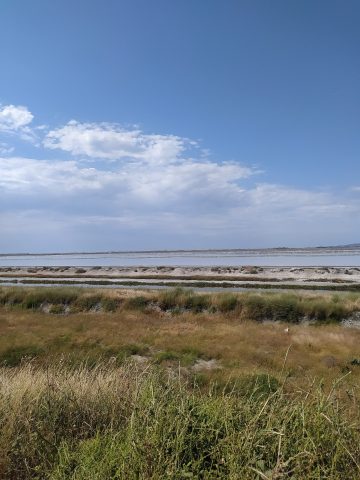
Amantia sits on a hillside near Selenicë, overlooking the Vjosë River valley. Its ruins merge with the landscape. There are no reconstructions here, no crowds—just the remnants of a city that once thrived under Greek and Roman rule, now being reclaimed by nature.
Founded in the 4th century BCE by Greek colonists from Corinth and Corcyra, Amantia controlled trade routes between the coast and the Balkan interior. The Romans later expanded it, adding a forum, public baths, and residential quarters. Even in decline, its ruins suggest a past that was both ordinary and extraordinary.
The ancient theater is carved into the hillside. Grass grows between its stone seats, but you can still picture spectators filling the space. Theaters in antiquity were where politics, religion, and daily life met. Nearby, the acropolis stands as a reminder of the city’s defenses. Crumbling walls show ancient masonry, and the outlines of towers remain visible.
The early Christian basilica, built between the 5th and 6th centuries, has mosaic floors with geometric patterns and bird motifs. It proves life continued here after Rome’s fall, though the city eventually faded. By the 19th century, when European travelers rediscovered it, Amantia had been abandoned for centuries.
Amantia is quiet. No guided tours, no souvenir stalls—just wind through the grass and shepherds with their flocks. The lack of modern interventions makes it feel untouched. You can wander freely, piecing together the city from fragments: a stretch of wall, a column, the faint outline of a street.
There’s no signage or clear paths. That might frustrate some, but it also adds to the experience. You might sit on the theater’s edge, looking over the Vjosë valley, and feel like you’ve stepped into another era. The river flows as it did two thousand years ago.
Amantia isn’t like Butrint or Apollonia. It lacks their grandeur or well-preserved monuments. But that’s why it feels real. No reconstructions, no sanitized past—just ruins as they were found: chaotic, mysterious, alive. It’s for those who prefer history unpolished, where the past isn’t just observed but felt.
If you’re in this part of Albania, visit. Amantia isn’t just old stones—it’s a reminder of layered history. Greek, Roman, and Byzantine influences all left their mark. The landscape holds those memories, as if the city’s people have only stepped away for a moment.