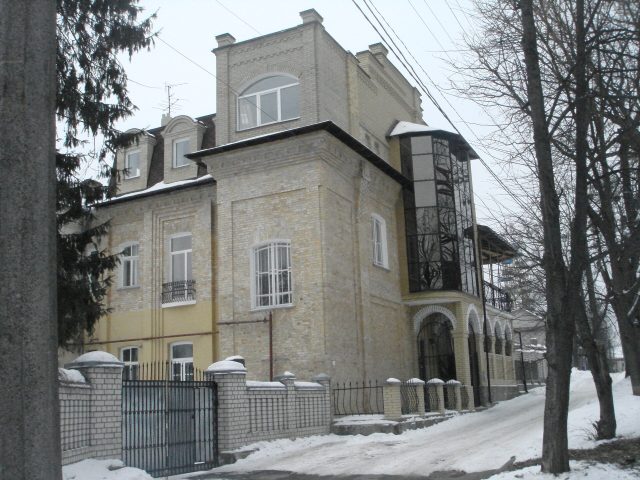
The Museum of Cosmonautics in Zhytomyr is where the personal story of one man intersects with the grand narrative of space exploration. This is the city where Sergei Korolev was born in 1907, and though his family moved away when he was still a child, the museum preserves the legacy of his early years alongside the broader history of humanity’s journey beyond Earth. Housed in a 19th-century mansion with ornate Renaissance Revival details, the building itself is a piece of history—once the home of a local merchant, now a space where the past and future coexist.
Korolev’s connection to Zhytomyr is more than just a footnote in his biography. The museum holds documents, photographs, and personal items that trace his childhood and adolescence, offering a glimpse into the formative years of the man who would later design the rockets that launched the first artificial satellite and the first human into space. One of the most striking exhibits is a reconstruction of his office, where visitors can sense the intensity of the era when engineers and scientists worked under immense pressure to turn theoretical ideas into reality. Among the displays are models of early spacecraft, including the R-7 rocket, which carried both Sputnik and Yuri Gagarin into orbit.
But the museum is not solely about Korolev. It presents a comprehensive overview of space exploration, from the foundational theories of Konstantin Tsiolkovsky to the technological advancements of the present day. The exhibits include satellite models, spacesuits, samples of lunar soil, and even fragments of actual spacecraft. A particularly compelling section features original blueprints, calculations, and correspondence related to the first manned spaceflights, revealing the sheer complexity and risk involved in those early missions.
A dedicated hall explores international collaboration in space, highlighting programs like the Apollo-Soyuz mission and the contributions of Ukrainian scientists and engineers to the global effort. The museum underscores that space exploration has always been a collective endeavor, involving thousands of people across different countries and disciplines. It’s a reminder that even the most groundbreaking achievements are rarely the work of a single individual.
The building itself is worth noting. Constructed in the late 1800s, the mansion retains much of its original charm, with intricate stucco work on the facade and preserved interior details. Over the years, it served various purposes before becoming the museum in 1987. Today, the blend of historical architecture and modern exhibits creates a unique atmosphere—one where the elegance of the past frames the technological marvels of the space age.
For those fascinated by engineering, the museum offers a chance to see real artifacts up close. Rocket engines, life-support systems, and even cosmonaut training simulators are on display, giving visitors a tangible sense of the machinery that made spaceflight possible. Children, in particular, often linger over these exhibits, trying to imagine how such complex systems functioned in the harsh conditions of space. The museum doesn’t just document history; it sparks curiosity about what might come next.
What makes this museum special is its ability to convey the spirit of an era without exaggeration. There’s no grandiosity here, just the straightforward presentation of facts and stories that illustrate how determination and ingenuity can overcome seemingly impossible challenges. A visit leaves you with a sense of connection to something larger than yourself—cosmos as both a scientific frontier and a shared human dream.
Zhytomyr, too, plays a role in this narrative. The city is inseparable from Korolev’s story, and the museum serves as a bridge between his early years and the legacy he left behind. Walking through the streets, it’s easy to imagine the boy who once lived here, whose childhood experiences shaped the man who would change the course of history. The Museum of Cosmonautics is more than a tribute to one man; it’s part of Ukraine’s cultural heritage, a reminder that even in smaller cities, ideas can take root and grow into something extraordinary.