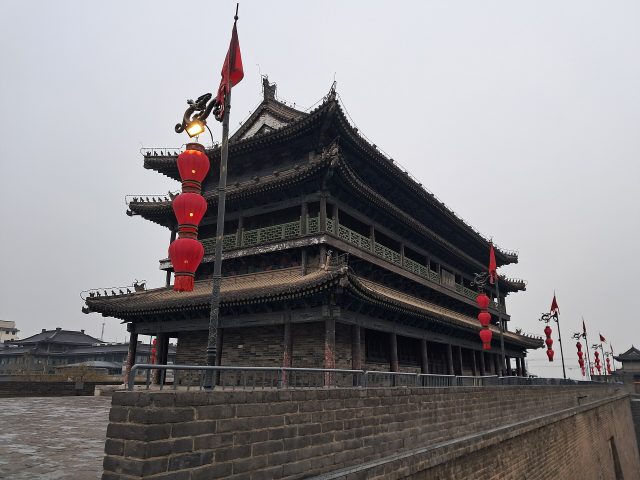
Xi’an’s Muslim Quarter is where China’s layered past brushes against the rhythms of everyday life. Tucked within the old city walls, this neighborhood has long been a world apart from the rest of Xi’an, its narrow lanes lined with low-slung houses and tiled roofs leading to bustling markets where the air hums with the scent of sizzling meat, fresh bread, and spices. It’s not just a place to visit—it’s a living community where one of China’s oldest Muslim populations, the Hui, has carried on its traditions for centuries, blending Islamic customs with the fabric of Chinese life.
The story of the quarter begins over a thousand years ago, when Xi’an—then called Chang’an—was one of the world’s great cosmopolitan hubs. Arab and Persian traders arrived in the 8th century along the Silk Road, bringing Islam with them. They settled here, marrying into local families and establishing a community that grew alongside the city. Over time, their descendants, known as the Hui, became an integral part of Xi’an’s identity. Their presence shaped the city in ways that are still visible today, from the food on the streets to the architecture of the mosques.
The buildings here tell a quiet story of cultural fusion. Unlike the domes and minarets of mosques in the Middle East, those in Xi’an’s Muslim Quarter often resemble traditional Chinese temples, with upturned eaves and intricate wood carvings. The most famous, the Great Mosque of Xi’an, dates back to the Tang Dynasty and has been rebuilt and expanded over the centuries. Its courtyards, surrounded by galleries of carved columns, feel more like a Buddhist temple than a place of Islamic worship—until you step inside and see the mihrab pointing toward Mecca, the Arabic calligraphy on the walls. It’s a place where two worlds coexist without erasing each other, where the sacred and the everyday intertwine.
The heart of the quarter is Huajue Lane, a street that pulses with energy from dawn until late at night. Stalls overflow with dried fruits, nuts, and spices, while food vendors serve up Xi’an’s most famous dishes: beef rolls wrapped in chewy flatbread, cold noodles slick with chili oil, and *yangrou paomo*, a rich lamb stew with torn bread. The smells shift with each step—smoky, sweet, spicy—while the sounds of bargaining, laughter, and sizzling woks fill the air. There’s no rush here; time moves at the pace of conversation, of a shared meal, of a moment’s pause to watch the world go by.
But beyond the markets and the main streets, the quarter holds quieter corners. Behind unassuming facades lie courtyard homes where families have lived for generations. These hidden spaces are worlds unto themselves, with potted plants lining the walls and elderly residents playing mahjong under the shade of trees. Children kick soccer balls across the stone floors, and the scent of home-cooked meals drifts through the air. Change has crept in—new cafes, guesthouses, and souvenir shops—but the essence of the place remains. It’s a neighborhood where the past isn’t preserved in glass cases but lived in, day after day.
Life here follows its own rhythm. The day begins before sunrise with the call to prayer, echoing softly over the rooftops. By mid-morning, the streets are alive with shoppers and vendors, the heat building until the afternoon lull, when the quarter slows to a drowsy pace. As evening falls, the lanterns flicker to life, and the scent of grilled skewers and simmering broths draws crowds back to the stalls. Night brings a different kind of quiet—not the silence of a museum, but the easy hum of a neighborhood winding down. Teenagers gather outside internet cafes, elders stroll under the glow of streetlights, and visitors linger over cups of tea, reluctant to leave.
For many, the Muslim Quarter isn’t just another stop on a tour of Xi’an. It’s a revelation. Here, China’s history reveals itself as something more complex than a single narrative, a place where different faiths and cultures have shaped each other over centuries. Islam didn’t arrive as a foreign imposition but took root and grew alongside Chinese traditions, leaving its mark on everything from architecture to cuisine. There’s no staged exoticism here—just the unfiltered reality of a community that has found its own way to belong.
Of course, the quarter isn’t frozen in time. Tourism has left its mark, with English menus and souvenir shops catering to visitors. But even as the neighborhood adapts, its soul remains intact. That’s because the Muslim Quarter isn’t a relic—it’s a place where people still go about their lives, where children play in the same courtyards their grandparents once did, where recipes are passed down through generations. The past isn’t something to be admired from a distance; it’s woven into the fabric of daily existence. And that’s what makes it one of Xi’an’s most compelling places—a neighborhood where history isn’t just remembered, but lived.