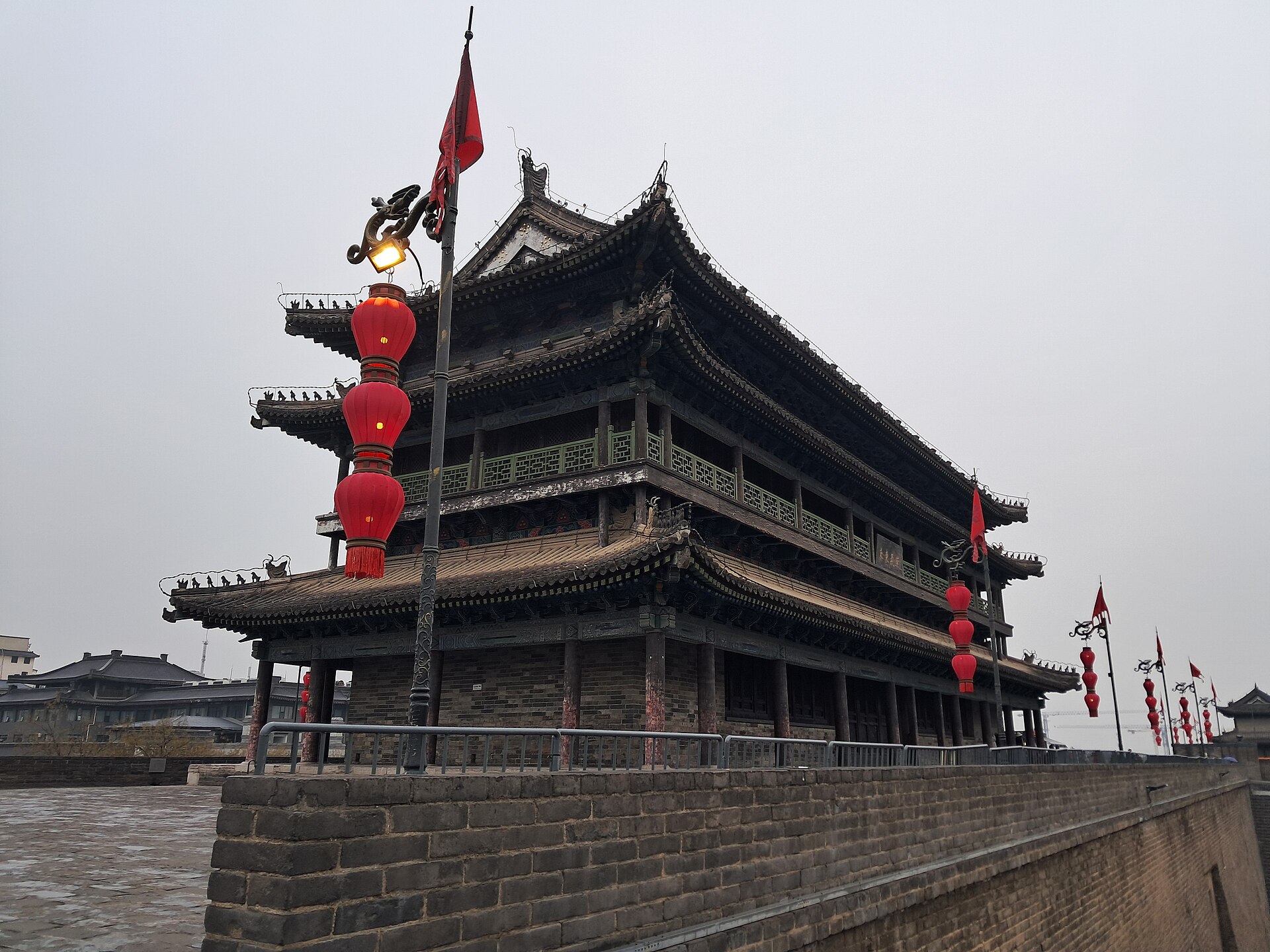
Xi’an’s city wall is one of the few remaining complete urban fortifications in China, a massive ring of earth and brick that has stood for over six centuries. Built in the late 1300s during the Ming Dynasty, it was constructed atop the foundations of earlier Tang-era defenses, preserving the outline of Chang’an, the ancient capital that once rivaled Rome or Constantinople in its influence. The wall stretches nearly fourteen kilometers in an unbroken loop, rising twelve meters high and varying in width from twelve to eighteen meters at the top. Unlike many other historic walls that have crumbled or been absorbed into modern cities, this one remains intact, a rare physical boundary between old and new.
The most unusual feature of Xi’an’s wall is the road that runs along its crest. Few other city walls in the world invite visitors to walk or cycle their entire length, but here, the broad, flat pathway makes it possible. Renting a bicycle is the most popular way to experience the wall—there are single bikes and tandems available near several of the gates, and a leisurely ride around the full circuit takes about two hours. The path is wide enough for groups to pass comfortably, and the gentle slope of the ramparts makes it accessible even for those who prefer walking. Along the way, small pavilions and shaded rest stops offer a place to pause, though the midday sun can be relentless in summer.
The wall is punctuated by four main gates, each aligned with a cardinal direction and designed with a distinctive architectural style. The southern gate, Yongning, is the most elaborate, with a towering barbican and a ceremonial plaza where reenactments of imperial processions sometimes take place. The gates were not just defensive structures but also symbolic thresholds, marking the transition between the ordered world of the city and the chaos beyond. Today, they serve as entry points for visitors, with ticket booths and bicycle rentals clustered nearby. The eastern and western gates are quieter, often used by locals who live in the neighborhoods just outside the wall.
From the top, the contrast between the city inside and outside the wall is striking. Within the ring, the streets are narrow and winding, lined with low-slung buildings that have changed little in centuries. The Muslim Quarter, with its labyrinth of alleys and bustling markets, is just a short walk from the Drum Tower, its presence announced by the scent of grilled lamb skewers and the sound of vendors calling out prices. Outside the wall, the city sprawls outward in wide boulevards and glass-fronted high-rises, a reminder of Xi’an’s modern ambitions. Few places in China offer such a clear division between past and present, and the wall itself acts as a kind of time machine, allowing visitors to step between them.
At night, the wall takes on a different character. Strings of red lanterns are hung along its length, their glow softening the harsh lines of the brickwork. During festivals, the entire perimeter becomes a canvas for light displays, with intricate designs projected onto the ramparts. The gates stay open late, and the path is well-lit, making it a popular evening stroll. The air is cooler then, and the city below hums with activity—restaurants spill onto sidewalks, and the distant clatter of mahjong tiles drifts from open windows.
The wall is also a practical part of the city’s daily life. Locals use it as a jogging route, and in the early mornings, groups practice tai chi on the broad expanse of the southern gate’s plaza. Near the northern gate, a short walk from the train station, the wall feels more utilitarian, with fewer tourists and more people going about their routines. This is where many visitors begin their exploration of Xi’an, stepping onto the ramparts for the first time and looking out over the rooftops, trying to imagine the city as it once was.
There are no grand museums or interpretive centers along the wall—its history is written in its bricks and the way it shapes the city around it. The wear on the stones, the patches of moss in the crevices, and the occasional graffiti scratched into the parapets all tell their own stories. Some sections have been restored more recently than others, but the wall has never been polished into a pristine monument. It feels lived-in, a structure that has adapted to the needs of each era while maintaining its original purpose.
For those who take the time to walk or cycle its length, the wall offers more than just a view. It’s a way to understand Xi’an’s layers—how the city has grown outward while still holding onto its core, how the past and present coexist in a single frame. The Muslim Quarter’s night market, with its steaming bowls of *paomo* soup and stacks of flatbread, is just a ten-minute walk from the wall’s base, a reminder that history here isn’t just something to observe but something to taste, hear, and feel. The wall doesn’t just surround the city; it defines it.