The Monument to the Discoveries stands along the banks of the Tagus River in Lisbon’s Belém district, a place where Portugal’s great maritime expeditions once began. Though it was completed in the mid-20th century, the idea for the monument took shape decades earlier, in the 1930s, when the country marked the 500th anniversary of Prince Henry the Navigator’s death. The original plan was to honor not just him, but all those who shaped the Age of Exploration. After years of delays, the monument finally took its place on the waterfront in 1960, timed to coincide with the 500th anniversary of Henry’s birth.
The monument’s design evokes a caravel poised for departure, its prow cutting through the air as if ready to set sail. At the forefront stands Prince Henry himself, holding a map—a man who never sailed but organized countless voyages along Africa’s coast. Behind him, a procession of figures represents the many who contributed to the era: navigators, cartographers, scientists, missionaries, and even poets. The Age of Discovery was about more than geography; it was a time of intellectual and cultural exchange, and the 33 figures carved into the stone reflect that complexity.
Rising 52 meters into the air, the monument manages to feel both imposing and graceful. Its upward sweep suggests motion, as if the entire structure is leaning into the wind. Designed by sculptor Cottinelli Telmo and architect Leopoldo de Almeida, the monument captures not just the grandeur of the era but its spirit of adventure. Inside, an elevator lifts visitors to a viewing platform, where the Tagus stretches out below, framed by the 25 de Abril Bridge and the rooftops of Belém. At the base, a vast mosaic compass points toward the lands Portuguese explorers once reached, a quiet acknowledgment of their global legacy.
Belém was a natural choice for the monument’s location. This was where the shipyards once stood, where the vessels of Vasco da Gama, Bartolomeu Dias, and others were built before setting off into the unknown. Nearby, the Belém Tower—another relic of the era—serves as a counterpoint to the monument. Where the tower symbolizes protection and homecoming, the Monument to the Discoveries embodies the boldness of setting out. Together, they tell two sides of the same story.
The atmosphere around the monument is always lively. Tourists come to take photos, but so do locals, who stroll along the riverbank or sit on the grass, watching the water. In the evening, when the lights come on, the monument glows against the darkening sky, its reflection shimmering in the Tagus. The illusion of movement is stronger then, as if the stone caravel might break free and sail into the night. The area is dotted with benches and small cafés, where people linger over coffee or wine, listening to the lapping of the river.
This is more than just a monument; it’s a tribute to an era that reshaped the world. The Portuguese take pride in their explorers, who charted the sea route to India, rounded the Cape of Good Hope, and reached Brazil before anyone else. But the monument also humanizes those achievements, reminding visitors that behind every great discovery were ordinary people—driven by ambition, fear, hope, and doubt. Standing before these stone figures, it’s hard to imagine what it must have been like to set off in fragile wooden ships, not knowing if you’d ever return.
The space around the monument often hosts cultural events—concerts, exhibitions, and festivals. Occasionally, the waterfront transforms into a 16th-century port, complete with historical reenactments, sailors in period costumes, and the sounds of old sea shanties. For Lisbon, this isn’t just a tourist attraction; it’s a place where national identity is reinforced, a reminder of how a small country on Europe’s edge once altered the course of history.
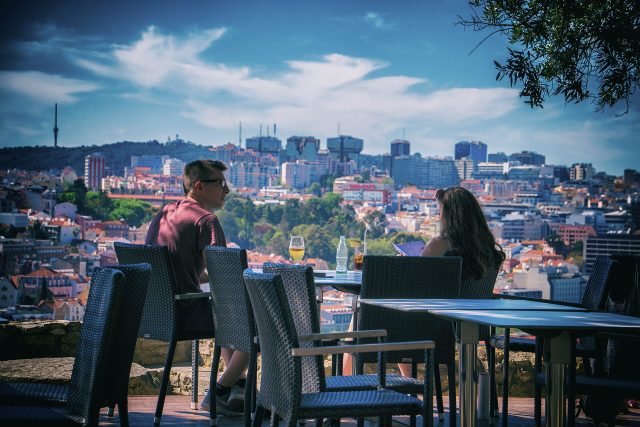
On clear days, the view from the monument’s observation deck stretches far beyond the city. The Tagus widens here, its waters flowing toward the horizon, much like the routes of the explorers who sailed from these shores centuries ago. Below, children often run across the compass mosaic, guessing which arrow points to which distant land. Adults stand quietly, gazing at the river, perhaps wondering how much of the world remains unexplored. The monument doesn’t just commemorate the past; it invites reflection on the future.