Khamaryn Khiid is one of those rare places where time seems to slow down, almost as if the world beyond its walls has paused. Tucked away near Dalandzadgad, deep in the heart of the Gobi Desert, the monastery feels like an oasis of calm amid the vast, windswept expanse of sand and rock. There are no crowds here, no city noise—just the quiet rustle of the wind and the occasional murmur of pilgrims or travelers who make the journey. Though small in size, the monastery carries a weight of history and atmosphere that makes it special, not just for Buddhists, but for anyone seeking solitude or a connection to Mongolia’s spiritual traditions.
Founded in the early 19th century, Khamaryn Khiid was one of many monasteries scattered across Mongolia during a time when Buddhism shaped the country’s cultural and social life. Unlike the grand religious centers such as Erdene Zuu or Amarbayasgalant, this monastery was never meant to be a major hub. Instead, it was a place where monks lived in harmony with the harsh desert environment, studying sacred texts and performing rituals without the distractions of the outside world. Like so many others, it suffered during the years of repression, when monasteries across Mongolia were destroyed or abandoned. Its buildings fell into disrepair, and the monks who once lived there were forced to leave.
Today, the monastery has been partially restored, though it bears little resemblance to its former grandeur. The main structure is a modest temple with the traditional Mongolian architectural style—wooden walls painted in warm ochre tones, intricately carved columns, and a roof with upturned eaves that hint at Tibetan and Chinese influences. Inside, faded murals depict Buddhas and bodhisattvas, while altars hold simple offerings: strips of silk, coins, and small bundles of food. There’s a sense of quiet reverence here, a feeling that despite the passage of time, the place still holds meaning for those who visit.
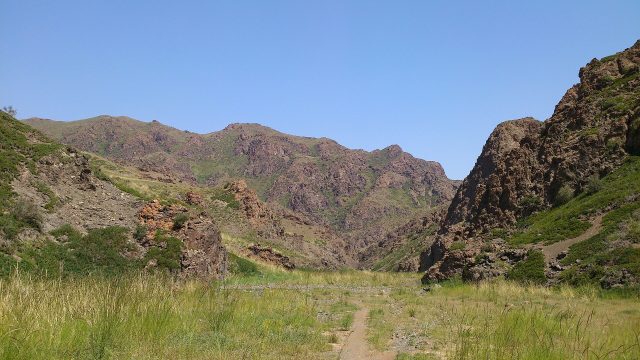
The landscape around Khamaryn Khiid is as striking as the monastery itself. The Gobi Desert is often imagined as a barren wasteland, but in reality, it’s a place of stark, unexpected beauty. Towering rock formations rise like ancient sentinels from the earth, while endless plains stretch out under the vast sky, dotted with patches of hardy grass and sudden bursts of green where water collects. The desert is home to Bactrian camels grazing on the hillsides and, if you’re lucky, the rare Gobi bear. Locals speak of spirits that still wander these lands, and the monastery is said to serve as a bridge between the human world and the unseen.
Visiting Khamaryn Khiid isn’t just about seeing a historic site—it’s about stepping into a rhythm of life that has remained unchanged for centuries. In the early morning, as the sun rises over the horizon, a thin mist lingers around the monastery, and the air is filled with the scent of burning juniper, used in rituals. By evening, when the heat of the day fades, the sound of throat singing or the soft chanting of mantras might drift through the air. If you’re fortunate, one of the few remaining monks may take the time to speak with you, sharing stories or simply offering a quiet moment of connection.
This isn’t a place overrun by tourists. There are no souvenir stalls, no guided tours herding visitors from one spot to the next. Instead, there’s space—space to breathe, to think, to simply be. Getting here isn’t easy; the journey from Dalandzadgad takes you along rough roads that wind through valleys and over hills, but that’s part of what makes the visit memorable. The isolation adds to the sense of discovery, as if you’ve stumbled upon something hidden, something real.
For many Mongolians, Khamaryn Khiid remains a sacred place. Pilgrims still come to walk the traditional circuit around the monastery, a ritual of respect and purification. Some tie prayer ribbons to the branches of trees or to the wooden poles set up for that purpose, while others sit in silence, soaking in the atmosphere. Even those who don’t follow Buddhism often find that the monastery has a way of quieting the mind, of making everyday worries feel distant.
Khamaryn Khiid isn’t a museum, frozen in time. It’s a living place, where the flicker of spiritual life still burns, however faintly. It doesn’t impress with grandeur or scale, but that’s precisely what makes it compelling. There’s nothing here but the wind, the sand, the ancient walls, and the people who come seeking something beyond the ordinary—whether it’s understanding, peace, or just a moment to pause and look around. That’s why, despite everything, the monastery endures, drawing those who are searching not for entertainment, but for something deeper.