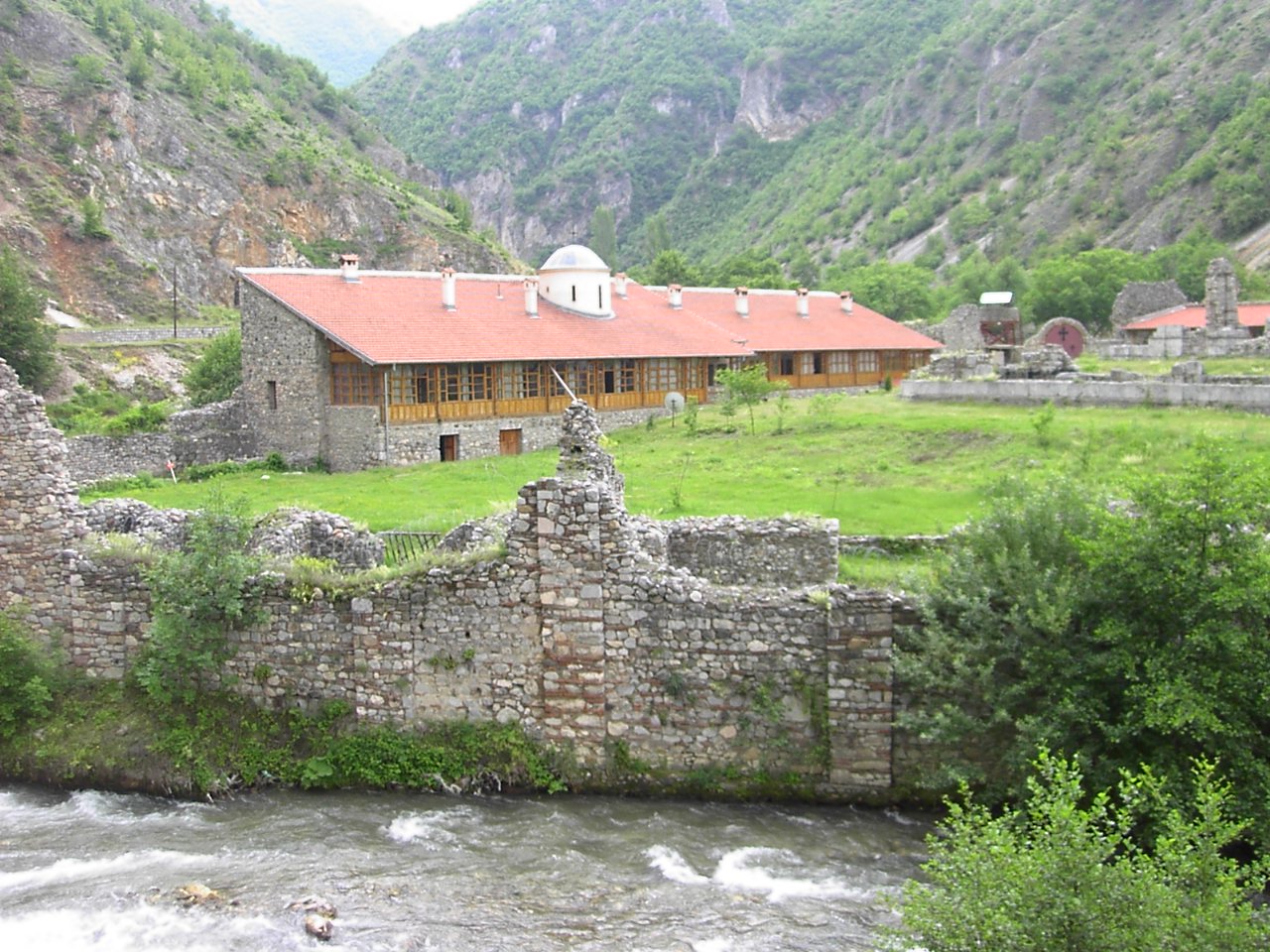
Nestled in the hills just outside Prizren, where the valley narrows and the river Prizrenska Bistrica carves its way through the landscape, the ruins of the Monastery of the Holy Archangels stand as a quiet witness to a vanished era. The location was never chosen by chance. This was a place where trade routes intersected, where the terrain offered both seclusion and strategic advantage, and where the natural beauty of the surroundings seemed to demand something enduring. Today, only fragments remain—crumbling walls, weathered arches, and faded frescoes—but even in decay, the monastery retains a sense of grandeur, a whisper of the spiritual and political power it once held in medieval Serbia.
Founded in the 14th century by King Stefan Dušan, the monastery was conceived as more than a religious sanctuary. It was meant to be his final resting place, a mausoleum where his remains would lie and where prayers would be offered for his soul. Construction began in 1343, but Dušan did not live to see its completion; the work was finished under his son, Uroš. In its prime, the monastery was a thriving center of faith, culture, and learning. Monks transcribed manuscripts, painted icons, and trained novices within its walls. Relics of saints were kept here, and the complex included not just a church but also living quarters, a refectory, a library, and workshops. It was a place where art, devotion, and royal ambition intersected, reflecting the height of Serbia’s medieval golden age.
The architecture of the monastery blended Byzantine traditions with distinct Serbian influences. The main church, dedicated to the archangels Michael and Gabriel, followed the classic cross-in-square design topped with a dome, a style common in Orthodox churches of the time. Inside, the walls were adorned with frescoes depicting saints, biblical scenes, and even portraits of Stefan Dušan himself. Some of these paintings have survived, their colors muted by time but their details still discernible. The stonework, too, was remarkable—carved with intricate patterns, mythical creatures, and symbolic motifs, each chisel mark a testament to the skill of the craftsmen. The monastery was not just a place of worship but a masterpiece of medieval artistry, where every element told a story.
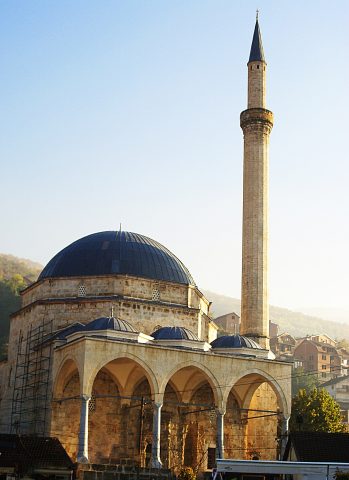
Yet the monastery’s fate was as turbulent as the history of the region itself. After the Battle of Kosovo in 1389, Serbia’s power waned, and its cultural and religious institutions began to decline. When the Ottomans took control in the 15th century, the monastery was looted and partially dismantled. Stones from its walls were repurposed to build the Sinan Pasha Mosque in Prizren, a stark symbol of the shifting tides of empire. Over the centuries, the complex fell into ruin, its once-vibrant life reduced to scattered remnants. It wasn’t until the 20th century that efforts were made to study and preserve what remained, turning the site into a monument not just to faith, but to the rise and fall of an entire civilization.
Visiting the Monastery of the Holy Archangels today is less about ticking off a tourist attraction and more about stepping into a different time. The ruins are set against a backdrop of forested hills, with the river rushing nearby, its sound mingling with the rustle of leaves. There’s a stillness here, a sense of isolation that makes it easy to imagine the monastery as it once was—monks walking the stone paths, the tolling of bells echoing through the valley, the murmur of prayers rising from the church. The ruins don’t feel abandoned so much as paused, as if the centuries have simply layered themselves over the place, leaving it suspended between past and present.
What makes this site particularly compelling is the way history lingers in the air. Standing among the ruins, you can almost feel the weight of the centuries—the kings and monks, the artists and pilgrims who once walked these grounds. The fragments of frescoes, the worn carvings, the crumbling walls all speak of a time when this was a place of both spiritual devotion and political significance. Even in its ruined state, the monastery retains a kind of power, a reminder of how faith, art, and authority once converged in this corner of the Balkans.
Getting here is part of the experience. From Prizren, the journey takes about half an hour by car, winding through a landscape of rolling hills and river valleys. The road itself is scenic, offering glimpses of the countryside that has changed little over the centuries. The best time to visit is in the early morning or late afternoon, when the light is soft and the shadows lengthen, bringing out the texture of the stone. There’s no entrance fee, and no tourist infrastructure—just the ruins, the river, and the quiet. It’s a place that demands respect, not just for its history, but for the sense of reverence it still inspires.
This isn’t a site to rush through. To truly appreciate it, you need to slow down—sit on a fallen stone, trace the outlines of a faded fresco, listen to the wind as it moves through the arches. It’s a place for those who see history not just in books, but in the way light falls on ancient walls, in the silence that settles over a forgotten corner of the world. The Monastery of the Holy Archangels doesn’t just tell a story; it lets you step into it, if only for a moment. And in that moment, the past doesn’t feel so distant after all.