Perched on a gentle rise in Prizren’s old town, the Church of Our Lady of Ljeviš stands apart from the city’s noise. Built in the early 14th century, it has endured empires, wars, and time itself. Its stone walls hold the weight of an era when Prizren was a center of culture, faith, and power in the Serbian kingdom.
The architecture combines Byzantine elegance with the Raška school’s distinct style. From the outside, the church looks unassuming, its small size hiding the harmony within. Inside, a dome rests on four slender columns, creating a sense of lightness. But the frescoes are what draw the eye—painted in the 14th century during the Palaiologan Renaissance, they depict biblical stories and saints with vivid colors and expressive faces. These murals are among the best-preserved examples of Serbian medieval art.
King Stefan Milutin, one of Serbia’s most powerful rulers, played a key role in its history. In the early 1300s, he either built or expanded the church, using it as a royal chapel. At the time, Prizren thrived as a trade hub, where goods, ideas, and art flowed in from across the region. The church reflected the ambitions of the Serbian state.
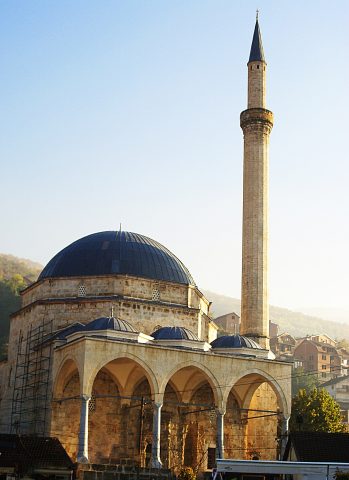
The Ottomans conquered the Balkans in the 15th century. They turned the church into a mosque, plastered over the frescoes, and tore down the bell tower. For centuries, it served a different faith, its original purpose lost. Only in the 19th century, as Serbia reclaimed independence, was the church restored to the Orthodox community. The frescoes, uncovered with care, revealed their enduring beauty.
Inside, the air is still. Light filters through narrow windows, illuminating the walls. Even on busy days, the church feels separate from the city’s hum. You can study the details—the folds of a saint’s robe, the expressions on their faces, the way the colors have survived.
The church remains a living part of Prizren. For some, it’s a place of worship; for others, a symbol of the city’s layered past. It hosts concerts, exhibitions, and cultural events, connecting history to the present. In summer, when Prizren fills with visitors, the church offers quiet.
Prizren blends East and West. The Church of Our Lady of Ljeviš reflects that complexity. It speaks of a time when Serbia was a major power and Prizren was its heart, yet it fits naturally into the modern city.
The walk up to the church winds through narrow streets, past houses with red-tiled roofs. From the hill, Prizren spreads out below—minarets, domes, and green hills in the distance. The church is one layer of history, but it’s one of the most vivid. It doesn’t announce its importance, and that’s why it lingers in memory.