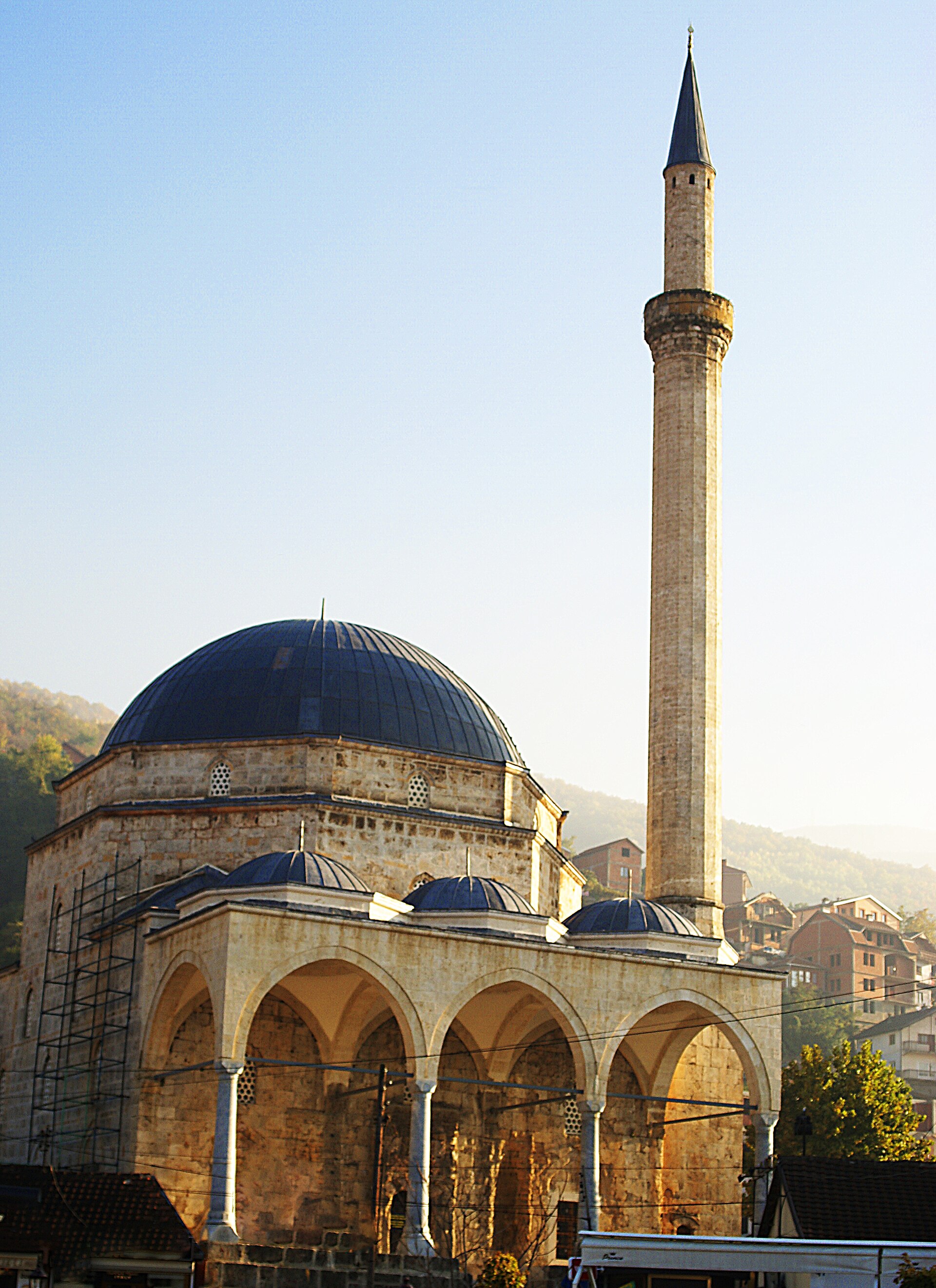
The Sinan Pasha Mosque in Prizren is one of those quiet places that lingers in your memory long after you’ve left. Perched on a gentle rise in the old town, it watches over the city like a silent witness to centuries of change. Built in the early 1600s, it carries the imprint of the Ottoman era, when Prizren was a thriving hub of trade and culture in the Balkans. Its minaret stands tall against the skyline, but the real story of the mosque unfolds when you step closer.
The architecture is classic Ottoman, yet there’s something distinctly Prizren about it. The mosque is built from pale stone that glows warmly in the sunlight, its entrance framed by a portico with three arches resting on slender columns—a common feature in mosques of that period. Inside, the prayer hall is spacious, crowned by a high dome where light filters softly through narrow windows. The walls once bore intricate paintings, though time and renovations have left only fragments of their former beauty.
Named after Sinan Pasha, an Ottoman military leader and statesman, the mosque reflects his influence in the region. While his name is often tied to military campaigns, he also contributed to Prizren’s development, leaving behind more than just this building. But the mosque’s history isn’t defined by one man alone. It has endured wars, shifting borders, and even earthquakes, yet it remains an active place of worship. For the local Muslim community, it’s not just a monument but a living part of their daily lives.
Prizren has always been a city where cultures and faiths intersect. The Sinan Pasha Mosque is just one piece of this intricate mosaic, standing near Orthodox churches, Catholic cathedrals, and an old synagogue. It doesn’t exist in isolation but blends seamlessly into the city’s fabric. In the summer, the mosque’s courtyard fills with the murmur of elderly men chatting and children playing under the shade of trees. In winter, the space grows quiet, though the minaret still punctuates the skyline, a reminder that life goes on.
Inside, the atmosphere is one of quiet reverence. Even if you’re not Muslim, there’s a sense of timelessness here, a place where prayers have echoed for centuries. The floor is covered in carpets, and in the corner, the mihrab points toward Mecca. Occasionally, the soft call of the muezzin drifts through the air, marking the rhythm of the day. The mosque welcomes visitors, but it’s important to remember that this is a functioning religious site, not a museum. Respectful silence and discretion are expected, especially during services.
Beyond its spiritual role, the Sinan Pasha Mosque is a testament to history. In the 19th century, as the Ottoman Empire weakened, Prizren became a center of Albanian national movements, and the mosque found itself at the heart of these changes. Later, during the Balkan Wars and global conflicts, it weathered turbulent times but survived. Today, it stands as a reminder of the region’s layered past, where empires rose and fell, and cultures intertwined.
The area around the mosque is a maze of narrow streets where the scent of freshly baked bread and coffee lingers in the air. Small shops sell spices and sweets, and if you take a moment to sit on a bench in the courtyard, you’ll see the unhurried pace of life in Prizren. The city doesn’t try to impress with grand attractions; instead, it charms with quiet corners where time moves at its own rhythm.
The Sinan Pasha Mosque is one such corner. It doesn’t demand attention but rewards those who approach it with respect and curiosity. You might visit in the early morning, when sunlight first touches the minaret, or in the evening, as the city fades into dusk. Either way, the mosque remains unchanged—a modest yet enduring part of Prizren’s landscape.