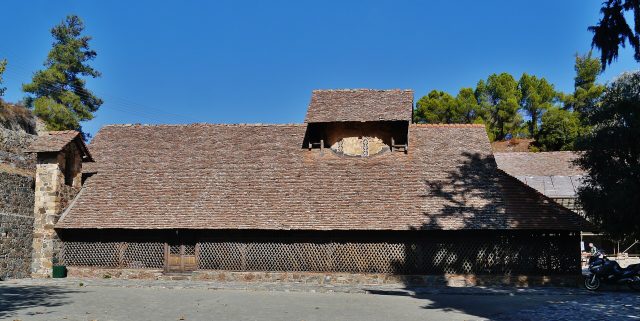
Nestled in the foothills of the Troodos Mountains, Panagia tou Araka Monastery feels like a world apart from the bustling coastal resorts of Cyprus. The journey there winds through the quiet village of Lagoudera, where stone houses with terracotta roofs line narrow lanes, and vineyards spill down the slopes. The monastery itself sits on a gentle rise, surrounded by ancient oaks and pines, its presence so unassuming that it’s easy to imagine little has changed here in centuries. There are no crowds, no tour buses—just the stillness of the mountains and the sense that time moves differently in this place.
The monastery’s origins trace back to the 12th century, when Cyprus was under Byzantine rule. According to local tradition, it was founded by a hermit who discovered an icon of the Virgin Mary in these hills, believed to have been painted by the Apostle Luke. The name *Araka*—meaning "spider" in Greek—remains something of a mystery. Some say it refers to a legend in which spiders wove webs to protect the icon from invaders; others suggest it alludes to the intricate patterns of the frescoes inside, resembling delicate threads. Whatever the truth, the monastery quickly became a spiritual hub, drawing pilgrims and artists alike.
What remains of the original complex today is just the church, though even that has been rebuilt over the centuries. Yet the church is the monastery’s true treasure. Its walls are covered in 12th-century frescoes, widely regarded as some of the finest examples of Byzantine art on the island. The paintings are remarkable not just for their technical skill but for their emotional depth—saints gaze with reproach or compassion, biblical scenes unfold like living tableaux, and the colors, though faded in places, retain an unexpected vibrancy. The most striking is the depiction of the Last Judgment, where angels weigh souls and sinners are cast into hell, a scene that is at once unsettling and mesmerizing.
Unlike the grand, wealthy monasteries of Cyprus, such as Kykkos, Panagia tou Araka has always been modest. There are no gilded icons or priceless relics here, just the quiet dignity of a place that has endured through the ages. The church is almost always silent, save for the occasional murmur of monks or the soft footsteps of visitors. Outside, the mountains stretch endlessly, crisscrossed by trails leading to other forgotten churches and monasteries. It’s easy to picture the hermits who once sought solitude here, tending to their prayers and gardens far from the noise of the world.
Today, only a handful of monks live at the monastery, their days marked by a slow, deliberate rhythm. They tend to the church, cultivate the small garden, and occasionally welcome guests. There is no admission fee, but visitors are asked to respect the sanctity of the space—no photography inside, no loud conversations, no entry into the altar. For many, this comes as a surprise. In a country where tourism has become an industry, Panagia tou Araka remains a place where the focus is not on entertainment but on quiet reflection.
Time moves differently here. In the morning, mist clings to the hills, gradually lifting to reveal the valley below. By midday, the sun warms the old stones, and in the evening, shadows lengthen, making the frescoes seem almost alive. If you’re lucky, you might hear the distant toll of the monastery bell, a sound that has echoed through these hills for nearly a thousand years.
This isn’t a place to rush through, to check off a list before moving on. It’s a place for those willing to pause, to listen—to the silence, to the wind in the trees, to the faint echoes of history. There are no guided tours reciting rehearsed facts, no souvenir stalls or cafes. Just the church, the mountains, and the sense that you’ve stepped into another era. Perhaps that’s why those who come here often find themselves returning, drawn back by something they can’t quite name.