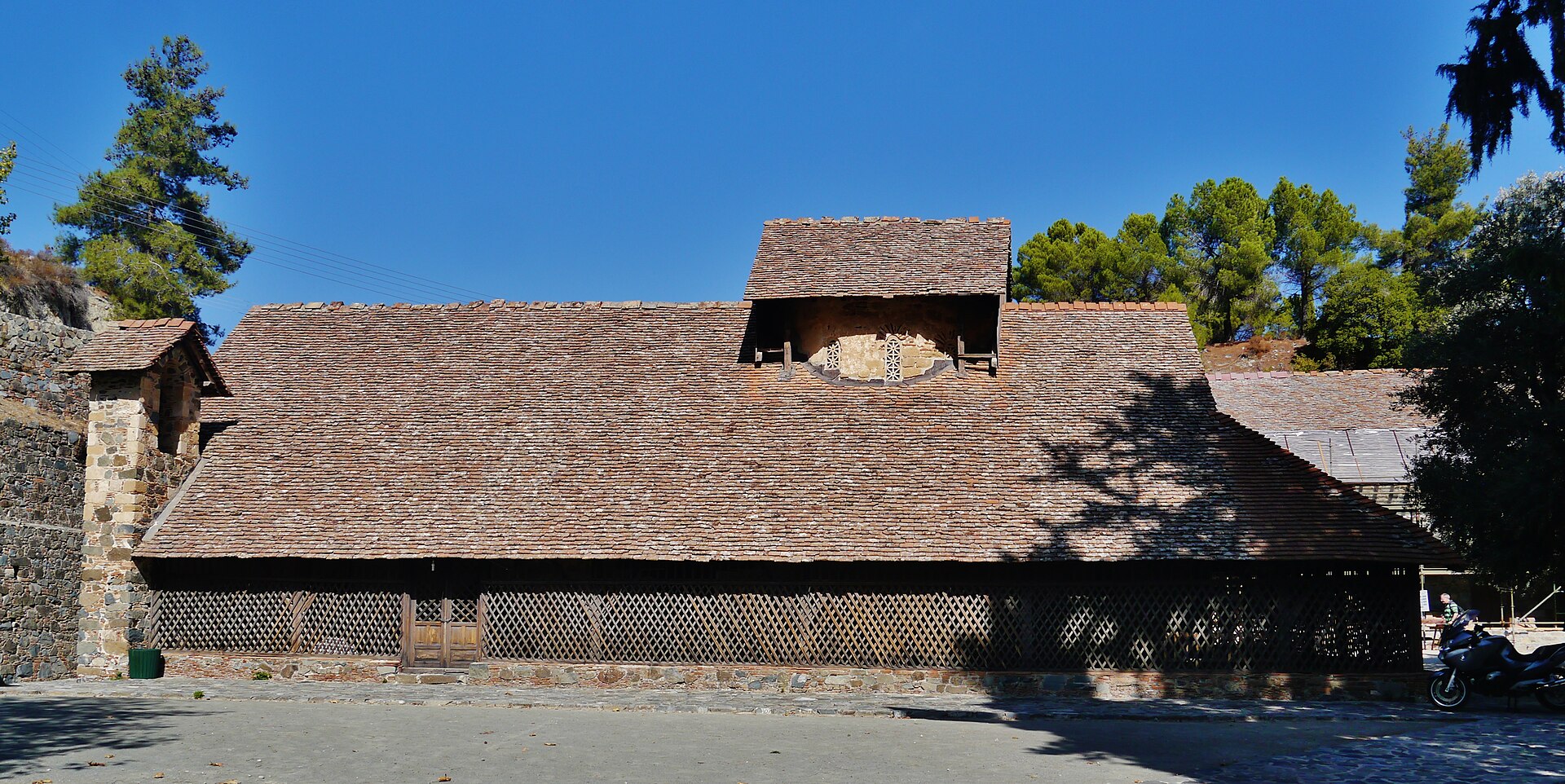
Perched on the slopes of the Troodos Mountains, Panagia tou Araka is a place few travelers find. The church stands among olive groves and vineyards, its name tied to the small grove—*araki*—where it was built in the late 12th century. Its simple stone walls and tiled roof have changed little since then, when its interior was covered with frescoes now considered some of Cyprus’s most important Byzantine art.
The church was constructed as Cyprus stood at a crossroads. By the end of the 12th century, the island had been under Byzantine rule for centuries, but in 1191, Richard the Lionheart seized it during the Third Crusade. Soon after, the Lusignan dynasty took control. Yet in remote villages like Lagoudera, daily life remained unchanged. Panagia tou Araka became a place where faith persisted beyond politics.
From the outside, the church is modest—a single-nave structure with a gabled roof, its stones arranged with quiet precision. A small porch on the southern side offers shade, but the interior holds the surprise: bare stone walls give way to frescoes, their colors still rich after centuries.
The paintings date to 1192 and are attributed to the Painter of Lagoudera, an anonymous master known for his soft lines and warm tones. The frescoes depict scenes from the lives of Christ and the Virgin Mary, along with prophets and martyrs. Some compositions, like the Dormition of the Virgin or the Harrowing of Hell, are rare for their time. The saints’ eyes seem to follow you as you move, creating an unsettling sense of connection.
Panagia tou Araka was never a grand monastery or pilgrimage site. It served the people of nearby villages, where generations were baptized, married, and buried. That intimacy shows in the frescoes—no cold grandeur, just devotion captured in paint.
In 1985, the church was named a UNESCO World Heritage Site as part of the painted churches of the Troodos region. The designation didn’t change its character, but it acknowledged those who had preserved it. Locals still tend to the church, keeping the grounds and sharing its story. Inside, the scent of wax and aged wood remains, while sunlight through narrow windows lights the frescoes in patches.
Visit on a weekday. The road winds through Lagoudera, a village where stone houses with wooden balconies line narrow streets. Vineyards cover the hillsides, and the air carries the scent of wild herbs. From the village, it’s a short walk to the church—a path through olive groves, where birdsong and rustling leaves fill the silence.
Panagia tou Araka doesn’t impress immediately. Its beauty unfolds slowly, like a story. There’s no opulence, just history—quiet, uncluttered, and real.