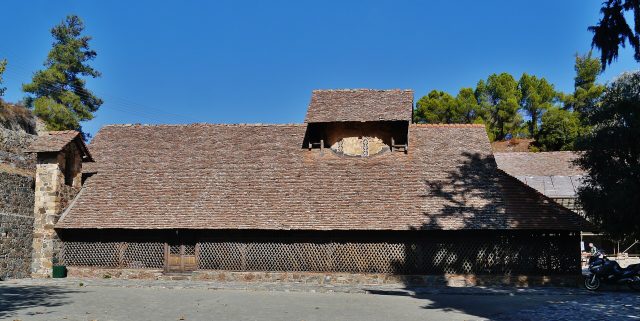
Nestled in the Troodos Mountains, the village of Lagoudera feels like a place where time has quietly settled into the folds of the landscape. The roads here wind through pine forests and terraced slopes, past old stone houses with red-tiled roofs, and the air carries the scent of wild herbs and sun-warmed earth. This is not a destination for those in a hurry. It’s a place for travelers who seek something beyond the usual tourist trails—something slower, deeper, and far more enduring.
At the heart of the village stands the Church of Saint Herakleidios, a small but remarkable building that has witnessed nearly a thousand years of Cypriot history. Dedicated to one of the island’s earliest bishops, Saint Herakleidios is said to have converted the Apostle Barnabas to Christianity, a legend that ties the church to the very origins of Cypriot faith. The current structure dates back to the 11th century, a time when Cyprus was firmly under Byzantine rule, and Christianity had already taken deep root in the island’s culture. Unlike grand cathedrals or wealthy monasteries, this church was never meant to impress with size or opulence. Instead, it was built for prayer, for quiet reflection, and for the people who lived in these mountains.
The architecture is simple, almost austere, as was typical of rural Byzantine churches. The building is small, with thick limestone walls that have mellowed into a warm golden hue over the centuries. Inside, the space feels intimate, almost enclosed, with a low dome resting on four sturdy columns. The windows are narrow, allowing only slivers of light to filter in, casting soft, shifting patterns across the walls. There is no gilded extravagance here, no marble or intricate carvings—just the quiet dignity of stone and plaster, shaped by hands that understood the value of restraint.
What makes the church truly extraordinary are its frescoes. Painted in the late 12th century, at the height of Byzantine artistry, they cover nearly every inch of the interior, from the vaulted ceiling to the lower walls. Though time has faded the colors and worn away patches of plaster, the scenes remain vivid in their storytelling. The artists who created them worked in the tradition of the Constantinople school, yet there is something distinctly Cypriot in their work. The faces of the saints often resemble the weathered features of local villagers, and the landscapes behind them could be the very hills and valleys that surround Lagoudera. Among the most striking compositions is the Last Judgment, a dramatic tableau where angels sound their trumpets and the souls of the dead rise to face divine justice. The figures are dynamic, almost alive, their expressions a mix of awe, fear, and hope.
For centuries, the Church of Saint Herakleidios served as a humble parish church, a place of worship for the farmers and shepherds who lived in the surrounding villages. It was never a major pilgrimage site or a wealthy monastery, which may explain why it has survived so well. There were no battles fought over its relics, no ambitious renovations to erase its original character. Even during the Ottoman period, when many churches across Cyprus were converted into mosques or left to decay, this small mountain chapel continued to function, though often in secret. The locals protected it, passing down stories of Saint Herakleidios and the generations who had prayed within its walls.
Today, the church remains open to visitors, though reaching it requires a bit of effort. Lagoudera is not a place you stumble upon by accident. The road here twists through the mountains, offering glimpses of vineyards clinging to steep slopes and villages tucked into the folds of the hills. There are no luxury hotels or tourist shops in the village—just a handful of houses, a small taverna serving simple, home-cooked meals, and an old fountain where travelers can rest. The church itself stands on a quiet square, surrounded by low stone walls, as if waiting for those who come not just to see, but to understand.
Inside, the air is cool, even on the hottest summer days. The light that filters through the narrow windows falls unevenly across the frescoes, illuminating a saint’s face here, a fold of drapery there, a golden halo glowing faintly in the dimness. There are no crowds, no guided tours rushing through their scripts—just silence, and the chance to stand in the presence of art that has endured for nearly a millennium. Occasionally, an elderly woman from the village will enter to light a candle or murmur a prayer before one of the icons, her presence a quiet reminder that this place is still alive, still part of the rhythm of daily life.
The Church of Saint Herakleidios is not a museum piece, frozen in time. It is a living connection to the past, a place where history hasn’t ended but simply slowed down. It speaks of a Cyprus that is often overlooked—the Cyprus of mountain villages, of Byzantine craftsmen who painted their faith onto stone, of ordinary people who found solace within these walls. If you find yourself in the Troodos Mountains, take the time to visit. Step inside, run your fingers over the worn stone, and listen. You might just sense the same quiet certainty that has drawn people here for centuries—the knowledge that some things, no matter how small, outlast the passage of time.