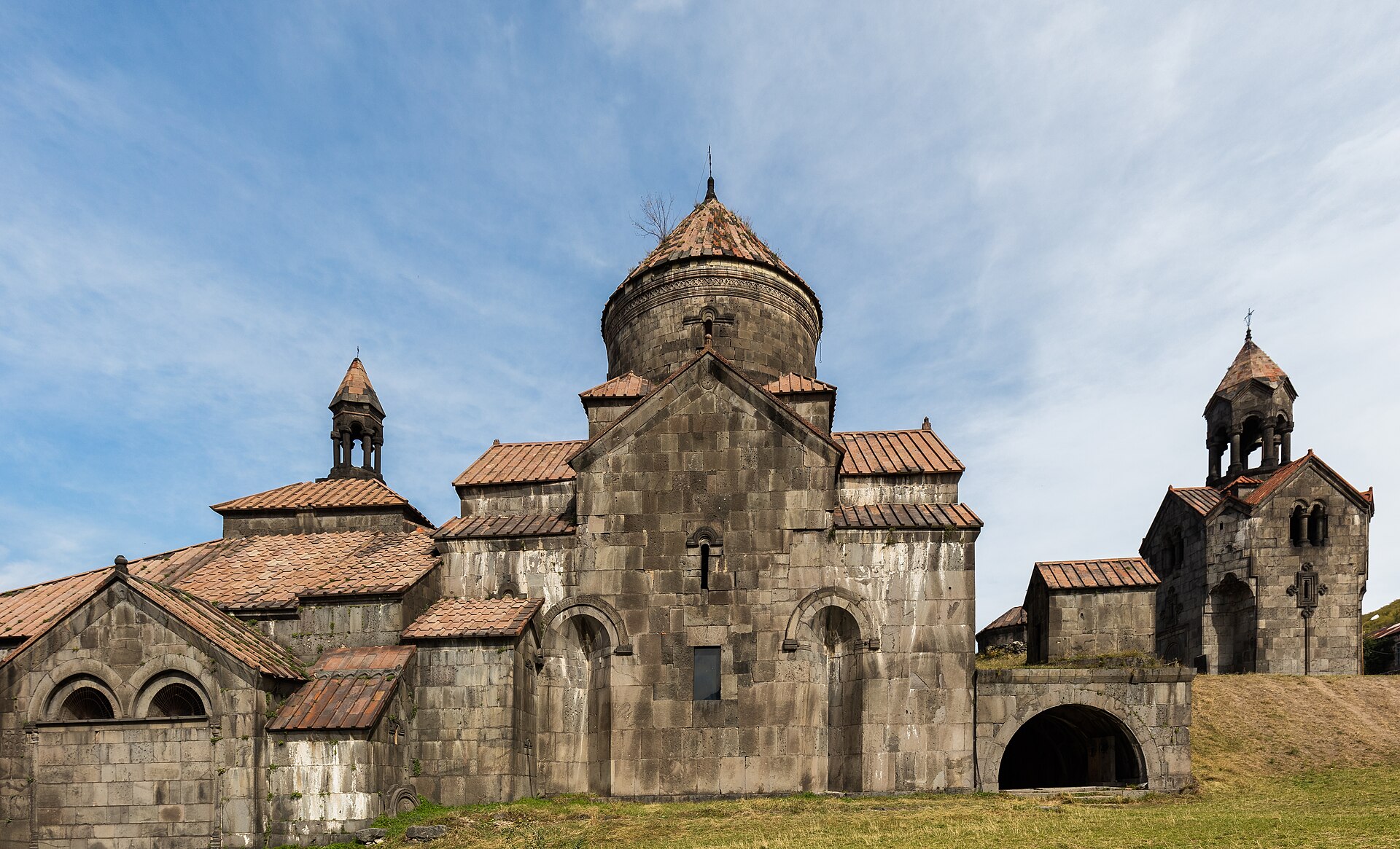
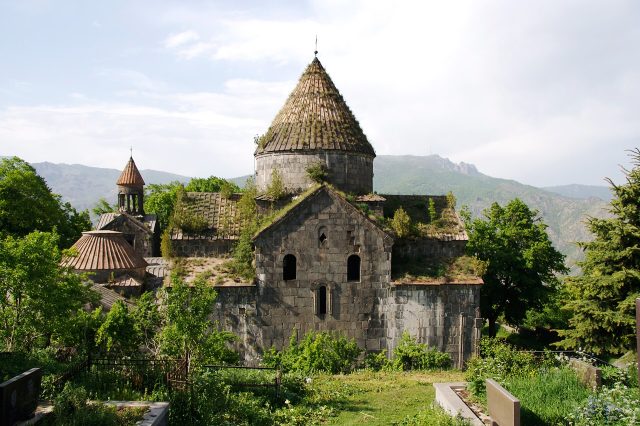
Hahpat Monastery sits on a gentle rise where the Debed River valley unfolds beneath the rugged slopes of the surrounding mountains. The air here carries the scent of wild herbs and damp stone, and the only sounds are the rustle of leaves in the old trees and the occasional murmur of visitors. The monastery doesn’t demand attention with bright colors or ornate details—instead, it blends into the landscape as if it had always been there, shaped by the same winds and rains that weathered the hills. Its dark tuff walls, worn smooth by centuries, hold a quiet that feels almost deliberate, as though the place itself is holding its breath.
Founded in the 10th century, Hahpat became one of the most important spiritual and intellectual centers of medieval Armenia. Scribes worked here, producing manuscripts that now reside in museums in Yerevan and Venice, their pages filled with intricate illuminations and careful script. The architecture reflects the practical yet profound aesthetic of the time: low, sturdy churches with domes resting on thick columns, their small windows casting just enough light to create a dim, contemplative interior. The oldest structure, the Church of the Holy Cross, dates back to 976. Its reliefs are simple but striking, particularly the image of Christ holding an open Gospel, the lines of the carving surprisingly delicate against the rough stone.
The monastery’s main church, Surb Nshan, was built in the early 11th century and remains its most recognizable feature. The dome seems to float above the valley, a silent sentinel over the landscape. Inside, faded frescoes still cling to the walls, their figures elongated and solemn, with the large, expressive eyes typical of Armenian religious art. Nearby stands the small Chapel of St. Gregory, where relics of Armenia’s patron saint were once kept. Though little more than a shell now, the chapel retains a sense of reverence, its empty space echoing with the footsteps of monks and pilgrims who once gathered here.
Hahpat was more than a monastery—it was a self-sufficient community with a library, scriptorium, refectory, and even guest quarters for travelers. Its school was renowned, teaching not only theology but also astronomy, medicine, and philosophy. The monastery’s location on trade routes connecting Armenia with Georgia and Byzantium brought wealth and influence, but history was not kind to it. Invasions, earthquakes, and fires repeatedly damaged its walls, yet each time, the complex was rebuilt, though never quite to its former glory.
Today, Hahpat remains an active monastery, though only a handful of monks live here now. The surrounding village, also called Hahpat, is home to descendants of those who have cared for the monastery over the centuries. For them, it’s not a relic but a living part of their world—a place to pray, to seek advice from the abbot, or simply to sit under the shade of the old trees. There’s no grand ceremony in their relationship with the monastery, just a quiet, enduring connection.
The best time to visit is early morning or late afternoon, when the light is soft and the shadows deepen the textures of the stone. The path to the monastery winds through the village, past houses with carved wooden balconies and gardens heavy with pomegranates and figs. As the trail steepens, the monastery walls come into view, their massive gates leading into a space that feels suspended in time. The refectory still holds its long stone table, and the library’s empty shelves hint at the manuscripts that once filled them. There are no signs, no rules posted at the entrance—just the unspoken understanding that this is a place of quiet reflection.
Unlike many monasteries that have become tourist attractions, Hahpat hasn’t been polished for visitors. There are no souvenir stalls or guards enforcing silence. If you’re lucky, you might witness a service or speak with the abbot, who might share stories not found in guidebooks. But even if you’re alone, the monastery reveals itself slowly, not as a museum exhibit but as a place where history is still unfolding, unhurried and unscripted.
If you have time, the area around Hahpat offers more to explore. Nearby Sanahin Monastery, another medieval gem, is smaller but equally significant, with tombs of the Zakarid dynasty, who played a key role in Armenia’s history. A footpath connects the two monasteries, winding through forests and offering sweeping views of the valley. Another point of interest is the 13th-century bridge over the Debed River, still in use today, its arches a testament to the engineering skill of the time.
Hahpat doesn’t try to impress. There are no grand gestures, no dazzling displays—just stone, sky, and the whisper of the wind. It’s the kind of place that lingers in the memory long after you’ve left, not because it was spectacular, but because it felt real. Here, the past isn’t something to be observed from a distance; it’s something you can almost touch, a quiet presence that makes the present feel a little less hurried. Maybe that’s why people return—because in a world that moves too fast, Hahpat offers a moment to pause and remember what it means to simply be.