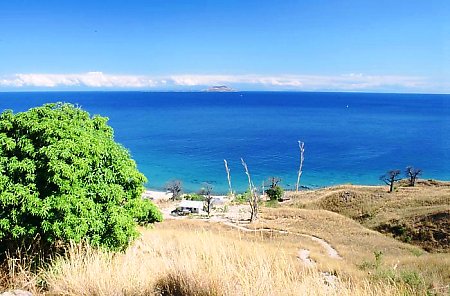
Likoma Island sits in the vast expanse of Lake Malawi, closer to Mozambique’s shores than to the Malawian mainland it belongs to. There are no bustling towns here, no well-trodden tourist paths. Life moves at the pace of the waves lapping against the shore, governed by the rhythm of the wind and the slow turning of the days. The island feels like a place where time has settled into its own quiet cadence, untouched by the rush of the outside world.
At the heart of Likoma, nestled among rolling hills and the vibrant blooms of bougainvillea, stands St. Peter’s Mission. It isn’t just a relic of the past—it’s a living part of the island, woven into the daily lives and memories of those who call this place home. The mission was established in the early 20th century by Anglican missionaries from the Universities’ Mission to Central Africa. They brought with them more than just faith; they introduced new ideas, education, and medical care to a community that had long lived by traditional beliefs and subsistence farming. The buildings they constructed—using local stone and timber—were the first permanent European-style structures on Likoma, built through the combined efforts of missionaries and islanders.
The architecture of St. Peter’s is unassuming, practical, and enduring. The centerpiece is a modest church, its high arched windows and sturdy wooden doors giving it a sense of quiet dignity. Inside, the whitewashed walls and simple wooden pews create an atmosphere of understated reverence. Sunlight filters through the colored glass of the stained windows, casting soft patterns across the floor. Nearby, the old schoolhouse, hospital, and living quarters for priests and teachers still stand, their weathered facades hinting at the passage of time. Walking through them feels like stepping into another era.
When the mission arrived, it brought change—some welcomed, some resisted. It was here that the first school on Likoma was opened, where children learned to read and write in English and Chichewa. The mission also established a hospital, treating illnesses like malaria that had once claimed countless lives. New crops and farming techniques were introduced, altering the way people lived and worked. Not everyone embraced these changes; some viewed the missionaries with suspicion, wary of outsiders disrupting their way of life. But over time, the mission became a fixture of the island, its influence shaping the community in ways that are still felt today.
St. Peter’s remains an active place of worship. On Sundays, the church fills with the voices of congregants singing hymns in Chichewa and English, the sound mingling with the distant murmur of the lake. Many of those who gather here are descendants of the mission’s first students, their connection to this place running deep. For them, the mission is more than just a building—it’s a thread linking past and present, a reminder of how their ancestors navigated the changes that came with the arrival of the outside world.
Life on Likoma moves at its own unhurried pace, and the mission is one of its quiet anchors. There are no crowds here, no souvenir shops or noisy cafes. The island offers something rarer: a sense of authenticity, a place where the past isn’t just remembered but still alive. Walking through the mission’s grounds, it’s easy to imagine the lives of those who came before—people who lived without electricity, without the constant hum of modern life, who found meaning in the simplicity of their surroundings.
Beyond the mission, the island unfolds in a patchwork of small villages. Homes are built from clay and thatch, their walls blending into the earthy tones of the landscape. Children play in the dusty paths, chickens scratch in the yards, and the scent of woodsmoke lingers in the air. The people of Likoma are warm but unobtrusive, their hospitality offered without expectation. If you’re lucky, you might see women preparing *nsima*, the staple maize porridge, or fishermen mending their nets by the shore, readying themselves for the next day’s catch.
Likoma is a world apart, a place where time doesn’t so much stand still as move to its own gentle rhythm. St. Peter’s Mission doesn’t demand attention—it doesn’t need to. Its significance lies in the quiet strength of its presence, in the way it has become part of the island’s fabric. The history here isn’t confined to books or plaques; it lives in the stones of the buildings, in the trees that have grown tall over the decades, in the stories passed down through generations. For those who seek more than just scenery—who want to step into a place where the past feels tangible and the present moves at a human pace—Likoma and its mission offer something rare: a glimpse into a way of life that endures.