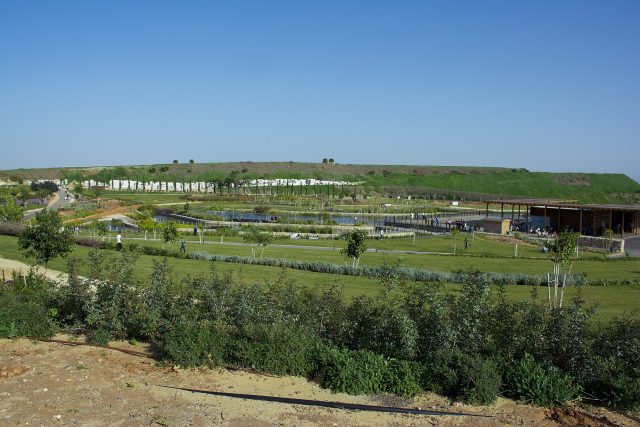
Even Yehuda’s memorial to fallen soldiers sits quietly on a low hill, set apart from the town’s daily rhythm by a ring of olive and cypress trees. There are no grand monuments here, no sweeping arches or towering sculptures. Instead, the space feels intimate, almost domestic—a place where loss is acknowledged without fanfare. The names of those who died in Israel’s wars are carved into a pale stone stele, surrounded by low granite slabs that bear additional inscriptions. The design is spare, almost austere, but the simplicity only deepens the sense of reverence.
The memorial was never meant to be a tourist attraction. It exists for the families of Even Yehuda, a small agricultural town founded in the mid-20th century, where many residents served in the military and some never returned. Over the decades, the names on the stone multiplied, each one representing a life cut short and a family left behind. The memorial’s understated presence reflects the town itself—modest, unassuming, but carrying a weight that isn’t always visible from the outside.
Unlike the larger, more ceremonial war memorials elsewhere in Israel, this one doesn’t draw crowds. There are no speeches by officials, no guided tours, no plaques explaining its significance to outsiders. On Memorial Day, when the country pauses to honor its fallen soldiers and victims of terrorism, local families gather here to light candles and lay flowers. But even on ordinary days, you might find someone sitting on one of the benches, lost in thought or simply taking a moment away from the rush of life.
The trees around the memorial—olive and cypress—are deliberate choices. In Israel, these species carry symbolic meaning: the olive for endurance, the cypress for mourning. Their presence softens the hard lines of the stone, adding a living element to the remembrance. The wind moves through their branches, and in the quiet, the sound feels like a whisper, as if the place itself is holding its breath.
Even Yehuda was built by people who worked the land, who understood the value of persistence and the cost of sacrifice. The memorial doesn’t romanticize war or glorify conflict. Instead, it acknowledges the quiet, personal toll—sons, daughters, neighbors, friends—who left and never came back. There’s no attempt to make their stories grand or heroic; the names on the stone are enough.
The atmosphere here isn’t one of overwhelming sorrow. There’s a gentleness to the place, a sense of time slowing down. On clear days, sunlight falls across the stone in shifting patterns, and the air carries the faint scent of earth and pine. The occasional sound of a car on the distant road or a bird calling from the trees doesn’t disrupt the stillness—it only makes it feel more real, more human.
For visitors, the memorial offers a different kind of experience than the more famous sites in Israel. There’s no script to follow, no prescribed way to feel. You can sit on a bench, read the names, or simply look at the trees and the sky. It’s a place that doesn’t demand anything from you, except perhaps a moment of reflection.
In a country where history is often written in bold, dramatic strokes, Even Yehuda’s memorial stands as a reminder that some of the most meaningful stories are the quiet ones. It doesn’t try to tell you what to think or how to remember. It simply exists, as a marker of loss, a testament to resilience, and a small but enduring part of the town’s life.