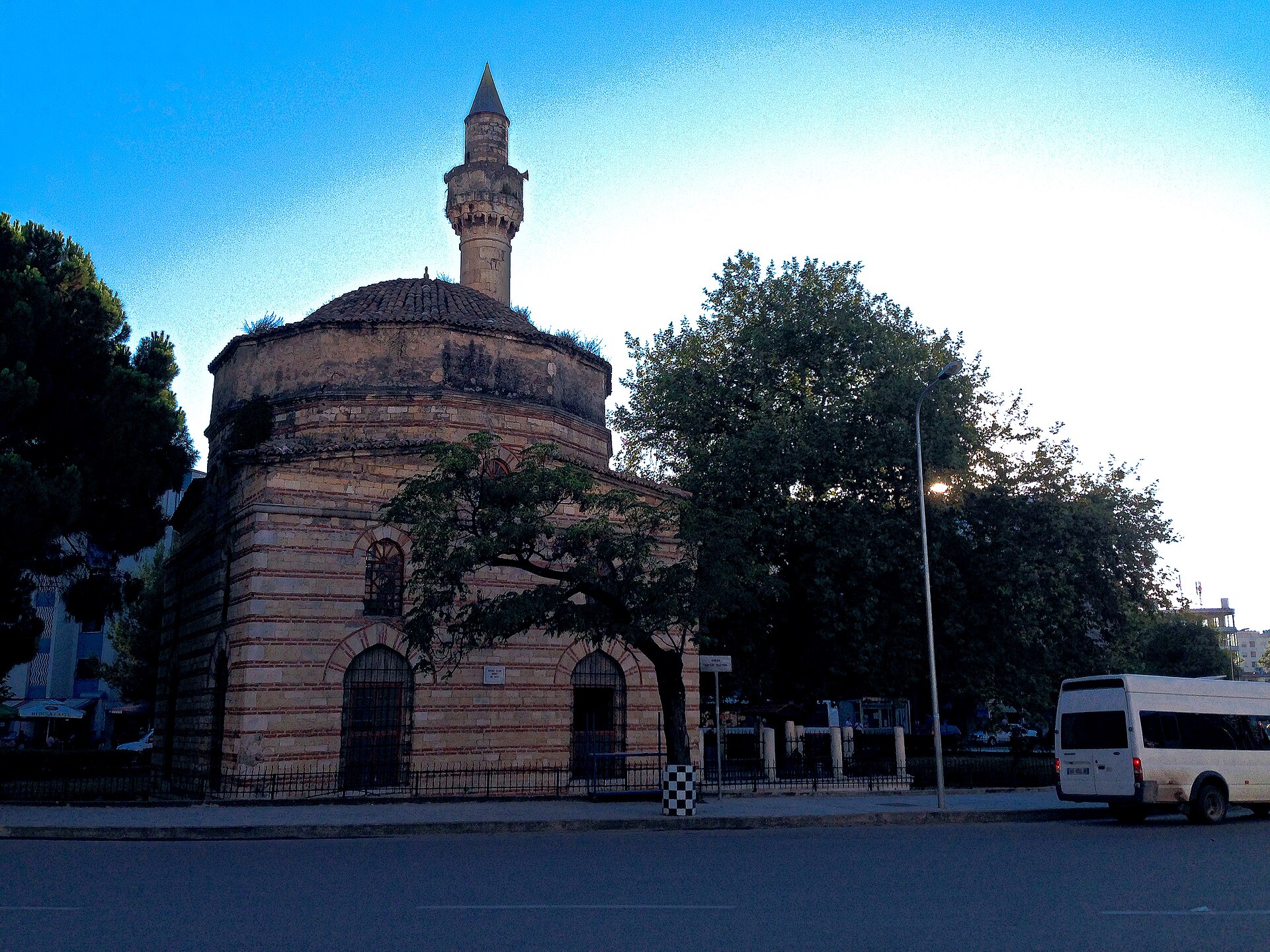
Vlorë’s Muradie Mosque is one of those quiet places that carry the weight of history without needing to say a word. Built in the mid-16th century, when Albania was part of the Ottoman Empire and Vlorë thrived as a bustling Adriatic port, the mosque stands as a remnant of an era shaped by trade, seafaring, and cultural exchange. Back then, the city was a crossroads where merchants, sailors, and travelers from different corners of the Mediterranean met, and the mosque became more than just a place of worship—it was a symbol of that diversity. Even now, its slender minaret rises above the old quarter, a familiar landmark for anyone wandering the narrow streets where time seems to move at its own unhurried pace.
The architecture of Muradie is classic Ottoman, though it bears the subtle marks of local craftsmanship. The building is constructed from stone quarried nearby, its surface warmed by the sun into a soft golden hue. Inside, the space is simple and unadorned—whitewashed walls, wooden beams overhead, and carpets laid out for prayer. The main hall is lit by tall arched windows, and the light shifts with the time of day: gentle and diffuse in the morning, rich and almost tangible by evening. The minaret, tapering slightly as it rises, is decorated with basic geometric patterns, not for show but as a nod to tradition. There’s no grandeur here, just a quiet respect for the way things have always been done.
Vlorë has long been a city where different cultures intersected, and Muradie Mosque is a living testament to that. During Ottoman rule, it wasn’t just a religious site but a hub of community life. Disputes were settled in its courtyard, deals were struck, and news was shared. When the empire fell and Albania came under communist rule, the mosque, like many religious buildings across the country, was shut down. For decades, it stood abandoned, until the early 1990s when it was returned to the faithful. Today, it’s open again, welcoming those who want to glimpse the past or simply find a moment of stillness in the middle of the city.
The area around the mosque is just as intriguing as the building itself. Vlorë has always had a maritime soul, and that’s evident even away from the waterfront. The old quarter’s winding streets lead past houses with carved wooden balconies, where fishing nets once hung and now laundry dries in the breeze. In the shade of the mosque, elderly men often gather to play backgammon or watch the world go by. In summer, the heat can be intense, and the shadow cast by the minaret offers a rare respite. In winter, when cold winds blow in from the sea, the mosque feels like a warm refuge—not just because of the prayers inside, but because it’s a place where people come to talk, to connect, to feel less alone.
Muradie isn’t like the grand mosques of Istanbul or Cairo, and that’s part of its charm. It doesn’t aim to impress with size or opulence; it simply exists, woven into the fabric of everyday life. For visitors, it might seem like a modest attraction, but for locals, it remains a vital part of the city’s identity. Religious holidays are celebrated here, weddings are held in its courtyard, and families gather for memorials. In that sense, Muradie is more than just a building—it’s a living space that evolves alongside the city.
Vlorë has never been a tourist hotspot, and perhaps that’s why its atmosphere feels so different from other Albanian cities. There are no crowds rushing for photos, no overzealous vendors tailoring their services to visitors. Muradie Mosque is part of this unhurried rhythm. In the mornings, worshippers arrive for prayer; during the day, schoolchildren pass by on their way home; in the evenings, friends meet in its courtyard. Sometimes, the sound of the Quran being recited drifts through the air; other times, it’s the laughter of children playing outside. All of it contributes to a sense of authenticity that’s often lost in places turned into polished tourist attractions.
If you ever find yourself in Vlorë, don’t head straight for the sea. Take a walk through the old town first, turn down one of the side streets, and pause by the mosque. With luck, you might hear the call to prayer, the voice of the muezzin amplified by speakers, echoing over the rooftops. Or you could just sit on a bench in the courtyard, watching as the sun sets behind the minaret, painting it in shades of pink and orange. In moments like these, it’s easy to understand why this place means so much to the people of Vlorë. It doesn’t just preserve the past—it lets you feel it, right here in the present.