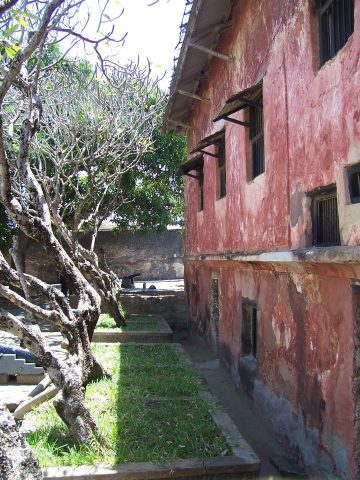
Mandhry Mosque is one of those quiet corners of Mombasa where the weight of history lingers in the air, settling into the coral walls like salt from the nearby ocean. Perched along the edge of the Old Town, its minaret has long served as a landmark for sailors returning to port, a steady presence against the shifting tides. More than just a place of worship, the mosque is a living record of the centuries-old connections between Kenya and the wider Indian Ocean world—Arab traders, Indian merchants, and Persian settlers who shaped the city’s identity through commerce, faith, and architecture.
No one knows exactly when Mandhry Mosque was built, though historians agree it dates back at least to the 16th century. By then, Mombasa was already a key node in the Swahili Coast’s network of trading cities, where goods, ideas, and people flowed between Africa, the Middle East, and Asia. The mosque’s construction reflects this era: its walls are made of coral stone, quarried from the ocean floor, while the roof is covered in traditional terracotta tiles likely imported from Oman or Yemen. Inside, the wooden beams are carved with intricate patterns, a testament to the skill of craftsmen who worked here generations ago. The building’s very materials tell a story of trade and adaptation, of a city that thrived on exchange.
The architecture of Mandhry Mosque blends Swahili traditions with Islamic influences, though it has its own distinct character. Unlike the soaring minarets of Middle Eastern mosques, its tower is squat and square, with a small balcony where the muezzin once called the faithful to prayer. The entrance is framed by a simple arched portal, a hallmark of Islamic design, but the decorative details—geometric carvings and latticework—bear the unmistakable imprint of local craftsmanship. The inner courtyard, surrounded by colonnaded walkways, offers shade from the tropical sun, creating a sense of seclusion. There’s no grand ornamentation here, just a quiet functionality that speaks to the practical needs of a community that has gathered in this space for centuries.
For much of its history, Mandhry Mosque was more than a religious site—it was a hub of daily life. The area around it buzzed with activity: merchants haggling over spices, textiles, and ceramics, while in the darker corners of the market, the grim trade in enslaved people unfolded, a painful chapter documented in old records. The mosque was where disputes were settled, deals were struck, and news was shared. Evenings brought gatherings under the trees, where stories and gossip passed between neighbors. Over time, the mosque’s role as a social and commercial center faded, but it remains a spiritual anchor for Mombasa’s Muslim community.
Today, the mosque is open to visitors, though it doesn’t cater to tourists in the usual sense. There are no guided tours, no explanatory plaques, no souvenir stalls—just the building itself, standing as it has for hundreds of years. Those who step inside do so for the silence, the sense of stepping back in time, or the chance to glimpse Mombasa as it was when the city was part of a vast maritime empire. The interior stays cool even in the midday heat, with light filtering through narrow windows to cast shifting patterns on the walls. In one corner of the courtyard, an old well still stands, once used for ablutions, while nearby, a small garden of palms and flowering shrubs offers a place to sit and listen to the distant murmur of the ocean.
For locals, Mandhry Mosque is more than an old building—it’s a connection to heritage and tradition. On Fridays, worshippers fill the courtyard for communal prayers, and during religious festivals, the mosque is adorned with strings of lights. On ordinary days, it stands quietly, as if guarding its secrets. Visitors who wander in from the bustling streets of the Old Town often remark on the contrast: no crowds, no vendors, just the rustle of leaves and the sound of waves breaking against the shore.
Mandhry Mosque isn’t the kind of monument that dazzles with size or opulence. Its charm lies in its simplicity, in the way it refuses to perform for tourists. There are no flashy renovations, no attempts to modernize—just the raw, unpolished beauty of a place that has endured. The coral walls, the worn wooden beams, the cool stone underfoot all tell a story without words, one of resilience and continuity.
If you find yourself in Mombasa, it’s worth stopping by, even for a few minutes. Walk through the courtyard, run your fingers along the coral walls, listen to the echo of your footsteps under the vaulted ceilings. You might not leave with all the answers, but you’ll carry away something less tangible: a sense of the past that shaped this city, and the quiet dignity of a place that has witnessed it all.