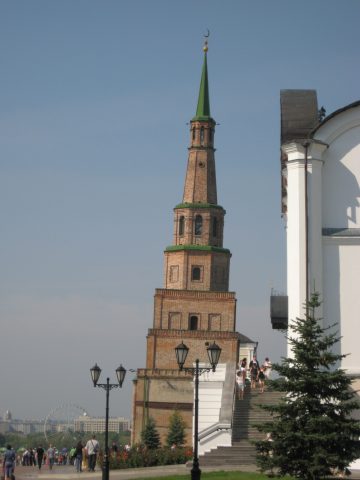
Kazan’s skyline is shaped by the Kul Sharif Mosque, a symbol of modern Tatarstan within the Kazan Kremlin. Here, the main mosque of the Kazan Khanate once stood before Ivan the Terrible’s conquest in the sixteenth century. The building you see today, completed in 2005, serves as both a place of worship and a cultural landmark.
The mosque’s design blends Tatar motifs with modern architecture. Four minarets, each nearly sixty meters tall, surround the central dome—a tulip shape common in Tatar art. Inside, the prayer hall is spacious, with marble and granite columns. Stained-glass windows let in shifting light, while wood and stone carvings add texture without clutter. The details matter, but they don’t distract.
The mosque is named after Kul Sharif, the last imam of the Kazan Khanate, who died defending the city. His story is part of Tatar history, and the building reflects that legacy. Inside, a museum traces Islamic culture in Volga Bulgaria. Exhibits include ancient manuscripts, coins, and everyday objects that show how faith, trade, and identity have evolved over centuries.
Kul Sharif Mosque is also a place for conversation. It hosts conferences, exhibitions, and events on Islamic heritage and interfaith relations. Visitors can explore the courtyard, look out over the Kremlin, or sit quietly. The space is open to everyone, whether you’re there for prayer or curiosity.
The mosque changes with the seasons. In winter, its white stone contrasts with snow-covered minarets. At night, lighting gives the structure a warm glow, reflected in the Kazanka River. Summer brings greenery, and from the observation deck, you can see the Kremlin, the river, and the old city. It feels like a place outside of time.
For many in Tatarstan, the mosque represents cultural revival. After the Soviet era, the republic sought to reclaim its heritage, and Kul Sharif became a key part of that effort. Today, it hosts national celebrations, music, and poetry readings. The space feels both grand and personal, where history is not just remembered but experienced.
Visiting is simple. Entry is free, but modest dress is requested—women cover their heads, and men avoid shorts and sleeveless shirts. Photography is allowed without flash. Guided tours, if available, explain the building’s symbolism and its role in Kazan’s life. Even if you’re not religious, the mosque offers a way to see how traditions coexist in modern Russia.
Kazan is where East meets West, and Kul Sharif Mosque shows that blend. It’s not like the ornate mosques of the Middle East or a purely European structure. It stands on its own, a place where history is reinterpreted. The mosque isn’t just a monument; it’s part of the city’s living culture.