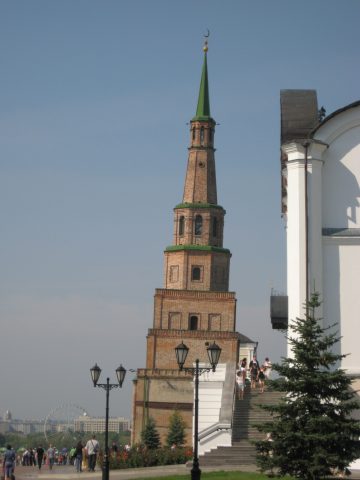
Kazan Kremlin is more than just a historic fortress—it’s the living heart of the city, where layers of time and culture intertwine. Perched on a hill where the Volga and Kazanka rivers meet, its walls have witnessed centuries of change, from the medieval capital of the Kazan Khanate to the modern symbol of Tatarstan. Every stone here carries a story, and every corner holds a piece of the past, waiting to be discovered.
The first fortifications on this site date back to the 10th century, when Kazan was a small settlement at the crossroads of trade routes. But it was in the 15th and 16th centuries, when the Kremlin became the seat of the Kazan khans, that it gained its true significance. Stone walls and towers rose during this time, some of which still stand today. After Ivan the Terrible’s conquest of Kazan in 1552, the Kremlin was rebuilt in the Russian fortress tradition, though traces of Tatar architecture remained, creating a unique blend of styles.
The centerpiece of the Kremlin is the Annunciation Cathedral, built in the 16th century by masters from Pskov. One of the oldest Orthodox churches in the Volga region, its white-stone walls, narrow windows, and tiered bell tower draw the eye immediately. Inside, 17th-century frescoes survive, and the iconostasis is a masterpiece of intricate craftsmanship. Nearby stands the Söyembikä Tower, Kazan’s most famous landmark. Legend claims it was built in memory of the last Tatar queen, who leapt from its heights rather than surrender to Russian forces. In reality, the tower was constructed later, in the 18th century, but the story has given it an air of mystery that lingers to this day.
Another defining feature of the Kremlin is the Kul Sharif Mosque, opened in 2005 on the site of a 16th-century mosque destroyed during Ivan the Terrible’s campaign. One of the largest mosques in Europe, its gleaming white minarets and domes dominate the skyline. Inside, the space is breathtaking—stained glass, intricate mosaics, and carved marble create an atmosphere of quiet grandeur. More than just a place of worship, the mosque has become a symbol of Tatar cultural revival, bridging the past and present.
Walking through the Kremlin is like stepping through history. Ancient walls stand alongside cobblestone paths, and the remains of the old cannon foundry, where artillery was once cast, hint at the fortress’s military past. The Museum of Islamic Culture offers deeper insight into the region’s heritage, while summer festivals and evening illuminations bring the site to life in a different way. When the sun sets, the Kremlin’s walls glow, turning the complex into something almost magical.
Yet the Kazan Kremlin is far from a static monument. Archaeological digs continue to uncover new layers of history, and restoration work ensures that its buildings remain true to their original forms. New exhibitions open regularly, and the site remains a place where locals and visitors alike can wander, soak in the views of the Volga, or stop for tea and traditional Tatar pastries in one of the small cafés.
What makes the Kremlin truly special is its setting. From the top of its walls, the city unfolds in all directions—historic streets lined with merchant houses, modern districts stretching toward the horizon, and the wide curve of the Volga in the distance. As evening falls and the lights come on, Kazan takes on a dreamlike quality, with the Kremlin at its center. It’s easy to lose yourself in the moment, imagining the merchants, warriors, and artisans who once walked these same paths, shaping the story of a city that still thrives today.