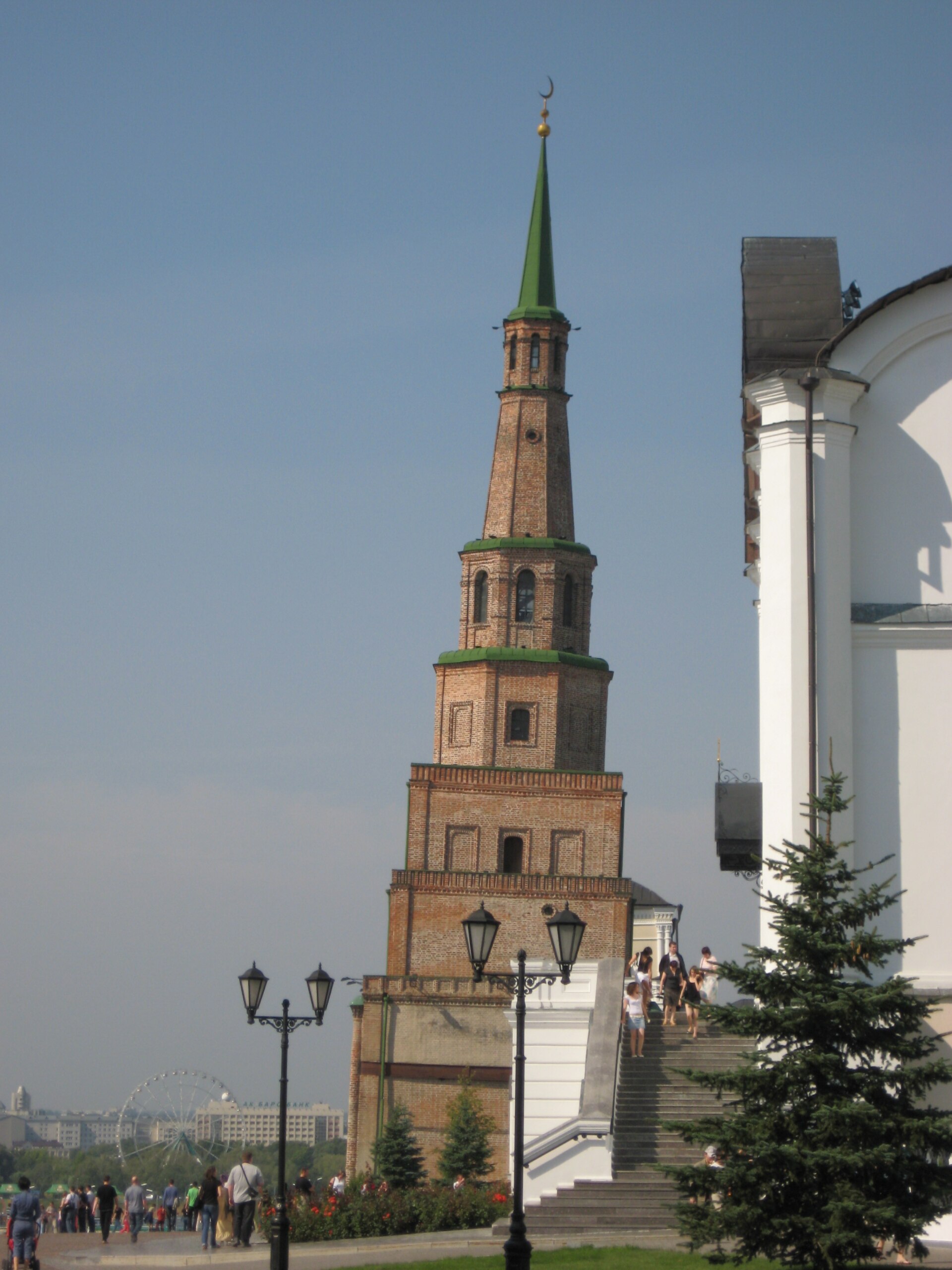
Standing within the walls of Kazan’s kremlin, the Söyembikä Tower is one of those rare landmarks that seem to hold the weight of a city’s past in their very stones. Its seven-tiered silhouette rises above the rooftops, slender and slightly tilted, as if leaning in to share a secret with anyone who pauses to look. The tower’s origins are as elusive as the stories told about it. Historians debate whether it dates back to the 16th century, built in the aftermath of Ivan the Terrible’s conquest of Kazan, or if it emerged later, when the city had already become part of the Russian state. What is certain is that it has long been a silent witness to Kazan’s transformations, a structure where Russian and Tatar influences intertwine in ways that feel almost deliberate.
The architecture of the tower reflects this layered history. The lower levels are solid and imposing, built from heavy stone in a style that echoes Russian fortress design. As the tower ascends, the structure becomes lighter, with decorative elements that hint at Tatar traditions—particularly the final tier, crowned with a pointed roof reminiscent of a minaret. The slight lean, visible even from a distance, adds a sense of movement to the otherwise rigid lines, though it also raises questions about the tower’s stability. Restorations over the years have ensured it remains safe for visitors, but the tilt remains, a quiet reminder of the passage of time.
No discussion of the Söyembikä Tower is complete without the legends that cling to it like ivy. The most famous involves the last ruler of the Kazan Khanate, Queen Söyembikä. According to the tale, Ivan the Terrible, captivated by her beauty, proposed marriage, but she set an impossible condition: he must build a tower in seven days. When the tower was completed, she climbed to the top and leapt to her death rather than submit to the Russian tsar. The story is compelling, but historians agree it’s more fable than fact—the tower likely postdates the fall of the khanate. Still, the legend endures, woven into the fabric of Kazan’s identity, a testament to how myth and history can blur in the public imagination.
Today, the tower serves as a functioning viewpoint, offering one of the best panoramas of the city. A narrow spiral staircase leads to the top, where visitors are rewarded with sweeping views of the kremlin’s white walls, the winding Kazan River, and the modern districts stretching beyond the historic center. The perspective shifts with the time of day—soft morning light casting long shadows, the golden hues of sunset reflecting off the river, or the quiet stillness of a winter afternoon when snow dusts the rooftops. It’s a place where the past and present coexist, where the city’s skyline tells its own story without words.
The tower is just one part of the Kazan Kremlin, a UNESCO World Heritage site that itself feels like an open-air museum of architectural styles. Within its walls, mosques stand alongside Orthodox churches, Soviet-era buildings share space with medieval fortifications, and each structure seems to carry the imprint of a different era. The Söyembikä Tower, rising above them all, acts as a kind of anchor, its presence a reminder of Kazan’s role as a crossroads of cultures. The tilt of its silhouette has become a symbol not just of the city, but of Tatarstan itself—a visual metaphor for a region shaped by diverse influences.
Visiting the tower is a quiet experience, far removed from the crowds that gather at more famous landmarks. Inside, the worn stone steps and narrow passages evoke a sense of stepping back in time. There are no elaborate exhibits or interactive displays, just the raw, unfiltered history of the place. This simplicity allows visitors to engage with the tower on a personal level, to imagine the hands that laid its stones or the voices that once echoed within its walls. It’s the kind of place where you might linger, not because you’re supposed to, but because something about it feels worth your time.
The tower’s appearance changes with the seasons, each bringing its own mood. In winter, the stark white of the snow against the tower’s stone makes it seem almost austere, a silent sentinel over a sleeping city. Spring and summer soften its edges, with greenery creeping up the kremlin walls and the river below glinting in the sunlight. Autumn, with its overcast skies and falling leaves, lends the tower an air of melancholy, as if it’s reflecting on the centuries it has witnessed. No matter the time of year, there’s a sense that the tower is more than just a structure—it’s a living part of Kazan’s rhythm.
For locals, the Söyembikä Tower is a point of pride, a tangible link to the city’s history. It appears in poems, songs, and art, its image reproduced on everything from postcards to the coat of arms of Tatarstan. To outsiders, it’s often the first introduction to Kazan’s unique character, a place where legends feel as real as the stones beneath their feet. The tower doesn’t just stand in the city; it seems to hold the city’s stories within it, waiting for someone to listen.
What makes the tower truly compelling is the way it resists easy interpretation. It doesn’t offer neat answers or grand narratives. Instead, it invites curiosity, leaving room for visitors to fill in the gaps with their own imaginations. You might stand at the top, looking out over Kazan, and wonder how many others have done the same over the centuries. How many secrets has this tower kept? How many lives has it touched? It’s this sense of mystery, more than anything else, that makes the Söyembikä Tower endure—not just as a monument, but as a living piece of Kazan’s soul.