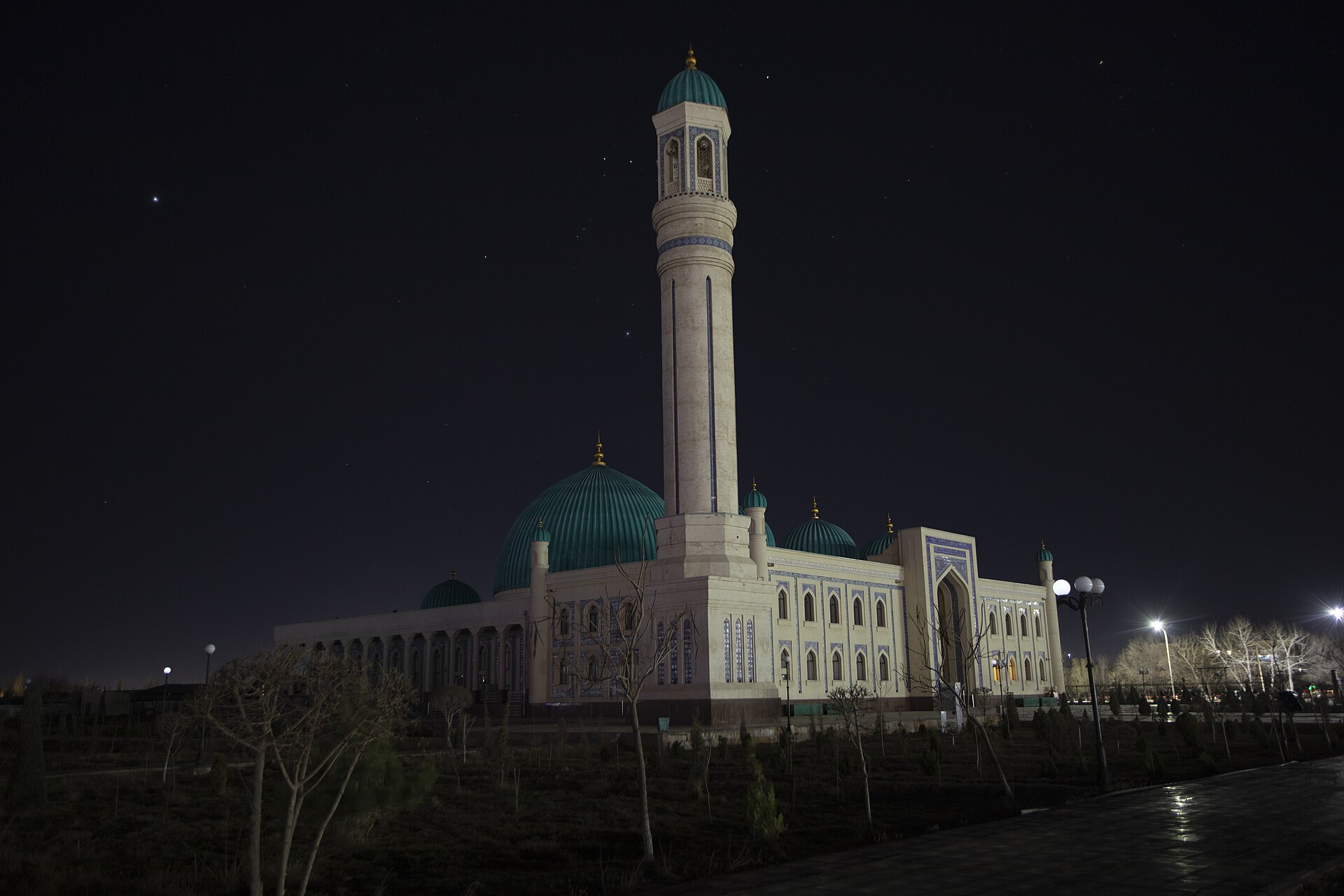
Nukus is a city that exists slightly apart from the well-trodden paths of Uzbekistan, a place where the vastness of the Kyzylkum Desert meets the quiet resilience of the Karakalpak people. Here, on the edge of Central Asia, the Imam al-Bukhari Mosque stands as a quiet testament to both faith and history. Named after Muhammad al-Bukhari, the 9th-century scholar whose collection of hadiths remains one of the most revered texts in Sunni Islam after the Quran, the mosque carries the weight of a legacy that stretches far beyond its walls. Al-Bukhari himself was born in Bukhara, but his influence has long since transcended geography, finding a home in this remote corner of the world where knowledge and tradition are held in deep regard.
The mosque’s architecture reflects a careful balance between the past and the present. Its design draws from classical Central Asian styles—tall minarets reaching toward the sky, a grand dome that dominates the skyline, and a spacious courtyard with a fountain at its center—but it avoids the ornate excess often associated with religious buildings. Inside, the space is calm and uncluttered, with geometric patterns and Quranic calligraphy adorning the walls. The light filters through stained-glass windows, casting soft hues that shift with the time of day. There’s no ostentatious display of wealth here, just a sense of quiet dignity, as if the building itself is designed to encourage reflection rather than awe.
Built in the early 2000s, the mosque has quickly become more than just a place of worship. It serves as a hub for the community, hosting not only daily prayers but also lectures, educational programs, and gatherings for both children and adults. During religious holidays like Ramadan and Eid al-Adha, the mosque comes alive with activity. Families from across the city and surrounding areas gather here, filling the courtyard with the sounds of conversation and the scent of traditional dishes. For many, these moments are as much about connection as they are about faith—a chance to reconnect with neighbors, share stories, and reinforce the bonds that tie the community together.
For the people of Nukus, the mosque is woven into the fabric of everyday life. Some come to pray, others to find a moment of peace in the middle of a busy day. The courtyard, shaded by trees and lined with benches, often becomes a meeting place where friends catch up or strangers strike up conversations. There’s a sense of informality here, a feeling that the mosque is not just for the devout but for anyone who seeks a quiet corner of the city. The rules are simple: respect the space and those who use it. That openness makes it feel welcoming, even to those who might not consider themselves religious.
Nukus itself is a city that defies easy categorization. Far from the bustling bazaars of Samarkand or the ancient mosques of Bukhara, it exists in a landscape shaped by the harsh realities of the Aral Sea crisis. The region is often associated with environmental challenges, but there’s a quiet strength here, a sense of endurance that defines the people who call it home. In this context, the Imam al-Bukhari Mosque takes on a deeper meaning. It’s not just a religious site but a symbol of resilience, a place where faith and tradition provide a sense of continuity in a world that is constantly changing.
Visiting the mosque offers a different perspective on Nukus, one that goes beyond the usual tourist attractions. There are no crowds here, no hurried guides rushing visitors from one landmark to the next. Instead, there’s a slow, unhurried rhythm to life, where the past and present coexist without fanfare. The courtyard, with its old trees and worn stone paths, feels like a place where time moves differently. If you’re lucky, you might hear the call to prayer echoing across the city, a reminder that some traditions endure, even in a place that has seen so much change.
The mosque also plays a role in preserving the intellectual heritage of the region. Its library houses a collection of Islamic texts, from medieval scholarly works to contemporary interpretations of religious thought. For students and researchers, it’s a valuable resource, a place where ancient wisdom is studied alongside modern questions. Regular discussions and lectures explore how tradition can adapt to the challenges of the 21st century, making the mosque not just a place of worship but a living institution that evolves with the community it serves.
Around the mosque, a small ecosystem of local life has taken shape. Nearby teahouses serve steaming cups of green tea with fresh bread, while vendors sell religious books and handmade crafts. Locals often strike up conversations with visitors, sharing stories about the city’s history and the role the mosque plays in their lives. For travelers, these interactions offer a glimpse into Nukus that no guidebook can provide—a chance to see the city through the eyes of those who know it best.
At its core, the Imam al-Bukhari Mosque is about more than just architecture or religion. It’s about the people who walk through its doors every day, whether to pray, to learn, or simply to sit in silence. It’s about how faith and culture become part of the everyday, shaping lives in ways that are both subtle and profound. If you ever find yourself in Nukus, the mosque is worth a visit—not just for the beauty of its design, but for the quiet stories it holds within its walls. Here, in a city that often feels overlooked, you might just find a sense of connection that lingers long after you’ve left.