Plovdiv’s Dzhumaya Mosque stands as one of the oldest and most significant Ottoman-era landmarks in Bulgaria, a quiet witness to centuries of shifting rule and cultural exchange. Built in the late 14th century, shortly after the Ottoman conquest of the city, it was originally known as the Ulu Mosque, or "Great Mosque," reflecting its importance as the main place of worship for Plovdiv’s Muslim community. Over time, it became known as Dzhumaya, derived from the Turkish word for Friday, the day of communal prayer in Islam. The mosque’s enduring presence in the heart of the city speaks to its role not just as a religious site, but as a marker of Plovdiv’s layered history.
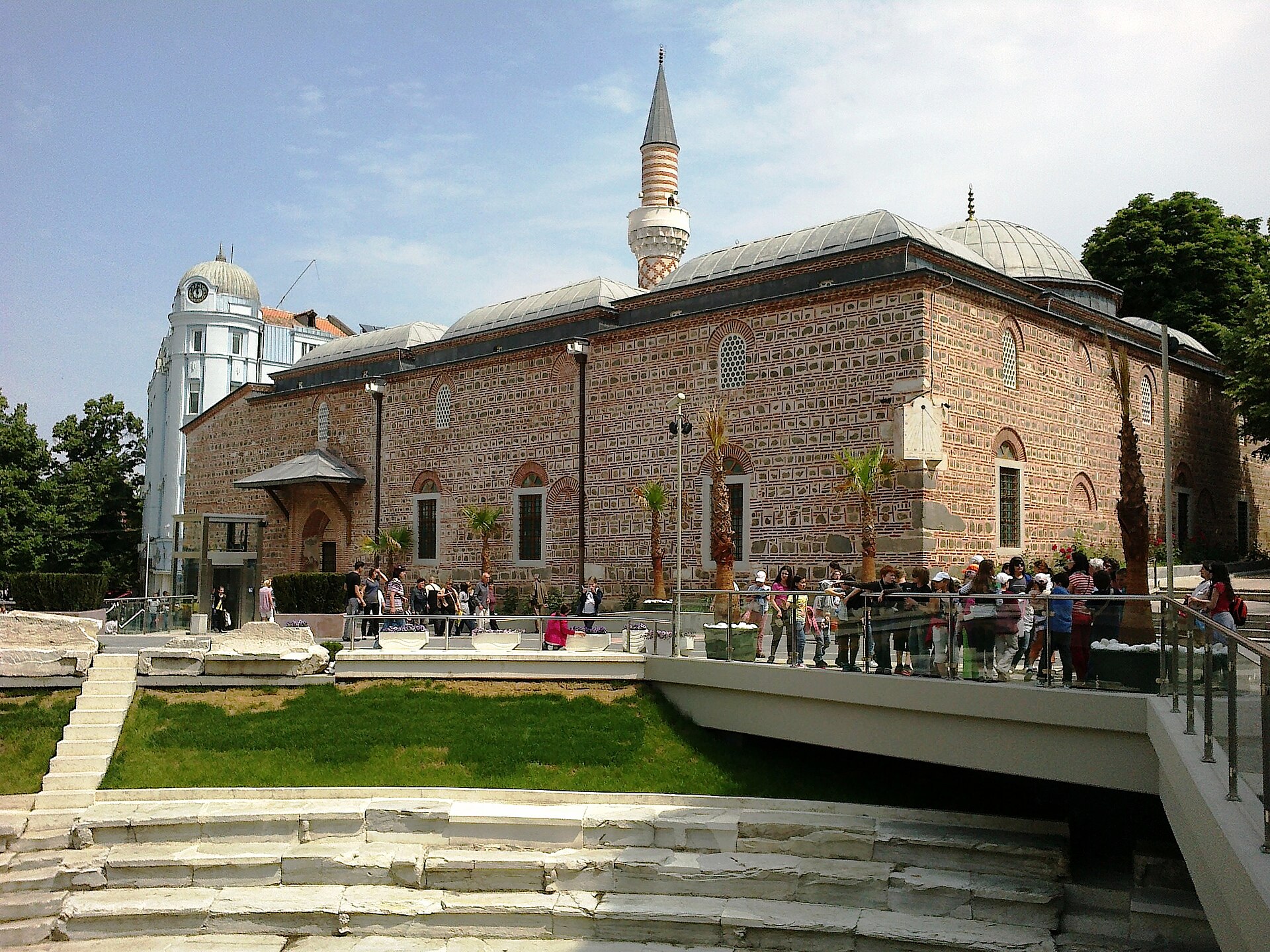
The architecture of Dzhumaya Mosque blends elements of early Ottoman design with local influences, creating a structure that feels both imposing and harmonious within its surroundings. Unlike the grand domed mosques of Istanbul or Edirne, this one is more modest in scale, with a rectangular prayer hall topped by a single large dome. The exterior is built from alternating layers of stone and brick, a technique common in Balkan Ottoman architecture, which gives the walls a striped, almost rhythmic appearance. The minaret, rising from the northwest corner, is slender and unadorned, its simplicity contrasting with the more elaborate designs found in later Ottoman mosques.
Inside, the mosque retains much of its original character, though time and renovations have softened some details. The prayer hall is spacious and airy, with high ceilings that draw the eye upward toward the dome. The mihrab, the niche indicating the direction of Mecca, is set into the southern wall, its once-vibrant colors now faded but still discernible. The wooden minbar, or pulpit, from which the imam delivers sermons, is a fine example of Ottoman craftsmanship, though its carvings have been worn smooth by generations of use. Natural light filters through arched windows, casting shifting patterns across the walls and floor, where worshippers once gathered on thick carpets, now replaced by more modern coverings.
The mosque’s location in Plovdiv’s Old Town places it at the crossroads of the city’s historical layers. Just steps away lies the Roman-era Ancient Theatre, a reminder of the region’s pre-Ottoman past, while the cobbled streets around it are lined with 19th-century Bulgarian Revival houses, their colorful facades and overhanging upper floors a stark contrast to the mosque’s austere stone. This proximity of eras and styles is one of Plovdiv’s defining features, and Dzhumaya Mosque sits comfortably within it, neither overshadowed nor overshadowing. It’s not uncommon to see visitors pausing outside the mosque, taking in the way its minaret rises above the rooftops, a quiet counterpoint to the nearby bell towers of Orthodox churches.
For much of its history, the mosque was more than just a place of worship. During the Ottoman period, it served as a center of community life, where people gathered not only for prayer but for education, social events, and even trade. The adjacent courtyard, now a small garden, was once a bustling space where merchants set up stalls and travelers rested. After Bulgaria regained independence in the late 19th century, the mosque’s role shifted. Many of Plovdiv’s Muslim residents left, and the building fell into disuse for a time. It was only in the 20th century that efforts were made to restore and preserve it, recognizing its value as a historical monument rather than just a religious site.
Today, Dzhumaya Mosque remains an active place of worship, though its congregation is smaller than in centuries past. The call to prayer still echoes through the Old Town five times a day, a sound that blends seamlessly with the clatter of footsteps on cobblestones and the occasional chime of a church bell. Non-Muslim visitors are welcome to enter outside of prayer times, provided they dress modestly and observe the usual courtesies. Inside, the atmosphere is one of quiet reverence, the kind that lingers in places where people have gathered for generations to reflect, pray, or simply find a moment of stillness.
What makes Dzhumaya Mosque particularly interesting is how it embodies the complexities of Bulgaria’s past. It’s easy to see it as a relic of Ottoman rule, a period often viewed through the lens of conflict and occupation in Bulgarian history. Yet the mosque also represents continuity—a building that has survived wars, regime changes, and the ebb and flow of populations. It has been cared for, repaired, and respected by successive generations, regardless of their faith or background. In this way, it’s as much a part of Plovdiv’s identity as the Roman ruins or the Revival-era houses, a reminder that history is rarely as simple as the narratives we impose on it.
For those exploring Plovdiv, the mosque offers a chance to step away from the more tourist-heavy sites and experience a different rhythm of the city. There’s no grand spectacle here, no museum-like displays or guided tours. Instead, it’s a place where history feels lived-in, where the past isn’t just preserved but still in use. Whether you’re drawn by its architecture, its religious significance, or simply the desire to understand Plovdiv’s many layers, Dzhumaya Mosque provides a quiet space to pause and consider the threads that connect the city’s present to its past.