Monastir is a city where history feels alive in the most unassuming ways, and the Bourguiba Mosque stands as one of its quiet yet enduring landmarks. Built in the 1960s, it was named after Habib Bourguiba, Tunisia’s first president and a figure deeply tied to the country’s modern identity. Unlike the ancient mosques that dot the Tunisian landscape, this one doesn’t boast centuries of layered history, but it carries its own significance—both as a place of worship and as a symbol of the nation’s post-independence era.
The mosque’s architecture is a blend of traditional Islamic design and mid-20th-century sensibilities. Its minaret rises cleanly against the sky, a slender tower that doesn’t dominate the skyline but rather complements it. The prayer hall is spacious, with high ceilings and a sense of openness that contrasts with the more enclosed, labyrinthine layouts of older mosques. The use of white stone gives the building a bright, almost luminous quality, especially under the Mediterranean sun. Inside, the mihrab—the niche indicating the direction of Mecca—is simple yet elegant, adorned with subtle geometric patterns that avoid the ornate excess of some historic mosques.
What makes the Bourguiba Mosque interesting is not just its design but its place in Tunisia’s recent history. Bourguiba, often called the "Supreme Combatant" for his role in the country’s struggle for independence, envisioned a modern Tunisia that balanced its Islamic heritage with secular progress. The mosque, completed in 1963, was part of that vision—a place where faith could coexist with the ideals of a new nation. It wasn’t meant to be a grand statement of power, like some of the region’s more imposing religious structures, but rather a functional and dignified space for the community.
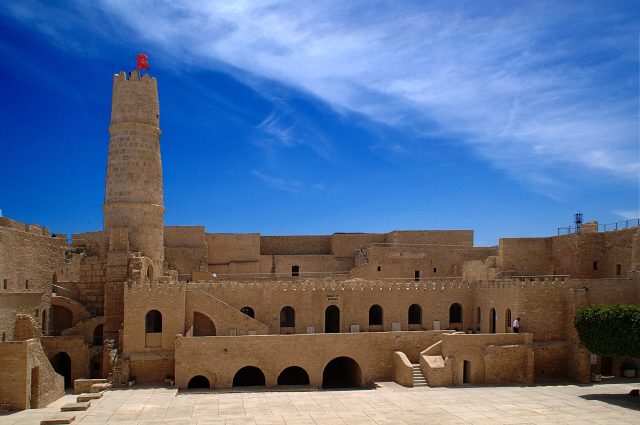
The mosque is located near the heart of Monastir, not far from the Ribat, the ancient fortress that has watched over the city for over a thousand years. This proximity to one of Tunisia’s most historic sites creates an interesting contrast. The Ribat, with its thick walls and narrow passages, speaks of a time when faith and defense were intertwined. The Bourguiba Mosque, by comparison, feels like a bridge between that past and the present—a place where the rhythms of daily life continue, unburdened by the weight of history.
Visitors to Monastir often find themselves drawn to the mosque not just for its religious significance but for its understated presence. It doesn’t demand attention like the more famous landmarks of Tunisia, such as the Great Mosque of Kairouan or the Zitouna Mosque in Tunis. Instead, it offers a moment of quiet reflection, a chance to step away from the bustle of the city and consider the role of faith in a country that has navigated so many changes. The courtyard, with its neatly arranged rows of trees and benches, is a peaceful spot where locals and visitors alike can sit and watch the world go by.
The mosque is also a reminder of how Tunisia has evolved in the decades since its construction. When it was built, the country was still finding its footing after gaining independence from France in 1956. Bourguiba’s policies, which included reforms like the Code of Personal Status that granted women unprecedented rights, were controversial at the time but helped shape modern Tunisia. The mosque, in its own way, reflects that era of transformation—a time when the country was redefining itself, not by rejecting its past, but by reinterpreting it.
For those who take the time to explore Monastir beyond its more tourist-oriented sites, the Bourguiba Mosque offers a glimpse into the everyday life of the city. It’s not a place that appears in many guidebooks, and there are no grand ceremonies or elaborate decorations to draw crowds. Instead, it’s a working mosque, a place where people come to pray, to gather, and to find a sense of community. The call to prayer echoes through the streets five times a day, a familiar sound that blends into the fabric of the city.
In a country where history is often measured in centuries, the Bourguiba Mosque is a relatively young addition to the landscape. Yet it has already become a part of Monastir’s identity, a quiet witness to the changes that have shaped Tunisia over the past half-century. Whether you’re interested in architecture, history, or simply the way people live their lives in this corner of the Mediterranean, the mosque offers a perspective that is both personal and profound. It’s a place where the past and present coexist, not in opposition, but in conversation.