Sheikh Shahabuddin’s mausoleum in Ahar is the kind of place that doesn’t reveal itself at first glance. Tucked away among the narrow lanes of the old town, it lacks the grandeur of Iran’s more famous tombs and palaces—no gilded domes, no marble colonnades. Instead, there’s something quieter, something that lingers long after you leave: a sense of time moving differently here, and the faint but enduring presence of a man whose name still carries weight in these parts.
Sheikh Shahabuddin Ahari was a 14th-century Sufi mystic and poet whose life and teachings left a lasting mark on the spiritual culture of Azerbaijan and northwestern Iran. In his time, Ahar was a key stop on the Silk Road, a crossroads for merchants, pilgrims, and wandering dervishes. The sheikh, known for his wisdom and asceticism, drew followers from near and far. After his death, his resting place became a site of reverence, not just for Sufis but for locals who still come to pay their respects. The mausoleum built over his grave is less a monument than a living connection to the past.
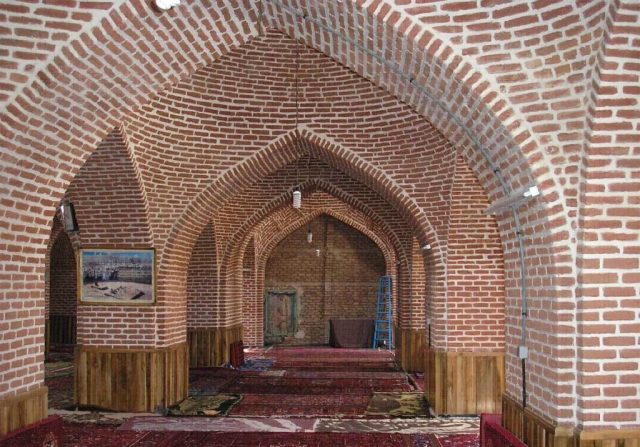
The architecture is simple, almost austere—a hallmark of many Sufi shrines. The main structure is a modest rectangular building of fired brick, its flat roof and small portal adorned with geometric patterns. Inside, the light is dim, filtering through narrow windows high in the walls. The main chamber is small, but its acoustics are striking: even a whisper seems to echo, as if the space itself is designed to preserve every sound. At the center lies the sheikh’s tomb, draped in dark green cloth embroidered with Quranic verses. Visitors often leave fresh flowers or leaves, a quiet offering to a man who lived centuries ago.
The mausoleum is woven into the fabric of Ahar, a city where cultures have long intertwined. Nestled in the mountainous region of East Azerbaijan, Ahar has always been a place of convergence—where Azerbaijani speech mixes with Persian, where wooden balconies in the Caucasian style overlook streets that still feel medieval. The mausoleum sits on the edge of the old town, where cobblestone lanes wind between sun-baked brick houses. Nearby, a small courtyard with a fountain offers shade on hot days, a gathering spot for locals. Just beyond lies an old cemetery, its gravestones inscribed with Arabic script, many marking the resting places of the sheikh’s descendants or disciples.
Visiting the mausoleum isn’t so much about sightseeing as it is about stepping into an atmosphere. There are no crowds here, no guided tours rushing through. More often than not, you’ll find only a handful of pilgrims or an elderly caretaker, who might share stories of the sheikh if you show interest. Time moves slowly in this place. You can sit on a bench in the courtyard, listening to the rustle of plane tree leaves and the murmur of the fountain, then step inside to stand by the tomb, trying to imagine the man who inspired such devotion.
This isn’t just a historical site; it’s a living testament to a spiritual tradition that has endured for centuries. Sufism, with its emphasis on inner refinement and divine love, has always been a vital part of Iranian culture. In Ahar, that tradition feels particularly alive. Even today, Sufi gatherings are held here, where poetry by Rumi and Hafez is recited, songs are sung to the accompaniment of the saz, and stories of saints are passed down. The mausoleum isn’t a museum—it’s a place where that practice continues, unbroken.
For travelers, the mausoleum can be an unexpected discovery. Ahar isn’t on the typical tourist trail; most visitors pass through on their way to Tabriz or Lake Urmia. But it’s in places like this, far from the usual routes, where you can glimpse the real soul of a country. Ahar is a city where history isn’t put on display—it’s embedded in the stones, in the conversations, in the quiet corners. Sheikh Shahabuddin’s mausoleum is one of those corners, a place where time seems to pause, offering a moment of connection to something timeless.
If you find yourself here, don’t rush. Sit in the courtyard, listen to the leaves, step inside, and simply be still. Maybe that’s why people come to places like this—not for spectacle, but for the quiet revelation that stays with you long after you’ve left.