Perched on the edge of Nakhchivan, where the windswept steppes meet the foothills, the mausoleum of Hüseyn Cavid feels like a natural extension of the landscape rather than a structure imposed upon it. There’s no grandiosity here, no bustling crowds or ornate memorials—just silence, space, and a building that seems to rise from the earth itself. It was built to honor a poet whose name became synonymous with 20th-century Azerbaijani literature, though his life was tragically entwined with the turbulent history of his country.
Hüseyn Cavid was born in Nakhchivan in the late 19th century, the son of a religious scholar. His education took him to Istanbul and Moscow, where he immersed himself in poetry, drama, and philosophical essays. More than just a writer, he became a cultural figure who shaped national identity through art, blending Eastern traditions with European modernism and a deep fascination with Azerbaijan’s past. Initially embraced by Soviet authorities, he later fell out of favor, labeled ideologically suspect. In 1937, he was arrested, and within years, he died in a Siberian exile. It wasn’t until after the Soviet Union’s collapse that his work was fully rehabilitated, returning to school curricula and theater stages, where it remains today.
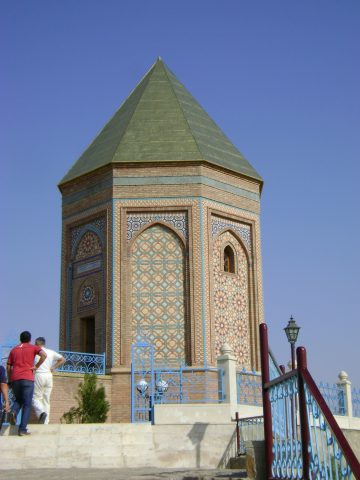
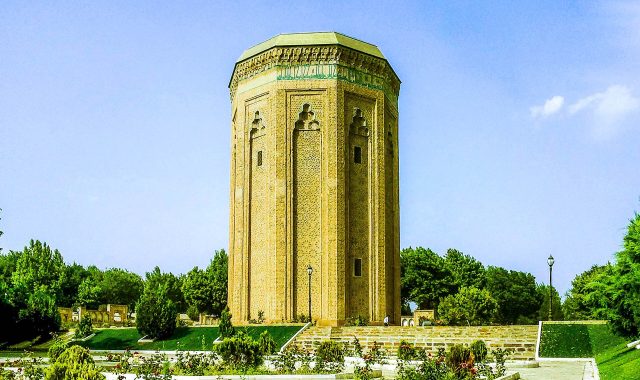
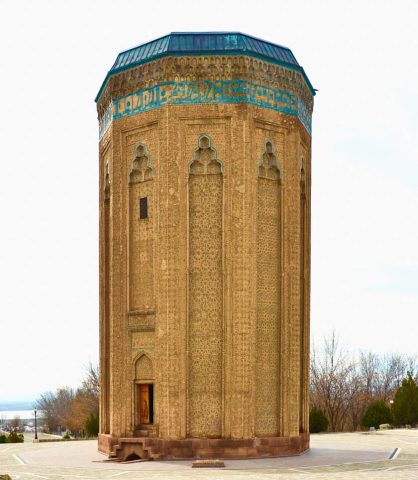
The mausoleum was completed in 1996, nearly six decades after Cavid’s death. Designed by architect Rasim Aliyev, known for his monumental style, the structure is strikingly restrained. A tall, octagonal tower of pale stone, crowned with a dome that seems to hover above the steppe, it avoids the usual pomp of memorial architecture. The entrance is modest, and inside, a spacious hall holds a marble sarcophagus beneath a bronze bas-relief of the poet’s face. There are no gilded decorations or elaborate murals—just light filtering through narrow windows and the quiet footsteps of visitors.
The location was chosen with care. The mausoleum stands on a hill, offering views of the Nakhchivanchay River valley and distant mountains. On clear days, the snow-capped peak of Mount Ararat is visible—a mountain that holds deep symbolic meaning for many Azerbaijanis, representing not just geography but historical memory. This connection to the land and its past gives the mausoleum a sense of timelessness, as if it bridges ancient Nakhchivan, the medieval caravan routes, the Soviet era, and the present day.
Around the mausoleum, a small park with winding paths and benches provides a place for reflection. Students often come to read Cavid’s poetry, while locals bring their children to learn about the poet’s life. In recent years, the site has become more than just a memorial; it’s a place where people come for the atmosphere itself—calm, contemplative, and free from the usual tourist hustle. Nakhchivan isn’t a city packed with conventional attractions, which makes the mausoleum all the more meaningful. It doesn’t demand attention or awe; it simply exists, a quiet reminder that culture isn’t just about museums and performances but about the living threads that connect generations.
Beyond its role as a memorial, the mausoleum has also become a cultural hub. Occasionally, it hosts poetry readings, art exhibitions, and literary gatherings. In the 2010s, the building underwent restoration to reinforce its foundation and restore its stone facade, though its original character was carefully preserved. Unlike many historical sites, it hasn’t been commercialized, and perhaps that’s why it retains its authenticity.
For visitors to Nakhchivan, the mausoleum can be an unexpected discovery. The city is often seen as a transit point on the way to Iran or Turkey, but it has its own understated beauty. The Cavid mausoleum is one of those places where that beauty becomes especially clear. It doesn’t ask anything of its visitors—no need to decipher symbolism, pore over historical details, or marvel at architectural feats. You only need to stand on the hill, look out over the valley below, and feel the way time moves differently here—slower, deeper, without hurry.