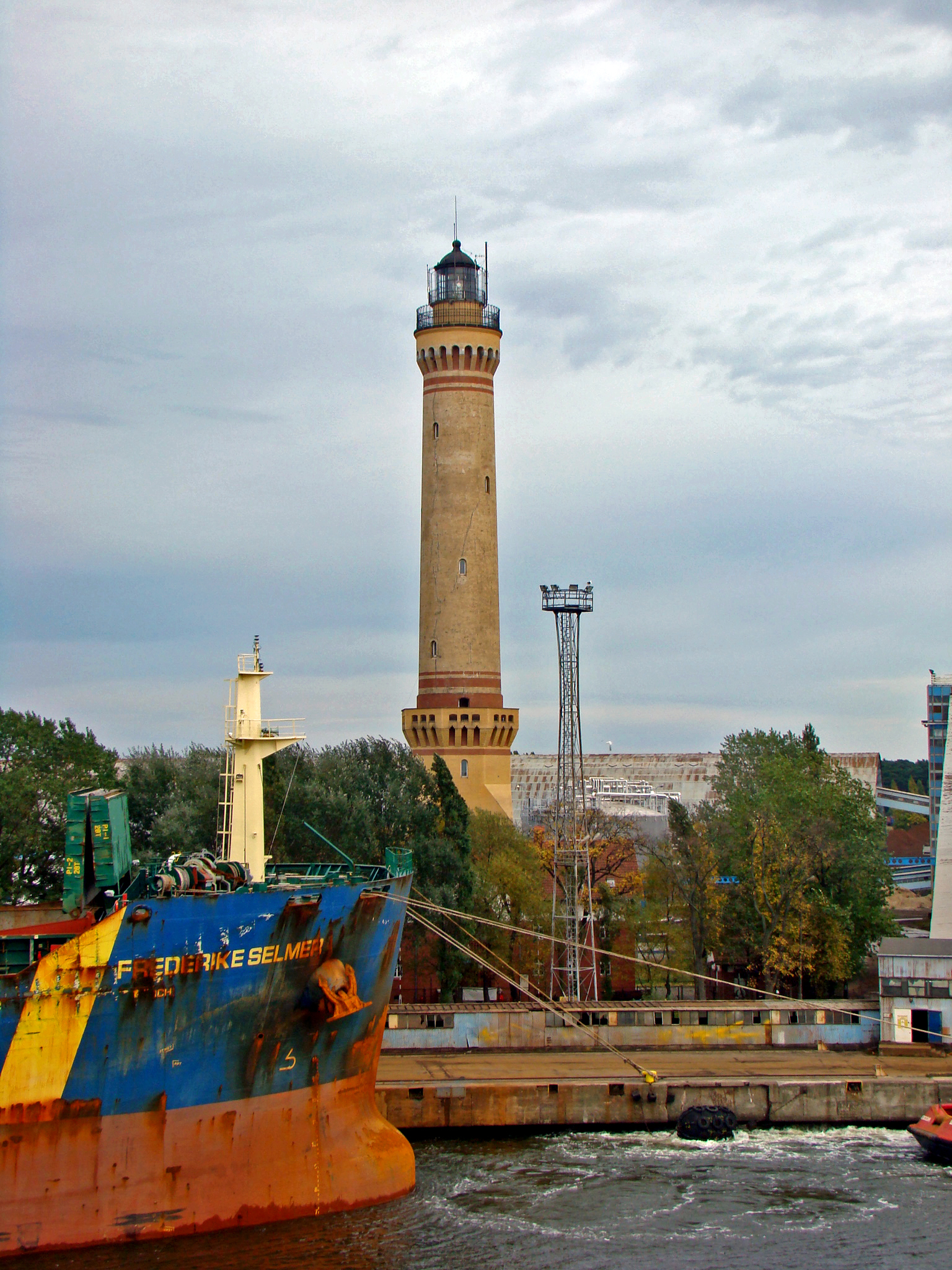
Perched on the western edge of Uznam Island, where the Baltic Sea meets the mouth of the Świna River, the lighthouse in Świnoujście has stood as a silent guardian for over a century and a half. Its white tower, capped with a bold red top, rises above the coastal dunes and sparse pine forests, a striking yet natural part of the landscape. Even those who don’t seek out lighthouses find themselves drawn to it—its presence is impossible to ignore, whether you’re strolling along the shore or watching the horizon from a passing ferry. It’s one of those places that feels both timeless and alive, a working monument to the sea’s enduring influence on this corner of Poland.
The story of the lighthouse begins in the mid-1800s, when this region was part of Prussia and the port of Świnoujście was rapidly growing in importance. The first beacon here, built in 1828, was too modest for the increasing maritime traffic, so in 1857, authorities commissioned a new structure—one that would be visible for miles and sturdy enough to withstand the Baltic’s storms. Designed by Karl Friedrich Schinkel, a name synonymous with Berlin’s architectural legacy, and overseen by local architect Friedrich August Stüler, the lighthouse was completed as one of the tallest in Europe at the time. At nearly 65 meters, it remains the tallest in Poland today, a testament to the engineering of its era.
The lighthouse’s design balances practicality with a certain understated elegance. Its brick core, clad in pale stone, gives it a solid, almost fortress-like appearance, while the narrow slit windows and spiral staircase inside evoke the feel of a medieval tower. Yet this was never meant to be a castle—its form was dictated by necessity, built to endure the salt spray and howling winds that sweep in from the sea. At the top, the original Fresnel lens once cast a beam visible for twenty nautical miles, guiding ships through fog and darkness. Technology has since moved on, and the lighthouse now operates automatically, but its purpose remains unchanged.
Climbing the lighthouse is an experience in itself. The staircase is narrow and steep, each step echoing in the hollow space of the tower. Those who make it to the top—all 200-plus steps—are rewarded with a view that stretches far beyond the city. From this height, Świnoujście unfolds in all directions: the bustling port with its cranes and ships, the long sandy beaches that seem to go on forever, and the green expanses of Uznam and Wolin islands. On clear days, you can even make out the distant outline of Usedom, the German island just across the border. The best time to visit is at sunset, when the sea turns gold and the first lights of the city begin to flicker below.
The lighthouse is deeply woven into the history of Świnoujście. In the 19th century, the city was a vital trading hub, a crossroads for goods moving between Germany, Russia, and Scandinavia. The beacon played a crucial role in keeping ships safe, especially during the long, foggy winters when the Baltic could turn treacherous. During World War II, the lighthouse, like much of the city, suffered damage from bombings, but it survived and was restored in the postwar years. Today, it’s more than just a navigational aid—it’s a reminder of an era when the sea was the only highway for trade and travel, and when the light from a tower like this could mean the difference between safe harbor and disaster.
There’s a quiet rhythm to life around the lighthouse. Unlike more crowded tourist spots, this part of Świnoujście retains a sense of calm, even in the height of summer. Locals treat the lighthouse as part of the scenery, something so familiar it barely warrants a second glance, but for visitors, it often feels like a discovery. Some come for the photos, others just to stand at the base of the tower and listen to the waves. In the warmer months, small markets or open-air concerts sometimes spring up nearby, while in winter, the area feels desolate and windswept, the sea reminding everyone of its raw power.
More than just a beacon for ships, the lighthouse in Świnoujście is a symbol of the connection between land and sea, past and present. It has weathered wars, shifting borders, and technological revolutions, yet it remains the same—steady, dependable, and just a little mysterious. That’s probably why it appeals to more than just history buffs or architecture enthusiasts. There’s something about it that speaks to anyone who’s ever felt the pull of the coast, the sense of standing at the edge of something vast. It’s easy to imagine sailors a century ago, spotting its light and knowing they were finally home. And though ships now navigate by satellites, the lighthouse still shines—a nod to tradition and a quiet reminder that some things endure.