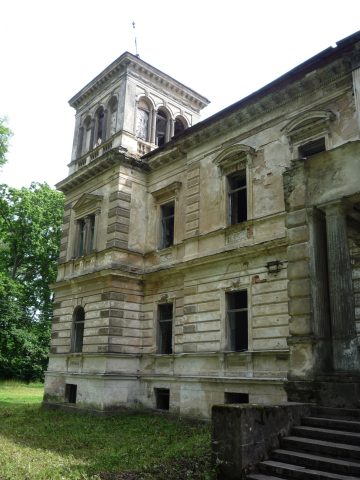
Lyntupy Local History Museum is one of those quiet places where the past doesn’t just sit behind glass—it lingers in the air, in the creak of floorboards, in the way sunlight falls through old windows. Tucked away in the small settlement of Lyntupy in northwestern Belarus, the museum feels less like an institution and more like a living room where the stories of the region have been carefully gathered over time. There are no grand reconstructions or flashy displays here, just a modest collection of objects that speak in their own understated way about the people who shaped this land.
The museum occupies a wooden house built in the early 1900s, a structure that still carries the warmth of a home rather than the sterility of a gallery. The building itself is a fine example of traditional Belarusian rural architecture, with its carved window frames and steep roof designed to shed snow. Inside, the low ceilings and the central stove in the corner make it easy to imagine the families who once lived here, their voices echoing in the same spaces where visitors now stand. The museum doesn’t try to impress with modern technology or elaborate setups; instead, it lets the objects tell their own stories, each one a fragment of a larger, quieter narrative.
The exhibits span several centuries, beginning with the everyday life of 19th-century peasants. There are spinning wheels, clay pots, and looms—tools that were once essential to survival, now arranged in a way that feels almost intimate. Nearby, farming implements and fishing gear hint at the rhythms of rural life: the slow, repetitive work of tilling soil, the patience required to set traps in the forest, the quiet satisfaction of a full net. Old photographs of local estates and portraits of long-gone villagers add faces to the history, reminding visitors that these weren’t just anonymous figures but real people with their own joys and struggles.
A separate section is dedicated to the turbulent 20th century, when Lyntupy, like the rest of Belarus, endured wars and upheavals. Military artifacts—letters from soldiers, medals, rusted weapons—are displayed alongside personal items that belonged to those who fought in the resistance. The most moving pieces are the ones tied to local partisans, their stories preserved in faded documents and black-and-white images. Nearby, postwar relics—school notebooks, tools from early collective farms, propaganda posters—paint a picture of a community rebuilding itself, where every small object carries the weight of resilience.
But the museum isn’t stuck in the past. Alongside historical exhibits, you’ll find traces of modern Lyntupy: photographs of village festivals, handcrafted textiles, paintings by local artists. The space doubles as a community hub, hosting workshops on traditional crafts, talks with elders, and exhibitions of children’s artwork. For school groups, it’s a chance to connect with their roots; for outsiders, it offers a glimpse into the unhurried pace of rural Belarus. The museum doesn’t just preserve history—it keeps it alive, bridging generations in a way that feels organic rather than forced.
What makes the museum special is its setting. Lyntupy isn’t a tourist hotspot but a working settlement where life moves at its own unhurried pace. The streets are lined with wooden houses, their shutters painted in faded blues and greens, and the local church stands on a hill, its bell tolling over the fields. The surrounding countryside—dense forests, quiet lakes, rolling farmland—feels untouched by time. The museum isn’t just a stop on a map; it’s part of the fabric of the place, a natural extension of the village itself.
Visiting the museum isn’t like ticking off a sightseeing checklist. There’s no rigid tour or scripted narrative—just the freedom to wander, to pick up an old photograph or run your fingers over a worn spinning wheel. Sometimes, the most powerful moments come from simply standing in silence, letting the weight of the past settle around you. The museum doesn’t aim to dazzle or entertain; its purpose is simpler and more profound: to hold onto the stories of those who came before and pass them on.
For travelers, the museum offers a way into Lyntupy’s world. After a visit, the village itself begins to reveal its layers. The old oak tree by the roadside, the sagging fence near the church, the lake where locals still fish—each takes on new meaning. You might walk to the 19th-century church, its wooden beams darkened by time, or sit on a bench outside the museum, watching life unfold at its own pace. History here isn’t just something that happened long ago; it’s in the way the wind rustles through the trees, in the laughter of children playing in the square, in the quiet persistence of a place that has seen so much yet remains unchanged in all the ways that matter.