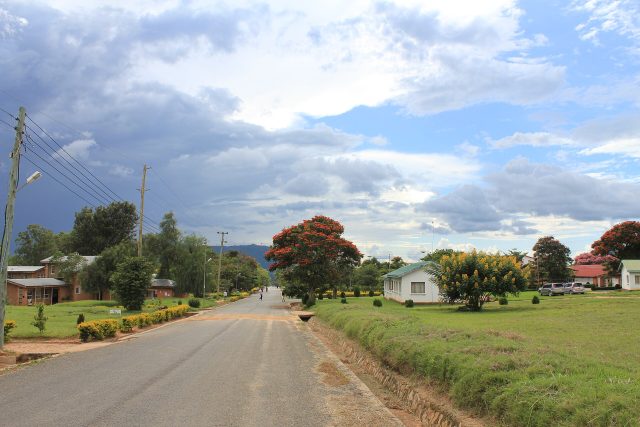
Standing on a low hill above Iringa, the Lutheran church feels like a natural part of the landscape, as if it has always been there. Built in the early 1900s when the town was little more than a distant outpost in German East Africa, it was one of the first permanent structures in the area. The church arrived at a time when European missionaries and colonial officials were beginning to leave their mark on the region, though its presence was never about grand gestures. Instead, it became a quiet witness to the changes that unfolded over decades—some peaceful, others far more turbulent.
The building itself is simple but carries a quiet dignity. Its pale stone walls, cut from the surrounding hills, blend with the earthy tones of the landscape, while the deep red roof stands out against the muted colors of the savanna. The design follows the straightforward lines of Lutheran tradition, adapted to the local climate and materials. Tall, narrow windows let in soft light, and the modest bell tower, though not particularly imposing, sends its chime across the town on Sunday mornings. Inside, the space is uncluttered—wooden pews, a plain altar, and a few old chandeliers, likely imported from Europe, create an atmosphere that feels both solemn and welcoming. There are no elaborate decorations, just the kind of understated beauty that comes from practicality and time.
For the people of Iringa, the church is far more than a historical landmark. It remains a central part of daily life, especially on Sundays when families gather for services. Many in the congregation are descendants of the first converts brought into the faith by German missionaries over a century ago. The liturgy is conducted in Swahili, though occasionally the strains of old German hymns still drift through the nave, a faint echo of the past. After services, the churchyard becomes a place of conversation and connection, where people linger to share news, meals, and stories. In these moments, the building feels less like a relic and more like a living thread in the fabric of the community.
The church’s history is closely tied to that of Iringa itself. The town took shape during the Maji Maji Rebellion in the early 1900s, a violent uprising against German colonial rule. In those years of conflict, the church was one of the few stable institutions in a region torn by unrest. Later, under British administration, it continued to serve as a place where different cultures met, sometimes in tension, sometimes in cooperation. Inside, memorial plaques honor both European missionaries and local figures who helped shape the town, offering a quiet acknowledgment of the shared past that has defined Iringa.
Beyond its walls, the church is surrounded by a small garden where acacia trees and bougainvillea provide shade. In the early mornings, birds move between the branches, and the air carries the scent of dry grass and earth. Elderly locals often sit on the benches, engaged in slow, unhurried conversations. There are no crowds here, no tour groups, just the easy rhythm of a town that moves at its own pace. For visitors, it’s a place to step away from the usual tourist routes and experience the quiet pulse of provincial life. The churchyard, with its dappled light and gentle breeze, feels like a world apart from the bustle of larger cities.
Though modest in appearance, the church plays a meaningful role in Iringa’s cultural life. Beyond regular services, it hosts local musicians, small artisan markets, and occasional festivals. The Christmas season is particularly special, when the church is decorated with garlands of native flowers and the choir sings carols that blend African and European traditions. These events are not grand spectacles but intimate gatherings that reflect the town’s layered identity. They offer a glimpse into how the past is not just remembered but actively woven into the present.
For travelers who venture beyond Tanzania’s well-known attractions, the Lutheran church in Iringa provides a different kind of experience. There are no safaris or beaches here, just the quiet authenticity of a town that has grown on its own terms. It’s a place where history is not confined to museums but lives in the daily routines of its people. The church, in its unassuming way, tells a story of resilience, adaptation, and the slow blending of cultures. Few visitors stay in Iringa for long, but those who do often leave with a deeper appreciation for the country’s complexity—a complexity that is often overlooked in favor of more dramatic landscapes.
The church stands as a reminder that some of the most meaningful places are not the ones that demand attention but the ones that quietly endure. It has seen wars and colonial rule, independence and change, yet it remains a constant in the lives of those who call Iringa home. For outsiders, it offers a moment of reflection, a chance to consider how history shapes the present in ways both visible and unseen. In a country known for its natural wonders, the Lutheran church in Iringa is a different kind of landmark—one that speaks to the human stories that have unfolded here over generations.