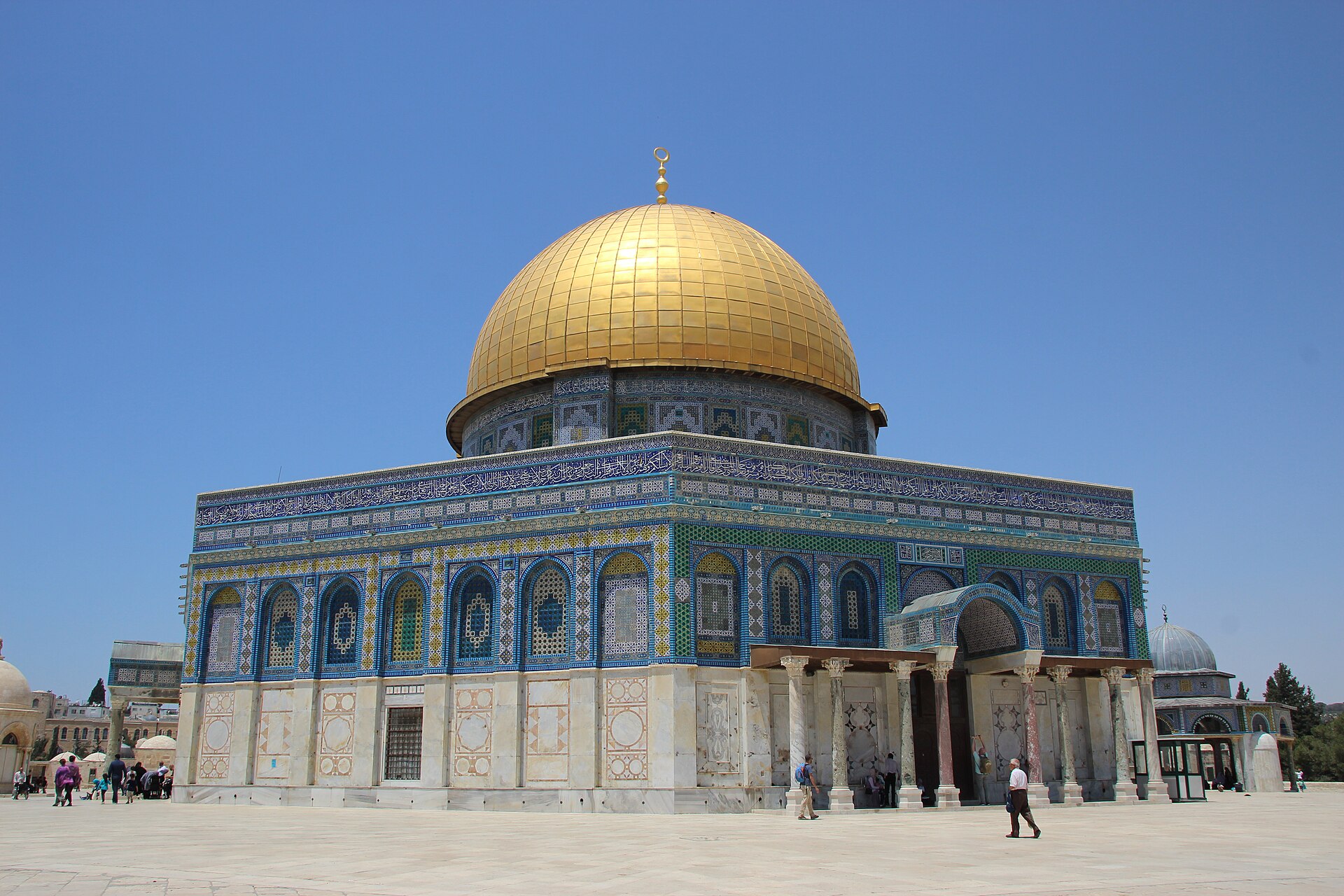
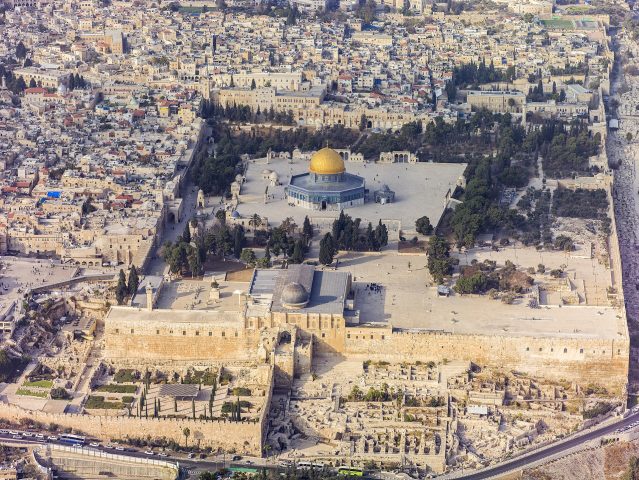
Perched atop the Temple Mount in the heart of Jerusalem, the Dome of the Rock is one of those rare places where history, faith, and art converge in a way that feels almost tangible. Its golden dome, shimmering against the sky, has become an unmistakable symbol of the city, visible from nearly every vantage point in the Old City. But beyond its striking appearance lies a deeper significance—one that has shaped the spiritual and cultural identity of the region for over a thousand years.
Built in the late 7th century under the orders of Umayyad caliph Abd al-Malik, the Dome of the Rock was never intended to be a mosque. Instead, it was conceived as a monumental shrine, a testament to the triumph of Islam and a celebration of its growing influence in the region. Its octagonal structure, with its soaring dome, was a deliberate departure from earlier architectural traditions, blending Byzantine, Persian, and Roman elements into something entirely new. The result was a masterpiece of early Islamic art, where every detail—from the intricate mosaics to the flowing Arabic calligraphy—served a purpose, whether symbolic, decorative, or spiritual.
The rock at the center of the Dome holds a significance that transcends any single faith. For Muslims, it is the spot from which the Prophet Muhammad is believed to have ascended to heaven during his Night Journey, a moment so sacred that the entire structure was built to honor it. For Jews, this is the Foundation Stone, the very place where God is said to have created the world and where the First and Second Temples once stood. Christians, too, revere the site, associating it with the teachings of Jesus and the early days of the faith. The rock itself, smooth and unassuming, carries the weight of these overlapping narratives, each one adding another layer to its story.
Inside the Dome, the atmosphere is one of quiet reverence. The walls are adorned with mosaics that have survived centuries, their gold and blue hues still vibrant despite the passage of time. The patterns—geometric, floral, and calligraphic—create a sense of movement, as if the space itself is alive with meaning. Light filters through the stained-glass windows, casting shifting patterns across the marble floors, while the air carries the faint scent of incense and the murmur of prayers. The wooden screen encircling the rock is a later addition, but it does little to diminish the sense of awe that fills the space. For those who visit, it’s impossible not to feel the presence of history here, pressing in from all sides.
The Dome of the Rock has witnessed countless transformations over the centuries. During the Crusades, it was briefly repurposed as a Christian church, only to be reclaimed by Saladin and restored to its original purpose. The Ottomans, who ruled Jerusalem for centuries, took great care in maintaining the structure, periodically re-gilding the dome and repairing the mosaics. In the 19th century, as Western travelers and scholars began to document the landmarks of the Holy Land, the Dome emerged as one of the most photographed and written-about sites in the region. Yet despite these changes, its core identity has remained intact—a place where the sacred and the historical are inextricably linked.
Visiting the Dome of the Rock today is not just about seeing a monument; it’s about stepping into a living narrative. The Temple Mount, where it stands, is one of the most contested spaces in the world, a place where politics and faith collide in ways that can feel both overwhelming and deeply personal. Access is tightly controlled, and the rules governing who can enter—and when—are a reflection of the broader tensions that define Jerusalem. Yet for those who do make it inside, the experience is often one of unexpected connection. Muslims pray near the rock, Jews gather at the Western Wall below, and tourists from every corner of the globe wander the courtyard, each drawn by their own reasons but all sharing the same space.
The Dome changes with the light, its appearance shifting as the day progresses. In the early morning, when the sun first touches the gold leaf, the dome seems to glow from within, as if lit by some inner fire. By midday, under the harsh Middle Eastern sun, the colors of the mosaics deepen, and the building casts long shadows across the stone-paved plaza. As evening falls, the Dome takes on a softer, more muted tone, its silhouette standing out against the darkening sky. At night, when the crowds have thinned and the city grows quiet, the site feels almost otherworldly, as if time itself has slowed to match the rhythm of the prayers still being offered within.
What makes the Dome of the Rock so compelling is not just its beauty or its history, but the way it embodies the complexities of the region. It is a place of profound spiritual significance, yet it is also a symbol of the divisions that have shaped Jerusalem for generations. It has been fought over, revered, and reinterpreted, yet it endures, a silent witness to the ebb and flow of empires, faiths, and peoples. For those who stand beneath its dome, it offers a moment of reflection—a chance to consider the threads that connect us, even in a place where so much seems to pull people apart.
Whether you come as a pilgrim, a historian, or simply a curious traveler, the Dome of the Rock leaves an impression that lingers long after you’ve left. It is a reminder that some places are more than just stone and mortar; they are living testaments to the ideas, beliefs, and struggles that have defined human history. In a city where every corner seems to hold a story, the Dome stands apart—not just for its grandeur, but for the way it invites you to become part of its ongoing narrative. And perhaps that is its greatest gift: the sense that, for a brief moment, you are standing at the crossroads of something far greater than yourself.