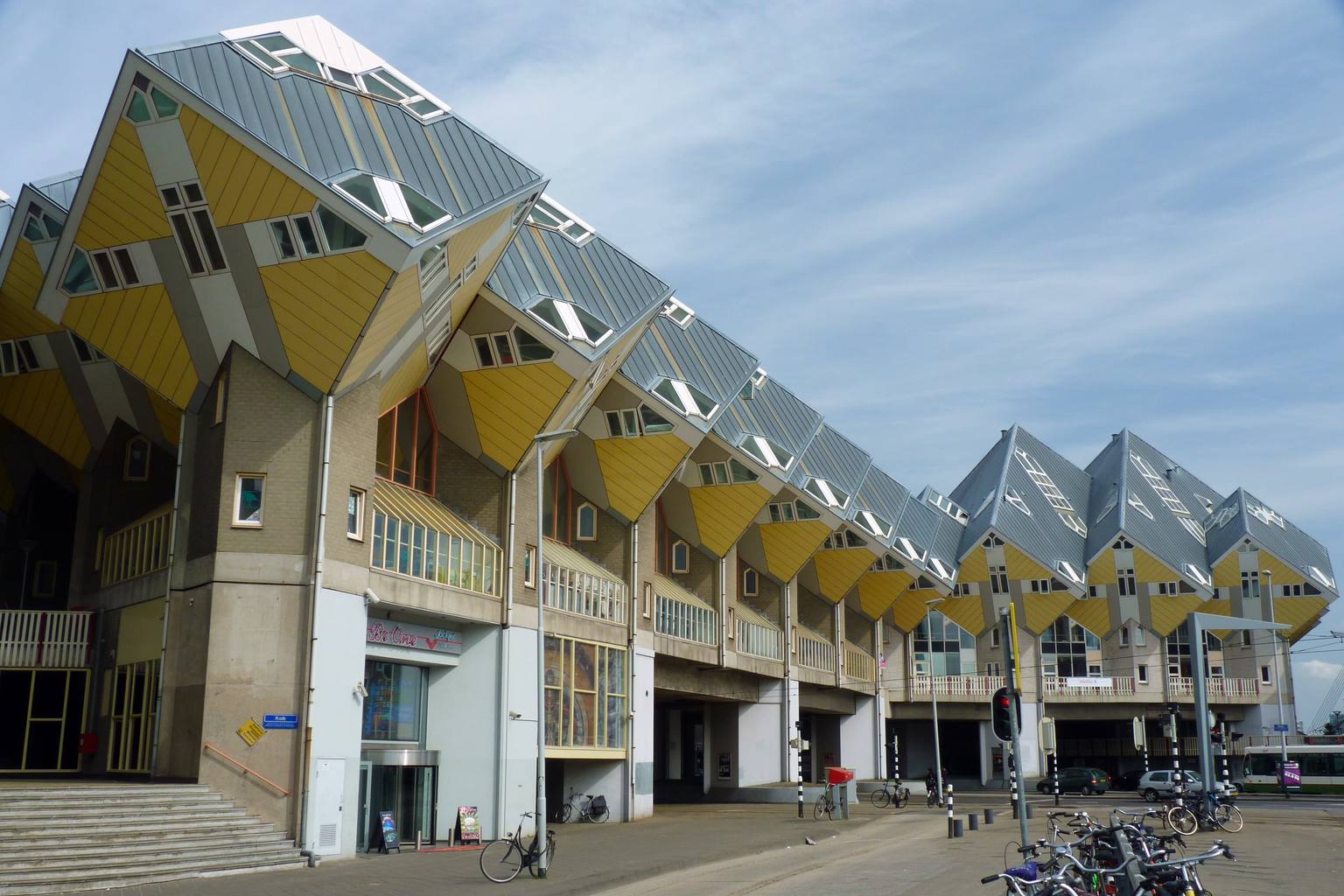
Rotterdam’s Cube Houses are the kind of place that makes you pause mid-step, tilt your head, and wonder how anyone could possibly live inside something so deliberately off-kilter. Perched at a forty-five-degree angle, their bright yellow facades look like a child’s building blocks left askew by an absentminded giant. Yet these aren’t the result of some architectural accident—they were designed in the late 1970s by architect Piet Blom as a radical reimagining of urban living. Each house rests on a hexagonal pillar, giving the impression of a forest of concrete and glass trees, their tilted crowns defying gravity. Blom’s vision was to create compact, efficient homes without sacrificing livability, a response to the challenge of building on a small footprint in a city still rebuilding itself after the war.
At first glance, the interiors seem impractical, even disorienting. Walls slope at odd angles, floors tilt underfoot, and windows frame the world in unexpected ways. But step inside, and you’ll find a surprisingly functional three-level layout. The ground floor serves as a living area, the middle level houses bedrooms, and the top, tucked beneath the cube’s apex, is often used as a study or lounge. Staircases are narrow and steep, furniture is custom-built to fit the slanted walls, and every piece of decor has to earn its place. It’s not the easiest space to navigate, but residents insist that after a few weeks, the angles stop feeling strange. Some even grow to prefer the coziness of a room that hugs you from all sides.
The Cube Houses weren’t just an experiment in form—they were part of a larger effort to revitalize the Blaak district, an area heavily damaged during World War II. Rotterdam, unlike Amsterdam or Utrecht, lacks the charm of medieval canals and gabled houses. Bombings in 1940 left much of the city in ruins, and when it came time to rebuild, planners embraced modernity. The result is a cityscape of bold, often controversial designs, where tradition takes a backseat to innovation. The Cube Houses stand near the bustling Overblaak Street, hovering above the Blaak metro station like a cluster of misplaced dice. They’re impossible to ignore, a jolt of the unexpected in a city that has made a habit of defying expectations.
One of the cubes has been turned into a museum house, offering visitors a chance to experience life inside a tilted world. The moment you step through the door, the rules of space seem to bend. Furniture clings to walls at impossible angles, windows peer into neighboring cubes, and low ceilings force you to duck. It’s a disorienting, almost surreal experience, like walking through a funhouse designed by a mathematician. Nearby, another cube operates as a hostel, so you can spend the night suspended in this architectural oddity, waking up to a view that feels more like a painting than reality.
More than just a tourist attraction, the Cube Houses have become a symbol of Dutch architecture in the late 20th century. They embody an era when designers were eager to break free from convention, experimenting with materials, shapes, and ideas. Opinions on them remain divided—some see them as a brilliant solution to urban density, while others dismiss them as a gimmick. But their impact is undeniable. They’ve drawn architects, students, and curious travelers from around the world, sparking conversations about what a home can—or should—be.
The houses don’t exist in isolation. The Blaak district is a microcosm of Rotterdam’s eclectic identity. Just steps away stands the Church of St. Lawrence, one of the few historic buildings to survive the war, its Gothic spires a stark contrast to the geometric cubes. Nearby, modern office towers with reflective glass facades rise like monoliths, their sleek surfaces mirroring the sky. This juxtaposition of old and new, familiar and avant-garde, is what gives Rotterdam its unique character. There’s no single architectural style here, just a sense of freedom—one that extends from the shape of the buildings to the design of the benches on the street.
Beyond their visual impact, the Cube Houses are a living part of the city. People actually call them home, offices occupy some of the cubes, and the area hums with activity. By day, tourists wander the streets with cameras; by night, students and locals fill the cafes and bars that have sprung up around them. The metro station makes it easy to explore, and the neighborhood’s mix of shops and eateries gives it a lively, unpretentious vibe. You could spend an afternoon sitting on a bench, watching how the light shifts across the yellow walls, or duck into a nearby pub to debate whether the houses are genius or madness.
What makes the Cube Houses memorable isn’t just their design—it’s the way they invite you to question what you take for granted. They’re not perfect, not by conventional standards, but that’s precisely why they resonate. They’re a reminder that cities aren’t just collections of buildings; they’re experiments, conversations, and sometimes even rebellions. And in a place like Rotterdam, where the past was erased in a single night, that spirit of reinvention is everywhere. The Cube Houses are just the most visible example—a bold, bright exclamation mark in a city that refuses to be ordinary.