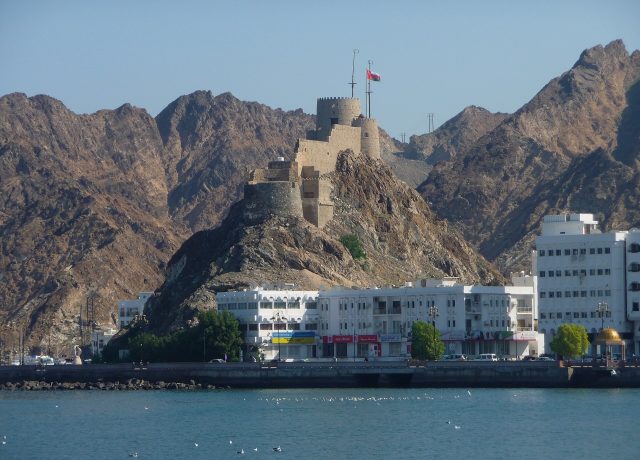
Al-Mirani Fort stands where the land meets the sea, a quiet sentinel overlooking the waters of the Gulf of Oman. Its weathered walls, built from coral stone and clay, have absorbed centuries of sunlight, blending into the rugged coastline as if they’ve always been there. Unlike the grand palaces or ornate mosques that dot Oman’s landscape, this fortress feels like a natural extension of the earth itself—unassuming yet unshakable. It doesn’t demand attention, but once you notice it, you can’t look away.
The fort’s origins trace back to the 16th century, when Portuguese forces seized Muscat and reshaped its defenses. They built Al-Mirani to guard the harbor, a strategic foothold in their quest to dominate the spice trade routes linking India, East Africa, and the Arabian Peninsula. The Portuguese named it after their king, but their hold on the region was short-lived. By the mid-1600s, Omani forces had reclaimed the city, and the fort became a cornerstone of their own maritime empire. Its walls, once a symbol of foreign occupation, now stood as a testament to Omani resilience.
Architecturally, Al-Mirani is a study in practicality. Its irregular polygonal shape and thick walls were designed to withstand cannon fire, while its position on a rocky promontory made it nearly impregnable from the sea. Inside, narrow passageways wind between towers, offering glimpses of the harbor below. Climbing the worn stone steps, you can almost hear the echoes of sentries scanning the horizon for approaching ships. The fort’s layout hasn’t changed much over the centuries, and walking through it feels like stepping into a living diagram of 17th-century military engineering.
After the Portuguese were expelled, the fort underwent several modifications, particularly under Imam Ahmed bin Said, the founder of the Al Said dynasty. In the 18th century, he integrated Al-Mirani into a broader defensive network that included its sister fort, Al-Jalali, on the opposite side of the harbor. Together, they controlled access to Muscat’s port, deterring pirates and rival fleets. This was a golden age for Oman, when its navy ruled the western Indian Ocean, and the forts played a crucial role in maintaining that dominance. Their cannons may have fallen silent, but their presence still shapes the city’s identity.
Today, Al-Mirani is open to visitors, though it remains less frequented than Al-Jalali. Inside, small exhibits showcase Oman’s maritime history—rusted cannons, anchors, and yellowed maps that hint at the daring voyages of Omani sailors. The real draw, however, is the view from the upper terrace. From here, the harbor stretches out below, a mix of tradition and modernity. Dhows bob in the water alongside sleek yachts, while the skyline of Muscat rises in the distance. It’s a reminder that this fort wasn’t just a military outpost; it was the nerve center of a trading empire.
There’s a weight to the air inside Al-Mirani, as if the stones themselves remember the past. The inner courtyards, once bustling with soldiers, are now quiet, shaded spaces where visitors can sit and soak in the atmosphere. In the heat of the day, the fort is almost deserted, save for the occasional tourist or the whisper of wind through the corridors. As evening falls, soft lights illuminate the walls, casting long shadows over the water. It’s easy to imagine the fort as it once was—alive with activity, the clatter of hooves, the shouts of merchants, the creak of ships preparing to set sail.
What makes Al-Mirani special is its lack of pretension. There are no gilded halls or elaborate frescoes here, just raw history etched into every crack and corner. It’s a place where the past feels tangible, where you can run your fingers along the same walls that once bore witness to sieges and treaties. For history enthusiasts, it’s an essential stop, but even those who stumble upon it by chance often find themselves lingering, drawn in by its understated power.
The fort’s relationship with modern Muscat is a study in contrasts. The city has expanded far beyond its old boundaries, with highways and shopping malls encircling the historic core. Yet Al-Mirani remains, a stubborn link to a time when Muscat was a small but vital port on the edge of a vast empire. It’s a reminder that progress doesn’t erase the past—it simply layers over it. The fort doesn’t compete with the city’s new landmarks; it complements them, offering a quiet counterpoint to the rush of contemporary life.
A visit to Al-Mirani pairs well with a walk through Old Muscat. Nearby, the Sultan’s Palace, the Sultan Qaboos Grand Mosque, and the National Museum offer deeper insights into Oman’s history and culture. The fort is particularly striking at sunset, when the light softens its rough edges and the water below takes on a golden hue. Many visitors photograph it from the corniche, capturing its silhouette against the fading sky. But the best way to experience Al-Mirani is to simply stand at its base, looking out at the sea, and let the weight of centuries settle around you. In a world that moves too fast, this fort is a rare place where time slows down.