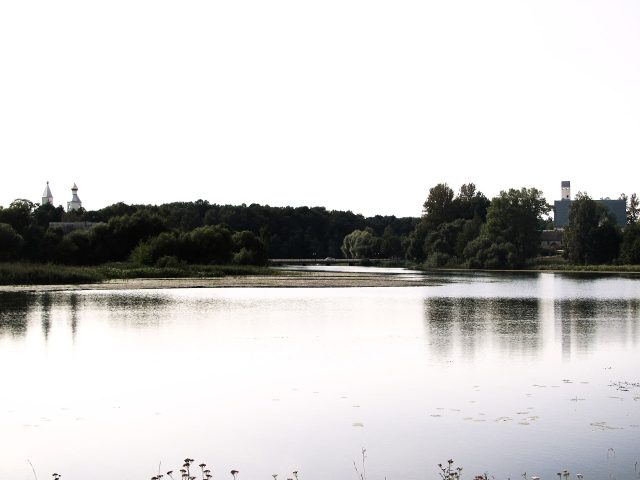
Logoysk is one of those quiet Belarusian towns rarely found on tourist maps. It sits among the rolling hills of the Minsk region, where time seems to move at its own pace. Yet in its center stands the Church of St. Casimir—a building that carries centuries of history without seeking attention. It doesn’t dominate the skyline or attract crowds. Even locals often walk past without noticing. But if you stop for a moment, the layers of its past become visible in the worn stones and faded paint.
The church’s origins
The church dates to the late 18th century, when this land belonged to the Polish-Lithuanian Commonwealth. Records are incomplete, but by 1790, it stood in its current location. At the time, Logoysk was under the rule of the Tyszkiewicz family, a powerful magnate dynasty. They likely commissioned the church, continuing a tradition of noble families building religious sites as symbols of faith and status. St. Casimir, the patron saint of the Grand Duchy of Lithuania, was chosen as its namesake—a figure associated with youth and Christian virtue.
Architecture and atmosphere
The Church of St. Casimir is a modest example of late Baroque. Its facade is plain: two tiers divided by a cornice, a triangular pediment, and a small bell tower. Inside, the space feels larger than it looks from outside. High vaulted ceilings, pale walls, and wooden pews create a quiet, uncluttered environment. The main altar holds an image of St. Casimir, with smaller altars dedicated to other saints. There’s no grandeur here—just a sense of stillness, as if the builders meant it for quiet prayer rather than display.
Like many churches in Belarus, this one has endured upheaval. After the partitions of Poland, the region came under Russian rule, and Catholic churches faced restrictions. The Soviet era brought harder times: the building was used as a warehouse, then left to decay. It wasn’t until the 1990s, after Belarus gained independence, that the church was returned to the faithful. Restoration preserved its original character, and today it serves as a place of worship, though few visitors come.
A living part of the town
Logoysk doesn’t announce its history. There are no dramatic stories here—just the quiet persistence of the past in small details. The worn steps leading to the altar. Old photographs on the walls. The occasional toll of the bells breaking the silence.
The Church of St. Casimir isn’t a museum. It’s a place where baptisms, weddings, and regular services still happen. For locals, it’s a familiar part of life, not a tourist site.
The church sits on a slight rise, surrounded by a small park. In summer, children play on the grass while elderly residents sit on benches. Winter brings silence, with snow covering the paths. In spring, blossoms fill the air. From the church steps, you can see Logoysk—its low houses, winding streets, and gentle hills. The town doesn’t try to impress. It simply exists.
Why visit?
Coming here isn’t about admiring architecture or checking off a historical site. It’s about stepping into the rhythm of a small Belarusian town. There’s no rush, no crowds. You can sit on a pew, listen to the silence, and think about the generations who have walked through these doors seeking a moment of peace.
You don’t need to be an expert to appreciate the Church of St. Casimir. There’s no grand narrative to unpack. Just walk in, take a seat, and let the place speak. Maybe that’s why it feels different from the noise of bigger cities. Logoysk and its church don’t demand attention. They reveal themselves only to those willing to slow down and look.