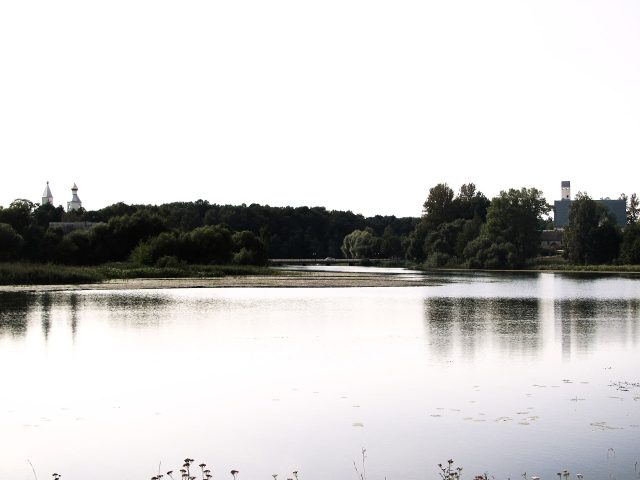
Logoysk is one of those quiet Belarusian towns that rarely make it onto tourist itineraries, tucked away in the Minsk region with little fanfare. Yet here, on an unassuming street, stands the Church of St. George—a building that speaks not through grand declarations, but through its quiet, unassuming presence. Small in size but striking in silhouette, the church rises above the surrounding houses with its slender bell tower, a reminder of a time when Logoysk was more than just a district center. Back then, it was a notable stop along trade routes, a place where life moved at its own unhurried pace.
Built in the early 20th century, the church reflects the architectural trends of its time, blending Russian Orthodox traditions with local influences. There’s nothing extravagant about its design—just clean lines, whitewashed walls, and narrow windows topped with gentle arches. The bell tower, crowned with a modest dome, gives the structure a sense of lightness, as if it barely touches the ground. Inside, the simplicity continues. The iconostasis is unadorned, free of gilding or elaborate carvings, yet the icons themselves carry a warmth that makes them feel alive. Sunlight filters through the tall windows, casting a soft glow over the walls and creating an atmosphere of quiet reflection. It’s easy to see why people have always come here not just for services, but to escape the noise of everyday life, if only for a moment.
The church’s history is woven into the fabric of Logoysk itself. The town is ancient, first mentioned in chronicles as far back as the 12th century, and over the centuries, it has seen its share of upheavals. It passed from Lithuanian princes to the Polish-Lithuanian Commonwealth, then to the Russian Empire, and in the 19th century, it even served as a county seat. Though Logoysk eventually lost its administrative importance, the Church of St. George endured, standing as a silent witness to the changing tides of history.
Like many religious sites in the Soviet era, the church was repurposed—first as a warehouse, then as a community club. Its bell tower was demolished, its domes removed, and for decades, it bore little resemblance to its original form. But in the 1990s, the church was returned to the faithful, and restoration began. Today, it looks much as it did a century ago, though some details reveal the passage of time. The bell tower, for instance, was rebuilt using modern techniques, giving it a slightly different character than the original.
St. George, the patron saint of the church, holds a special place in Orthodox tradition. Often depicted as a dragon-slayer, he symbolizes courage, protection, and the triumph of good over evil. In a town like Logoysk, where life has always moved at a gentle rhythm, the church has long been a place of solace and strength. Generations have marked their most important moments here—baptisms, weddings, funerals—making it a cornerstone of the community.
Nowadays, the Church of St. George is more than just a place of worship. It’s a piece of Belarus’s cultural heritage, drawing visitors who are curious about history, architecture, or simply the quiet charm of small-town life. There’s no tourist bustle here, no crowds, just the same peaceful atmosphere that has defined the place for decades. You might visit in the early morning, when the first light of dawn touches the white walls, or in the evening, when the church is softly illuminated, and it’s easy to imagine that time has stood still.
Logoysk will never be a major tourist destination, and the Church of St. George isn’t the kind of landmark that dazzles at first sight. But that’s part of its appeal. It doesn’t demand attention; it simply exists, as much a part of the town as the streets and the people who walk them. For those who take the time to notice, it offers something rare—a moment of stillness, a connection to the past, and the quiet beauty of things that endure.