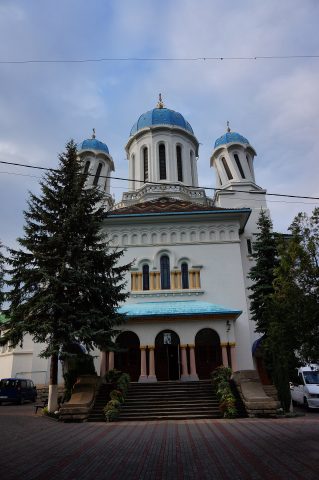
Storozhynets is one of those small Ukrainian towns where time seems to move at its own unhurried pace, and the past lingers in quiet corners. Perched on a gentle hill in the center, the Church of St. John the Baptist stands as a quiet witness to the town’s layered history. Built in the early 20th century, its architecture carries the unmistakable marks of Neo-Gothic style—tall, narrow windows, sturdy buttresses, and a slender spire reaching toward the sky. The design is restrained yet elegant, a reflection of the era’s taste for medieval revival, which swept through Europe at the time. Inside, the space feels intimate rather than grand, with pale walls, simple wooden pews, and an unadorned altar. The light filters softly through the stained glass, casting muted patterns on the floor, and the air carries the faint scent of aged wood and candle wax.
The church’s story is inseparable from that of Storozhynets itself, a town shaped by centuries of shifting borders and cultural influences. Founded in the 15th century, it spent much of its history under the rule of different powers—the Moldavian Principality, the Ottoman Empire, and later the Austro-Hungarian monarchy. The Catholic community here took root in the 19th century, when the region became part of the Habsburg lands. Polish, Hungarian, German, and Ruthenian settlers brought their traditions with them, and by the early 1900s, the town was thriving, thanks in part to its timber and woodworking industries. The church was completed in 1908, funded by local parishioners, merchants, and even the imperial authorities, who saw it as a way to strengthen Catholic identity in the region.
What makes the church’s architecture particularly interesting is how it embodies the spirit of its time. Neo-Gothic wasn’t just a fashionable choice—it was a deliberate nod to Europe’s medieval past, a way to reconnect with what many saw as a more spiritually grounded era. The building’s red brick gives it a warm, almost earthy feel, contrasting with the sharp lines of its pointed arches and towering spire. Small decorative details—a rose window here, a finial there—add texture to the facade, catching the light in different ways as the day passes. Inside, the high vaulted ceiling draws the eye upward, a reminder of the grandeur that once filled the space during services, when the sound of an organ would have echoed through the nave.
Like many religious buildings in the Soviet Union, the church faced a difficult period in the 20th century. It was closed, repurposed as a warehouse, a community center, and even a gym. Only after Ukraine regained independence in the 1990s was the building returned to the Catholic community. Today, the congregation is smaller than it once was—fewer people in Storozhynets identify as Catholic now—but the church remains an important part of the town’s identity. It’s not just a place of worship but a monument to the region’s complex history, a tangible link to the generations who gathered here before.
Visiting the church is less about ticking off a tourist attraction and more about stepping into a quieter, slower rhythm. There’s no crowd, no rush—just the sound of leaves rustling in the small park that surrounds the building. In summer, the greenery softens the brick walls, and benches invite visitors to sit and take in the view of the town below. Winter transforms the scene entirely: snow blankets the ground, the red brick stands out starkly against the white, and the spire seems to pierce the low, gray sky. Inside, the cool air offers a respite from the heat, and the stillness makes it easy to imagine the voices that once filled the space.
The Church of St. John the Baptist is more than just an old building—it’s a piece of living history. It has survived wars, political upheavals, and economic hardships, yet it still stands, much as it did over a century ago. For those who wander into Storozhynets, a town often overlooked by travelers, the church offers a glimpse into the past. It’s a place where architecture and faith intersect, where the stories of the people who built it, prayed here, and preserved it are still palpable. Whether you’re drawn by history, architecture, or simply the search for a moment of quiet reflection, the church has a way of making the past feel present.