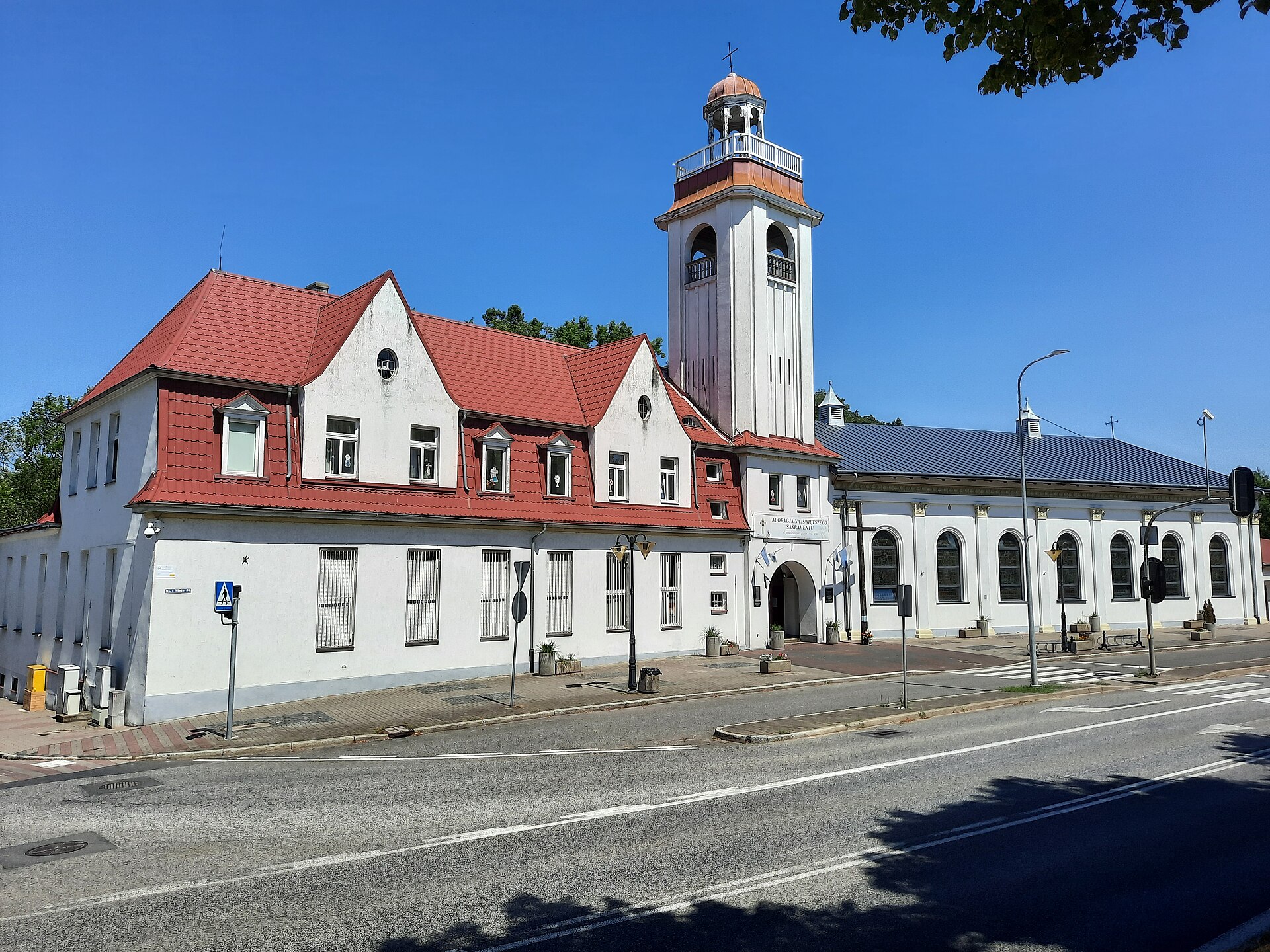
The Church of Our Lady Queen of Poland in Słubice is more than just a place of worship. It stands as a quiet witness to the layered history of this small border town, where faith, identity, and daily life have long been intertwined. Built in the mid-20th century, the church reflects the transformations that shaped Słubice—a city that has seen borders shift, cultures merge, and communities rebuild. Perched on the edge of Poland, just across the river from Germany, the town has always been a crossroads, and the church, rising above its streets, serves as a reminder of how deeply tradition and history are woven into the fabric of the region.
The architecture of the church is unassuming yet striking in its own way. Designed in the modernist style that became common in post-war Poland, it avoids ornate details in favor of clean lines and functional simplicity. The facade is marked by a mosaic of the Virgin Mary, a focal point that draws the eye of passersby. Inside, the space feels open and airy, with high windows allowing natural light to soften the atmosphere. There’s no overwhelming grandeur here, just a sense of calm that invites reflection, whether in prayer or quiet contemplation.
Słubice itself is a town with a story worth knowing. After World War II, these lands became part of Poland, and the city began to take shape as a new home for those who settled here. The church was constructed in the 1950s, a time when Słubice was still finding its identity as a Polish town. For the local community, it quickly became more than a place of worship—it was a gathering spot, a venue for celebrations, and in difficult times, a sanctuary. The church offered stability in a period of change, grounding the lives of families who had seen their world upended.
The dedication of the church to Our Lady Queen of Poland carries particular significance. This title, deeply rooted in Polish history, frames the Virgin Mary as a protector of the nation, a symbol of resilience and unity. For a border town like Słubice, where cultures and rulers have come and gone over centuries, this connection to national identity is especially meaningful. The church stands as a place where people could reaffirm their sense of belonging, a quiet but powerful statement of faith and heritage.
Inside, the church holds a few understated details worth noticing. The altar is simple yet elegant, its design uncluttered but thoughtful. The stained-glass windows, though not intricate, cast a gentle glow that shifts with the light. Along the walls, images of saints revered in Poland share space with memorial plaques, each telling a small part of the parish’s story. There’s no opulence here, no gilded excess—just a modest beauty that feels sincere, the kind that lingers in the memory long after a visit.
Słubice is a town where history is etched into every corner. The church sits among other buildings that have stood for decades, while nearby, the Oder River flows, marking the border between Poland and Germany. Walking through the streets, one gets the sense of a place that moves at its own pace—unhurried, unburdened by the crowds of more famous destinations. The church fits naturally into this landscape, its presence as much a part of the town as the river or the old brick facades that line the streets.
Visiting the Church of Our Lady Queen of Poland offers a chance to connect with more than just local history. It’s an opportunity to see how faith and national identity intersect in the lives of ordinary people. The church is open to all—those who come to pray, those who seek a moment of quiet, and those who simply want to admire its architecture. There’s nothing flashy about it, and that’s precisely what makes it special. In its simplicity, it speaks volumes about the people who built it and the community it serves.
For anyone interested in Poland’s post-war history, Słubice and its church make for a compelling stop. The town has always been a meeting point of cultures, and the church reflects that complexity. Here, one can sense the spirit of an era when Poland was rebuilding, and people turned to faith and tradition as anchors in uncertain times. The Church of Our Lady Queen of Poland isn’t just a religious site—it’s a piece of living history, a place where the past feels close enough to touch.