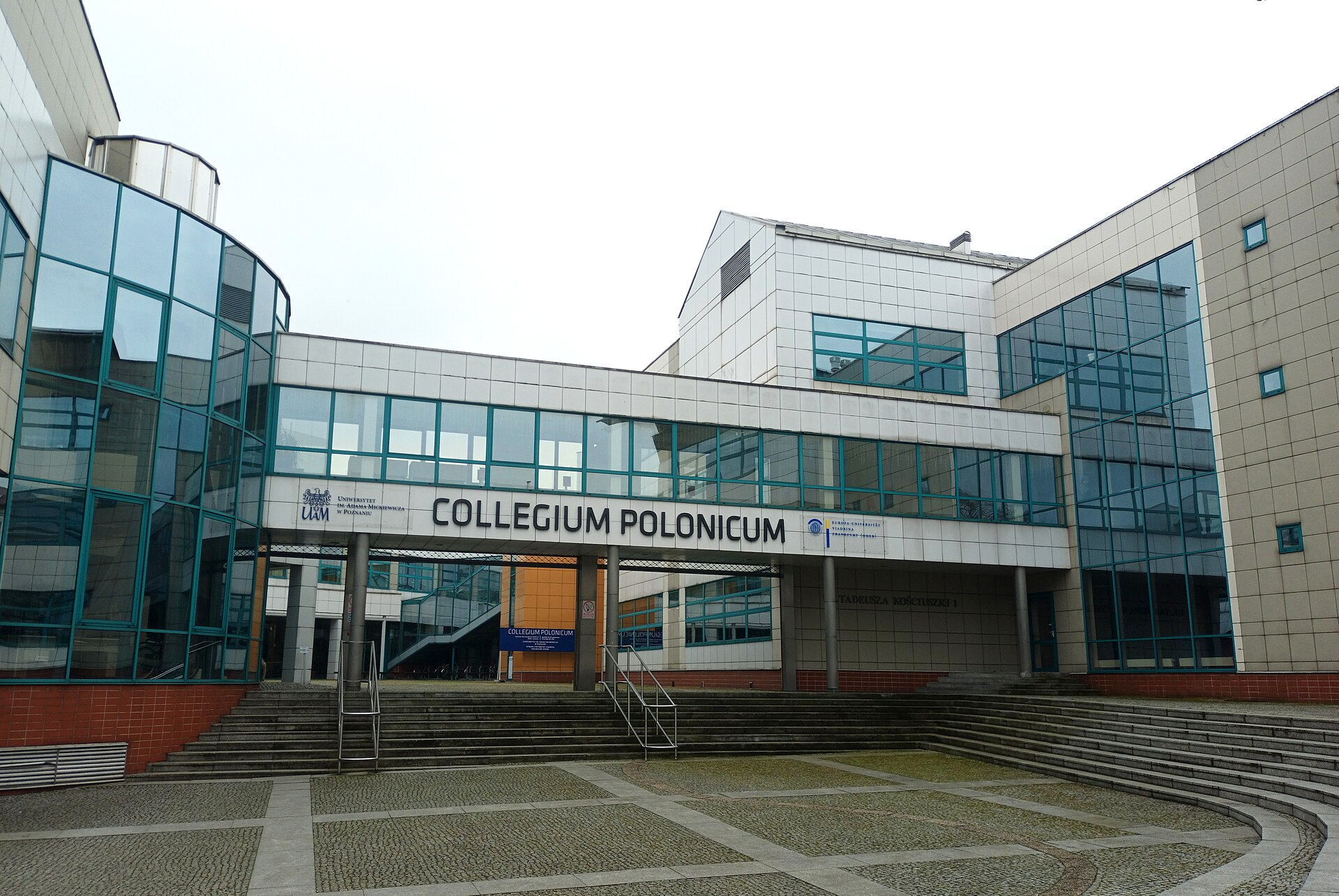
The Collegium Polonicum in Słubice stands where history doesn’t just linger—it keeps happening. Built in the late 19th century as part of the German university in Frankfurt an der Oder, it once belonged to a city without borders. The Oder River connected rather than divided. After the Second World War, the border between Poland and Germany split the city in two. The eastern half became Słubice; the western half stayed German. The Collegium Polonicum, on the Polish bank, now holds two nations, two languages, and two histories under one roof.
The building’s architecture reflects its past. Late Historicist style, common in German academic institutions of the time, gives it a solid, enduring presence. Deep red brick, tall arched windows, and an imposing entrance suggest permanence. Inside, modern renovations soften the original character, but traces remain: ornate ceiling moldings, wide staircases worn smooth by footsteps, and heavy wooden doors with detailed handles. These details show how the space has adapted without losing its origins.
The Collegium Polonicum is a branch of Adam Mickiewicz University in Poznań. Students from Poland, Germany, and elsewhere study European integration, cross-border cooperation, and intercultural communication here. Lectures switch between Polish and German. The hallways buzz with Polish, German, and English. It doesn’t feel like a typical university—it feels like a small piece of Europe.
Słubice and Frankfurt an der Oder coexist, and the Collegium Polonicum helps make that possible. It hosts conferences, workshops, and cultural events for students, locals, politicians, and researchers. The building’s design supports this: spacious lecture halls, intimate seminar rooms, and quiet corners for conversation. Ideas are exchanged as much as knowledge. The past is examined for what it teaches about today.
The library holds books and documents on Pomerania, Silesia, and Brandenburg. You’ll find 19th-century volumes next to contemporary research on cross-border dynamics. Rare editions, hard to find elsewhere, sit alongside works on European integration. For students and scholars, it’s a resource. But it’s also where new ideas form. The library isn’t just for storing knowledge—it’s where that knowledge is debated and expanded.
The small park around the building extends its life. In warmer months, students work on benches with laptops or textbooks. In winter, children sled down the gentle slope. The park connects academia to everyday life. From here, you see the Oder River flowing toward the German shore. Borders aren’t just lines on a map—they’re something people navigate daily, whether in politics or by crossing a bridge.
The Collegium Polonicum’s story mirrors Słubice’s—a place shaped by change. It was a German university building, then a neglected structure in a divided city. Now it symbolizes Polish-German cooperation. Each phase left its mark, but the building kept its purpose. It’s not just an academic institution; it shows how common ground can be found even in division.
For Słubice, the Collegium Polonicum is more than a building. It’s a gathering place, a cultural hub, and a source of energy. City festivals, concerts, and exhibitions happen here. Students become part of the local fabric—some stay after graduation, others leave but carry a piece of Słubice with them. The Collegium, with its red-brick walls and river views, remains a constant. Some connections endure, even as borders shift.