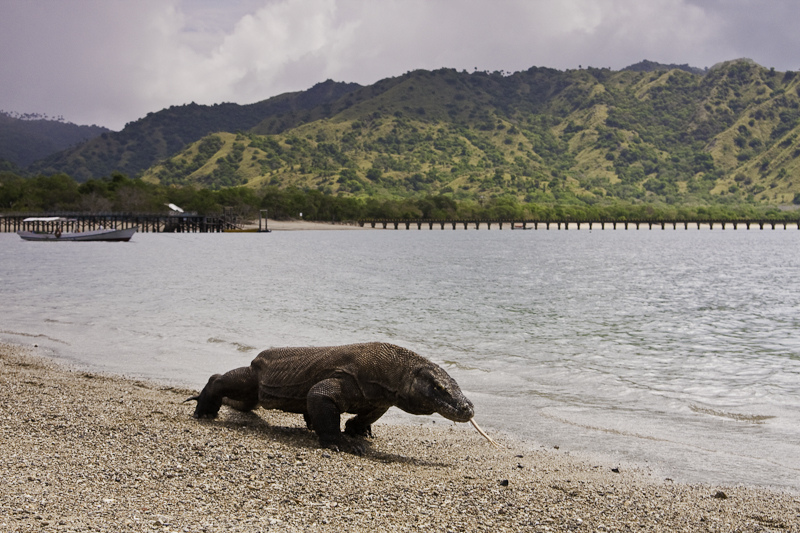
Komodo is one of those rare places where the world still feels untamed, as if time has barely touched it. Tucked between the islands of Sumbawa and Flores in the Lesser Sunda archipelago, it’s part of a protected national park recognized by UNESCO for its raw, unspoiled beauty. There are no high-rise resorts, crowded beaches, or shopping malls here—just rugged coastlines, dry savannas, and an ocean that shifts from gentle waves to powerful swells without warning.
The island’s most famous inhabitants are the Komodo dragons, the largest lizards on Earth. These ancient predators can grow up to three meters long and weigh over a hundred kilograms, and they exist nowhere else in the wild except on Komodo and a handful of neighboring islands. Seeing one in person is less like observing an animal and more like stepping into a prehistoric world where humans are merely visitors. Their ancestors roamed the planet alongside dinosaurs, and today, they move with a slow, deliberate power that feels almost otherworldly. Because they’re a protected species, visitors can only encounter them with licensed guides who know their behavior and ensure safety—for both the dragons and the people watching them.
Komodo is small, covering just under four hundred square kilometers, but its landscapes are surprisingly varied. The interior is a mix of dry tropical forests and open savannas, where hardy plants thrive in the arid climate. The coastline is a patchwork of hidden coves, some with white sand, others with the rare pink-hued beaches formed by crushed coral. Beneath the waves, the waters are part of the Coral Triangle, one of the most biodiverse marine regions on the planet. Coral reefs teem with life, from tiny clownfish to reef sharks, making it a paradise for divers and snorkelers.
The island’s history is woven into the broader story of the Indonesian archipelago. For centuries, it was a stop for traders, pirates, and later, Dutch colonizers who claimed it as part of their East Indies territory. The local Manggarai people have lived here for generations, fishing and farming in ways that have changed little over time. A few traditional villages remain, where stilt houses stand as they have for centuries, and the rhythm of life is still dictated by the sea and the seasons. For the Manggarai, the land and water aren’t just resources—they’re part of an identity that has endured despite outside influences.
Komodo’s climate is hot and dry, especially from April to October, when temperatures often climb above thirty degrees Celsius and rain is scarce. The best time to visit is between November and March, when the weather is slightly cooler and the landscape greens up after the dry season. But even then, don’t expect luxury. There are no five-star hotels or gourmet restaurants—just simple guesthouses and liveaboard boats that ferry visitors between the islands of the national park. This isn’t a place for those seeking comfort; it’s for travelers who want to experience something real, even if it means roughing it a little.
The main draw here is the chance to explore a wild, untouched environment. Hiking trails wind through the island, offering glimpses of not just Komodo dragons but also wild boars, buffalo, and rare bird species. Underwater, the diving and snorkeling are world-class. Sites like Manta Point are famous for their encounters with giant manta rays, while other spots reveal schools of barracuda, sea turtles, and vibrant coral gardens. The currents can be strong, so it’s not always beginner-friendly, but for those who venture beneath the surface, the rewards are unforgettable.
What makes Komodo special isn’t just its wildlife or landscapes—it’s the sense of stepping outside the modern world. There are no crowds, no souvenir shops, no pressure to do anything but observe. The silence is broken only by the sound of waves, the calls of birds, and the occasional rustle of leaves as a dragon moves through the brush. The local people live much as they always have, and nature sets the pace. A trip here isn’t a typical vacation; it’s an adventure that leaves you with a deeper appreciation for the wild and a reminder of how small humans are in the grand scheme of things.
That said, Komodo isn’t a zoo or a theme park. It’s a fragile ecosystem, and visitors are expected to respect it. Rules are strict: no feeding the animals, no littering, no straying from marked paths. Guides enforce these guidelines because the future of the island depends on it. In recent years, there’s even been talk of temporarily closing the park to tourism to allow the environment to recover. For now, it remains open, but anyone who comes here should understand that they’re not just tourists—they’re temporary custodians of a place that needs protection.
Komodo has a way of staying with you long after you leave. It’s a place that makes you think about the balance between humans and nature, about how rare and precious these untouched corners of the world really are. There’s no room for hurry or distraction here—just the ocean, the rocks, the forest, and those ancient lizards, moving through their world as they have for millennia. In a time when so much of the planet has been mapped, developed, and tamed, Komodo feels like one of the last truly wild places left.