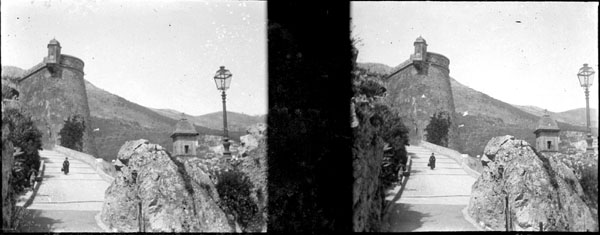
Perched on the edge of a sheer cliff, the Prince’s Palace of Monaco is the home of the Grimaldi dynasty. From its strategic position high above the Mediterranean, the palace overlooks the principality, its stone walls bearing witness to centuries of shifting power, intrigue, and reinvention. What began as a fortress has transformed into a symbol of sovereignty, its architecture a patchwork of eras—medieval ramparts alongside Renaissance elegance, each layer telling a story of a place that refused to fade.
The palace traces back to the 12th century, when Genoese forces built a stronghold here to control coastal trade routes. The Grimaldis seized it in 1297 through a ruse: disguised as Franciscan monks, they gained entry and took control. Over the centuries, the palace endured sieges and was rebuilt, yet it never lost its central role in Monaco’s identity. The structure we see today took shape largely in the 16th and 17th centuries, when the Grimaldis softened its martial edges, replacing battlements with grand facades. Even now, the palace retains a dual nature—part fortress, part royal residence—reflecting Monaco’s own balancing act between defense and diplomacy.
At noon, the changing of the guard unfolds in the square below. The ceremony is brief, but the precision of the guards in their white-and-red uniforms, the beat of the drums, and the snap of their heels on the cobblestones carry weight. Inside, the palace’s public rooms reveal its ceremonial life. The Mirror Gallery, with its gilded moldings and crystal chandeliers, hosts receptions. The Throne Room, adorned with the Grimaldi coat of arms, still serves its original purpose. Tapestries, frescoes, and antique furniture fill the spaces, chosen over generations to shape the family’s image.
For the Grimaldis, the palace has always been more than stone and mortar. It’s where they were born, where they ruled, and where they welcomed figures like Queen Victoria and Winston Churchill. Today, Prince Albert II uses it for state functions and governance. Unlike many royal residences turned museums, this one remains a working home. In summer, visitors can wander the inner courtyard, where citrus trees scent the air drifting up from the harbor. From here, the view stretches across the old town’s rooftops to the yacht-lined port and the Mediterranean. On clear days, the Italian coastline shimmers in the distance.
The terrace outside the palace is one of Monaco’s most photographed spots.
The view hasn’t changed in centuries. What was once a lookout for enemy ships is now a place to watch the sun set. The palace’s position on the Rock of Monaco made it nearly impregnable, but also a target. During the French Revolution, the Grimaldis fled as their home was looted. In the 19th century, the palace fell into disrepair. Prince Charles III revived it by founding the Monte Carlo Casino, turning Monaco into a destination for the wealthy.
The Prince’s Palace feels different from other royal residences. Maybe it’s the scale—Monaco is so small that the palace feels like a grand family home. Or maybe it’s the way history here isn’t locked behind glass. It’s in the creak of the floorboards, the faded frescoes, the way light slants through the windows in the afternoon. The palace has seen betrayals, exiles, and financial crises, but also triumphs, like the restoration of Monaco’s independence. Even now, when the Grimaldis are as likely to appear at a Formula 1 race as in their throne room, the palace remains the principality’s heart.
Visiting the palace isn’t about checking off a tourist site. It’s about stepping into a story that’s still unfolding. Unlike Versailles or Buckingham Palace, this place feels alive. The guards march, the flags flutter, and inside, the business of running a country continues. You leave with more than photos of a view. You leave with the sense that you’ve glimpsed something rare—a place where history isn’t just preserved, but lived.