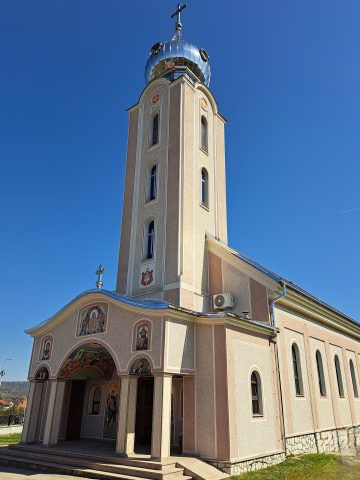
Kneževo’s mosque is one of those quiet places that doesn’t demand attention but lingers in the mind long after you’ve left. Tucked into the slope of a gentle hill, it blends almost seamlessly into the town’s modest landscape, surrounded by low houses with red-tiled roofs and patches of greenery. Without knowing it’s there, you might walk right past it, mistaking it for just another part of Kneževo’s unassuming daily life. Bosnia and Herzegovina has no shortage of mosques, especially in regions with Muslim communities, but this one stands out for its understated presence—less a monument than a natural part of the surroundings.
Like many mosques in Bosnia, this one dates back to the Ottoman era, when Islam became woven into the fabric of the region. Built sometime between the 16th and 17th centuries, it was part of the Bosnian sanjak, a small but significant outpost of the empire. Back then, Kneževo was little more than a village, and the mosque served as more than just a place of worship. It was a gathering spot where people exchanged news, settled disputes, and marked the rhythm of their week with the Friday call to prayer, a reminder of their connection to a distant imperial capital.
The architecture is classic Ottoman, simple and functional. The building itself is small and single-storied, with a minaret that rises just enough to be seen above the rooftops without overpowering them. The facade is unadorned, with the kind of arched windows and wooden shutters you’d find in countless other mosques across Bosnia. Inside, the prayer hall is spacious and uncluttered, with rows of worshippers facing Mecca on woven carpets. Wooden beams support the ceiling, and the walls bear the same geometric patterns found in other mosques of the region. There’s a sense of stillness here, as if the building itself encourages you to slow down.
Kneževo isn’t the kind of place that makes it onto most travel itineraries, and that’s part of what makes the mosque feel so authentic. Unlike the more famous mosques in Sarajevo or Mostar, which see steady streams of visitors, this one remains firmly rooted in the everyday. Locals come and go for prayers, children play in the square out front, and elderly men sit on benches, watching the town’s quiet routines unfold. There’s no performance here, no sense that the place exists for anyone but the people who use it. It’s history without the polish of tourism.
The best time to visit is at dusk, when the sun sinks behind the hills and the minaret casts a long shadow across the cobblestones. In that light, it’s easy to imagine the centuries that have passed here, the generations who have walked through the same doors. The mosque has seen its share of upheaval—Bosnia’s history is marked by conflict—but each time it has been damaged, it has been restored, its original character preserved. It’s not a relic behind glass; it’s a living space, still serving the same purpose it was built for.
For travelers who do make it to Kneževo, the mosque offers a chance to reflect on how different cultures and faiths coexist in this part of the world. Bosnia and Herzegovina is a place where Catholic churches, Orthodox cathedrals, and Muslim mosques stand side by side, not as exceptions but as part of the norm. The mosque in Kneževo is just one example of that, but it’s in these quieter, less-visited places that the country’s layered identity feels most tangible.
If you find yourself in Kneževo, take a moment to step inside if the door is open, or simply sit on one of the benches nearby. There’s no rush here, no crowds, just the quiet hum of a small town going about its day. That’s the real draw of places like this—not grand historical narratives, but the sense that history is still unfolding, unremarkable and enduring all at once.