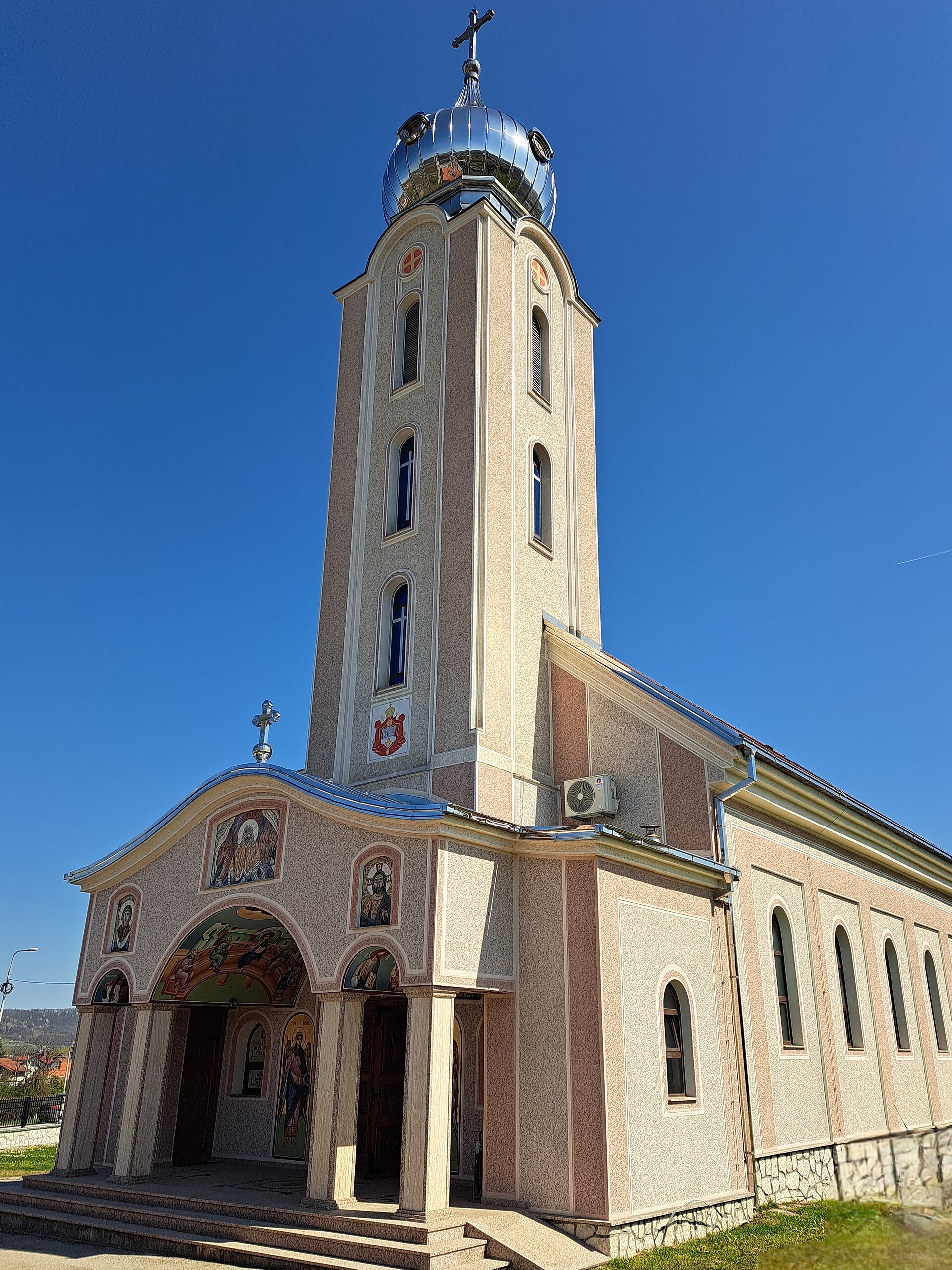
Perched on a hill above Kneževo, the Church of Saint Elijah the Prophet doesn’t stand out at first glance. Yet its quiet presence lingers, rooted in the land like the low houses and green slopes around it. A slender bell tower and a traditional dome shape its silhouette—familiar in these parts, where Orthodox Christianity has shaped lives for centuries.
History in the landscape
Kneževo is a small settlement in a region that has seen empires rise and fall. Orthodox communities took root here during the Ottoman era, when Bosnia and Herzegovina was part of an empire where Islam was the state religion but Christian worship was tolerated. The church itself was built later, in the late 1800s, under Austro-Hungarian rule. Records are sparse, but the style and surviving documents suggest it was completed sometime between 1880 and 1900.
Modest but deliberate
The church is built from stone and brick, its single dome and arched windows softened by simple decorative details. The bell tower rises above the rooftops, a quiet marker of faith. Inside, the iconostasis was painted by local craftsmen, and the wooden pews are worn smooth by decades of use. The icons, darkened by time, still hang where they always have.
For the people of Kneževo, this church is where life’s milestones unfold. Baptisms, weddings, funerals—generations have gathered here. During the Yugoslav era, when religion was discouraged, the church endured in a quieter role. After the 1990s war, it became a gathering point again, a place to reclaim disrupted traditions. Today, it stands as a symbol of continuity.
A place that breathes
Kneževo is small, and the church is central to its identity. It’s not just a place of worship but a living connection to the past. There are no crowds, no guided tours—just quiet reverence, the kind that feels natural, not performative.
Visiting isn’t about ticking off a sightseeing list. It’s about stepping into a slower rhythm. The wooden door creaks. Footsteps echo on stone. The bell chimes, drifting over the town. If you arrive during a service or find a moment to sit on a bench outside, you’ll see people come and go with their daily concerns.
This isn’t a place for spectacle. Kneževo offers something quieter. The church is part of that world, where time moves with the seasons and tradition shapes life. For travelers who look beyond the obvious, who want to feel history’s weight and the resilience of ordinary people, this unassuming church is worth the discovery. It doesn’t shout its importance. That’s why it stays with you.