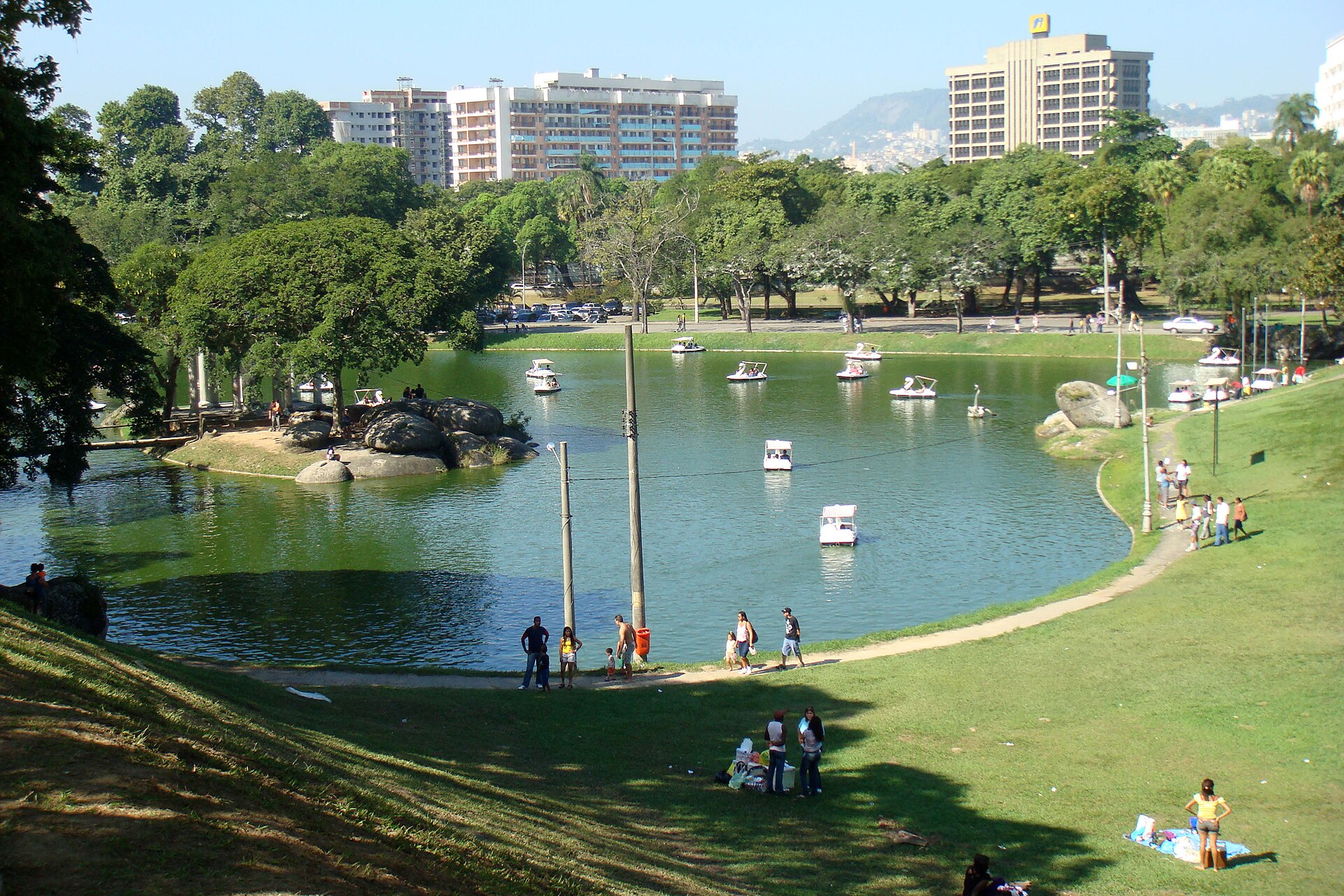
Quinta da Boa Vista is one of those rare places in Rio de Janeiro where the city’s restless energy gives way to something quieter, almost timeless. Tucked away in the northern part of the city, this sprawling park was once the heart of Brazil’s imperial past, and even now, its wide lawns, shaded groves, and crumbling stone bridges carry the faint echo of a different era. It’s not a place that demands attention—there are no neon signs or tour buses lined up at the gates—but that’s part of its charm. On any given day, you’ll find locals strolling along the paths, joggers weaving through the trees, and families spreading out picnic blankets under the fig trees. The pace here is slower, as if the park itself has decided to ignore the rush of the city just beyond its borders.
At the center of Quinta da Boa Vista stands the old imperial palace of São Cristóvão, a building that looks as if it were lifted straight from the streets of Lisbon or Paris. Built in the early 19th century, its neoclassical façade—with its tall columns and symmetrical windows—was meant to project power and permanence. For a time, it did. When the Portuguese royal family fled to Brazil during the Napoleonic Wars, this was where they made their home. Later, after Brazil declared independence, the palace became the official residence of Emperor Pedro I and his son, Pedro II. Inside, the grand halls still hold traces of that era: ornate furniture, gilded mirrors, and even the personal belongings of the emperors. But more than the objects, it’s the weight of history that lingers—the knowledge that decisions made within these walls shaped the course of a nation.
The park surrounding the palace was designed in the mid-1800s to resemble the landscaped gardens of Europe, though with a distinctly Brazilian twist. There are no rigid flowerbeds or manicured hedges here. Instead, the land rolls gently into hills, dotted with ponds and clusters of trees that feel wild, even though they were carefully planted. One of the most peaceful spots is the lake, where willows dip their branches into the water and swans glide between the lily pads. The air here is cooler, especially in the summer, when the dense foliage blocks out the worst of the heat. In the winter—if you can call Rio’s mild, dry season winter—the park fills with the scent of blooming trees, and the light takes on a softer, golden hue.
Quinta da Boa Vista wasn’t just a political center; it was also a place where ideas flourished. Emperor Pedro II, a man fascinated by science and the arts, turned the palace into a gathering place for some of the brightest minds of his time. Visitors included Louis Pasteur, Alexander von Humboldt, and even Richard Wagner, who reportedly played the piano in one of the palace’s grand salons. The emperor’s curiosity helped foster a cultural exchange that positioned Brazil as part of a broader intellectual world. Today, the palace houses the National Museum, though much of its collection was lost in a devastating fire in 2018. The building itself, however, remains a symbol of that era—a time when Brazil was eager to prove it could stand alongside the great nations of Europe.
For most cariocas, Quinta da Boa Vista is simply a place to escape the city’s relentless pace. Unlike the crowded beaches of Copacabana or Ipanema, it rarely feels overrun, even on weekends. In the mornings, runners loop around the paths, their footsteps muffled by the soft earth. By midday, mothers push strollers along the shaded walkways, while children chase each other near the ponds. As evening falls, groups of friends gather with guitars and coolers, their laughter mixing with the rustle of leaves. The park has its share of events—open-air concerts in the summer, holiday markets in December—but it never feels like a spectacle. It’s a place where Rio’s residents come to unwind, to let their kids run free, to remember what it’s like to have space to breathe.
One of the park’s most striking features is the towering statue of Christ the Redeemer that stands atop a hill within its grounds. It’s not the famous one atop Corcovado, but a smaller replica, its arms outstretched in the same gesture of welcome. From here, the view isn’t as dramatic as the one from the mountain, but it has its own appeal. On clear days, you can see the red-tiled roofs of the surrounding neighborhoods, the distant sparkle of Guanabara Bay, and the jagged outline of the hills beyond. The best time to visit is at sunset, when the light turns the sky shades of pink and gold, and the shadows stretch long across the grass.
What makes Quinta da Boa Vista special is the way it balances history and everyday life. You can spend an hour here without ever thinking about the past—just enjoying the shade, the quiet, the way the light filters through the trees. But if you look closer, the traces of history are everywhere: the old gas lamps that once lit the imperial gardens, the stone bridges arching over dry creek beds, the weathered statues half-hidden in the undergrowth. It’s as if the park has absorbed the weight of the centuries without letting it become a burden. The past isn’t preserved in glass cases here; it’s woven into the landscape, as natural as the trees and the earth.
For anyone trying to understand Brazil, Quinta da Boa Vista offers a kind of quiet revelation. It’s a place where the country’s colonial roots, its imperial ambitions, and its modern identity all come together—not as separate chapters in a history book, but as layers of the same story. You could spend a whole afternoon wandering its paths, moving from the grandeur of the palace to the tranquility of the lake, then up the hill for a view of the city below. Along the way, you might stumble upon a forgotten fountain, a patch of wildflowers, or simply the play of light and shadow on an old stone wall. It’s in these moments, when the past and present feel inseparable, that Rio reveals its truest self.