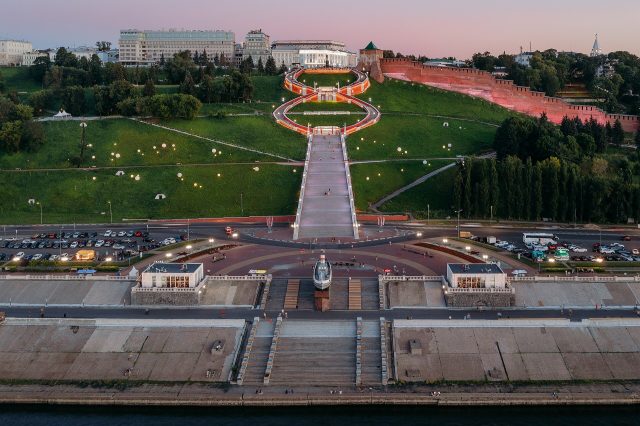
The cable car stretching across the Volga in Nizhny Novgorod is one of those places that quietly becomes part of a city’s identity, even when it wasn’t originally meant to be anything more than a practical solution. Connecting the two banks of the river, it links Nizhny Novgorod with the town of Bor, serving not just as a means of transport but as an unexpected viewpoint over the water. For many, the ride turns into a brief excursion—passengers often remember the sweeping views of the Volga, the distant horizons, and the city’s neighborhoods long after the journey ends. Yet the cable car is more than just an engineering feat; it’s a bold idea that reshaped how people move between these two places.
The need for a new crossing became clear in the early 2000s, when the existing routes between Nizhny Novgorod and Bor could no longer handle the growing traffic. The bridges over the Volga were constantly congested, and the ferry service depended on weather and seasonal conditions. The cable car offered a different kind of solution—fast, free from traffic jams, and relatively comfortable. It opened in 2012 and quickly became an essential part of the region’s transport network. For locals, it meant a reliable way to commute, while for visitors, it provided a fresh perspective on the city and the river.
At just over three and a half kilometers, it’s one of the longest cable cars of its kind in Europe. The ride takes about fifteen minutes, enough time to take in the surroundings from above. The cabins move smoothly, without jolts, and on clear days, visibility extends far enough to make out the city’s outskirts. The most striking view is near the Strelka, where the Oka River flows into the Volga. Here, the water widens into a vast expanse, and the panorama feels truly grand.
The stations at either end are simple and functional, yet they have their own character. Designed in a modern style, they feature large windows that frame the cabins as they lift off the platform and ascend into the sky. On the Nizhny Novgorod side, the station sits near the historic center, close to Meshcherskoye Lake, while the Bor station is adjacent to a park. Both are equipped with ticket offices, waiting areas, and small cafés where passengers can grab a bite before or after their ride. Inside the cabins, the temperature is kept comfortable, and the large windows ensure the views remain unobstructed.
For locals, the cable car has become more than just a way to get around—it’s part of daily life. Many prefer it over cars and buses, especially during rush hour, when bridge traffic turns into a test of patience. The ride saves time and offers a few moments of quiet above the river. For tourists, it’s a chance to see Nizhny Novgorod from an unusual angle. The city, spread across hills with its ancient Kremlin walls, merchant houses, and modern districts, reveals itself in full. Evening rides are particularly popular, when the city lights up and the Volga mirrors their glow.
The cable car operates year-round, and each season brings its own charm. In winter, when the river freezes and snow blankets the banks, the journey feels like a trip into a fairy tale. Spring brings high water, making it seem as if the cabins are floating just above the surface. Summer turns the landscape lush and green, while autumn sets the forests on the opposite bank ablaze with color. Weather affects visibility, but even on overcast days, the ride doesn’t lose its appeal—the mist over the river adds a touch of mystery.
Though the cable car is a modern structure, it fits naturally into Nizhny Novgorod’s landscape. The city has always been a place where history and industry coexist, where a 16th-century Kremlin stands near factories and old streets give way to broad avenues. The cable car is another link in that chain, bridging past and present. It’s a reminder that even in an age of advanced technology, it’s possible to create something that serves a purpose while also being pleasing to the eye.
Riding the cable car isn’t just about crossing from one bank to the other—it’s a chance to slow down for a moment. In the rush of city life, such pauses feel especially valuable. As the cabins rise smoothly over the river, with rooftops and green spaces drifting below, there’s a sense of stepping out of the usual rhythm. It’s a place where you can simply look, breathe, and think without the distractions of everyday life. That might be why the cable car has become more than just a transport hub—it’s a place people come to for the experience.